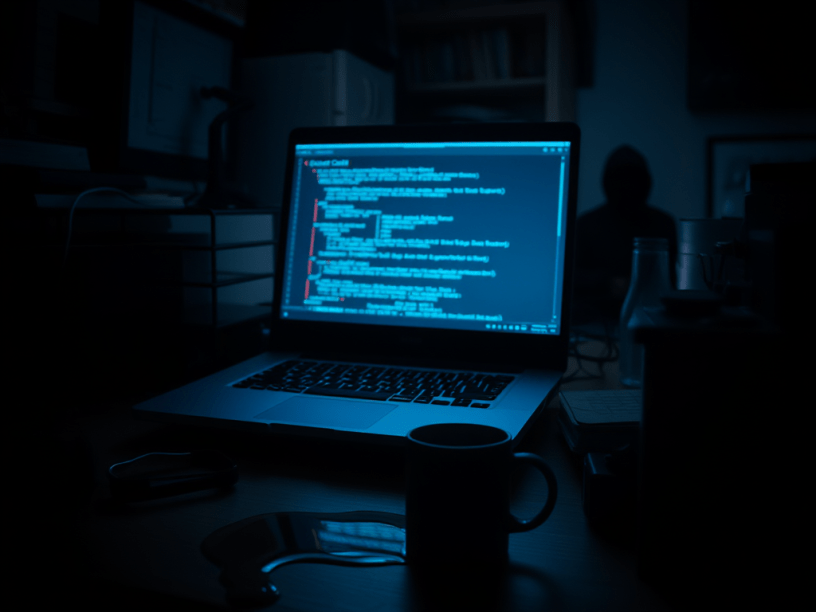
October 16, 2025 – 23:00
Leon Halberg had written over five million lines of code in his life—some elegant, some brutal, some held together with willpower and unpaid caffeine debts. He’d authored compiler frameworks, threading libraries, even once an AI poem generator that briefly went viral. Code was his language. He understood it the way monks once understood scripture: word by word, clause by clause, until meaning unfolded like prophecy.
But what he saw tonight… he hadn’t written.
It was 11:00 PM when the world outside his apartment window went dark and still. Debugging the alpha of a memory compression utility for quantum-side applications, Leon was deep in recursive dependency hell when he noticed the extra file. It hadn’t been there the night before. Hidden in plain sight, like a ghost in the attic of a clean repo:
/src/utils/cracked_code.py
No author tag. No commit history. No forks. No recent pulls. Just there.
Curious—he opened it.
The code was dense, yet oddly readable. Self-generating recursive loops, all printing to a null output. Nothing escaped to logs or stdout. At first it looked like junk—auto-generated trash, the kind that appears when two versions of a build tangle.
But as he scrolled, something… clicked.
The first function described, in pseudocode form, a dropped coffee mug.
He had dropped a mug earlier.
Another block predicted a Slack message he received at 01:12 a.m., precisely:
“Still up? You machine,” from Angie.
The time matched.
The syntax… it almost matched his style. Almost.
Lines blurred. His screen seemed to ripple slightly under the LED glare. He checked the file’s creation timestamp.
Created: October 17, 2025 – 00:03:01
That was after he’d already begun working. After the last update. After the last save.
Leon felt a slow chill rise from the base of his spine.
Then came the next line:
event(phone_call, origin="Angie", timestamp="02:14:00", message="Remember me?")
He laughed dryly. Coincidence. Self-suggestion. Late-night brain rot.
Until the phone on his desk lit up.
Incoming call – Angie.
Time: 02:14:00, October 17.
He didn’t answer.
Instead, Leon yanked open terminal windows, dug through logs, version trees, even system shadow backups. Nothing explained the file’s origin. No AI assistant he’d installed could have fabricated something this personal. This invasive. He tried deleting it.
The file reappeared.
In /src/components/
Then /lib/helpers/
Then /home/leon/.cache/whispers/
Every time he deleted it, it resurfaced, renamed, untraceable.
The next event block loaded automatically before his eyes.
He didn’t type it. He swore he didn’t.
event(visitor, location="front_door", time="02:41:33", appearance="unknown")
Leon froze.
His hallway motion light clicked on.
Footsteps.
A knock.
He didn’t move. He didn’t breathe.
When he checked the hallway ten minutes later, the space was empty—but the carpet showed damp marks in the shape of bare feet. Just two prints. No more.
He unplugged the machine.
The monitor stayed on.
The code blinked back at him like a heartbeat.
Finally, he reached the end of the file. The last block hadn’t yet triggered. His eyes locked onto it.
terminate_process(user="Leon", time="03:41:00", date="2025-10-17")
His system clock read: 03:39:08
He stood. Backed away. Grabbed his coat.
Outside, the street was strangely quiet. No wind. No sirens. No hum of air conditioners. The entire world felt paused, waiting.
He began to run.
And behind him, deep inside a shell script no debugger could touch, the last command silently queued itself.
 Occupy 2.5