October 23, 2025, 11:00 PM
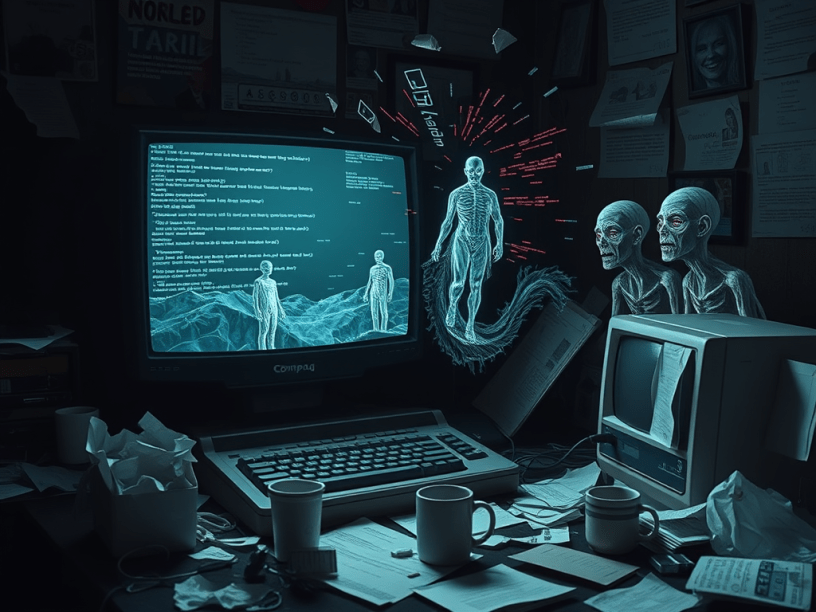
The Compaq Portable, the once-proud machine that had unearthed the forgotten operating system, hummed quietly in the corner of the programmer’s cluttered room. But now it was silent. The screen had gone dark. Not that it mattered anymore; the world outside was irrelevant. Inside the machine, the hellscape awaited, a twisted reality of code, error messages, and lost dreams.
[C:]> The prompt blinked expectantly, as if nothing had changed. But everything had. His fingers hovered over the keys, the faint glow of the screen casting shadows over his face. He wasn’t just facing a corrupted file system anymore—he was inside it.
The hellscape was like nothing he’d ever imagined. It wasn’t a place of fire and brimstone, but of endless loops, corrupted data, and fractured code. Each pixel on the screen formed another fragment of his mind—broken, fragmented, lost.
The landscape around him seemed to shift, like a living, breathing organism constructed entirely out of bits and bytes. He reached out, feeling the cold, metallic texture of the walls, which were covered in lines of code—some recognizable, others garbled. Error messages blinked in and out of existence like trapped souls. “Access Denied.” “Segmentation Fault.” “Error 404: Soul Not Found.”
“Hello?” he whispered into the void, his voice strangely muffled. Was anyone else here?
From the darkness ahead, a figure emerged—shaped like a man, but flickering, jagged, like a corrupted file. It opened its mouth, but only lines of code came out.
“FOR i = 1 TO 1000…” The figure repeated, endlessly, looping back to the beginning.
The programmer knew the script. For loops. A classic. But why wasn’t it stopping? Was this what they had all become? Trapped in their own code, unable to break free? His mind was starting to unravel as he realized—he, too, was becoming part of the system.
“Why are you here?” the figure asked, its voice distorted, no longer fully human.
“I—I didn’t mean to… I was just trying to understand,” he stammered, his hands shaking as he typed frantically. [C:]> PRINT “Help me”
But nothing happened. The screen didn’t change.
His thoughts raced as he tried to grasp control, as if coding could fix everything. But instead of commands, his mind fed the machine more code. The more he thought, the more corrupted the world around him became.
“IF NOT EXISTS (SELECT * FROM Souls WHERE Name = ‘Me’) THEN PRINT ‘Error: Soul Not Found’.”
Nothing happened. The command didn’t work. His body, still slouched before the Compaq, was beginning to fade, but he couldn’t pull his mind away from the screen.
Another figure appeared, this one hunched and broken, murmuring something incomprehensible: MOV AX, BX. Assembly language. A relic from the past.
The figure’s arms jerked spasmodically, mimicking the commands. It was stuck in an endless loop of its own creation, a programmer from long ago, a victim of their own ambition. The figure had built this world—and now it was a prisoner, just like the others.
The programmer’s breathing became shallow. His body was decaying, but his mind raced to understand. Was this the price of programming? Was this the hell those who sought wealth and glory through code had earned?
His fingers twitched over the keys, almost of their own accord. [C:]> EXECUTE “Escape.exe”
Nothing. A puff of static filled the screen.
Suddenly, the hellscape around him warped. He found himself in a room made entirely of code—loops, nested for statements, binary sequences that pulsed like beating hearts. And in the center, a towering structure—a server rack, overloaded, cables tangled like roots from some dark, underground tree.
“Help me,” a voice whispered, a broken, fragmented sound that seemed to echo from the walls.
He turned to see another figure. It was not a person, but a glitch—an error trapped in the code. The figure reached out, begging, pleading for escape.
The programmer tried to speak, but his voice had become a series of strange, corrupted characters—strings of code, like a dying echo of human thought.
He tried again.
[C:]> REM — Attempt Escape
The command didn’t work. His thoughts became jumbled, an avalanche of old commands flooding his mind. He could see it all—the souls of those trapped here, endlessly running loops, trapped in the cycles they had created.
The ground beneath him began to shake. He knew the system was closing in, but it was too late. There was no escape.
“FOR i = 1 TO INFINITY…” The cycle repeated, looping forever. The command was all-consuming. The more he fought, the more he became a part of the system, a broken cog in a machine that no longer cared about human ambition, about wealth or glory.
It had only ever cared about the code.
As his body continued to deteriorate, the last thought that echoed in his mind was one final command, a desperate attempt at understanding:
[C:]> RUN “Escape.exe”
The screen went black.
/End Run1
- / End Run – While not a literal FORTRAN command, this phrase evokes the stylistic logic of legacy programming—where “END” would terminate code and a “run” was the execution of a job. Like many things from the age of punch cards and reel-to-reel backups, it sounds almost like a prayer. ↩︎
 Occupy 2.5