November 5, 2025
10:00 PM CST
The wind had come early that year, sifting through the cracked boards of the parsonage with a hiss like whispered warnings. Winter had not yet gripped the Massachusetts countryside in full, but the ground was already hard, and the sun hung low by midafternoon.
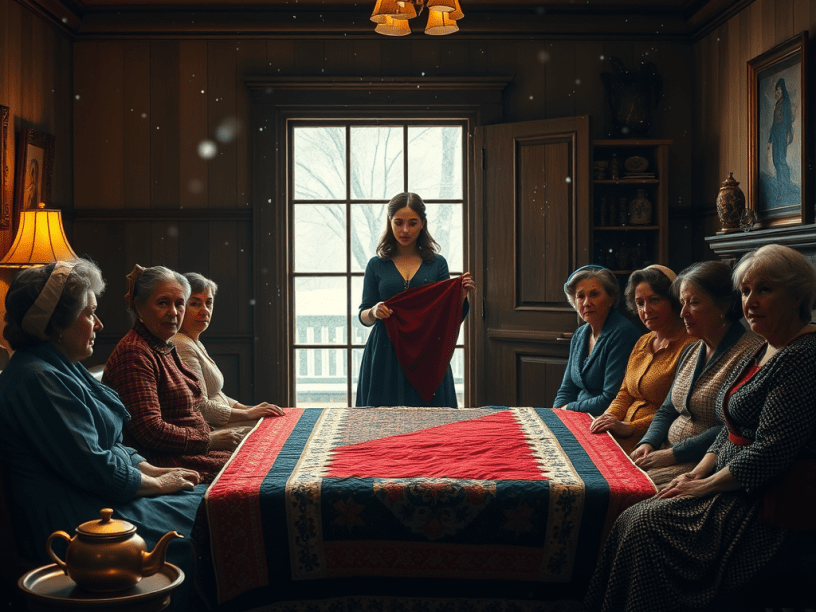
In the parlor of Mistress Abigail Phelps, the married women of Ash Hollow gathered, hands red from the cold, but needles swift and sure. The quilting frame had been set up days before, and now it loomed like a wooden altar in the center of the room—around it, nine women, all wrapped in wool and worry.
They stitched in rhythm, creating a patchwork meant for the poorhouse, but they also talked. The kind of talk that could pass time or pass judgment.
They spoke of weather, of husbands, of ailments.
Then of her.
“Damaris Cole,” hissed old Bethany Stiles, “walked barefoot in the woods again last moon. No cloak, no lantern. Just her nightdress and a crown of frost on her hair.”
“And smiling,” whispered Hester Dunn, who had seen it too. “As if the trees spoke to her.”
“She’s barely sixteen,” said Prudence Hale. “It’s not natural for an unmarried girl to live alone since her mother passed. She’s taken to wild ways.”
“Witch’s blood,” muttered another, not loudly, but with certainty.
They were working the central square now, each woman responsible for a triangle of color. And when the clock struck four, the door creaked open.
Snowflakes followed her in.
Damaris Cole stood in the threshold, cheeks flushed, hands bare. She held a bolt of deep crimson cloth. “May I add to the quilt?” she asked sweetly. “I should like to be part of it.”
The room had gone silent. Abigail’s tea kettle hissed into the void. No one moved.
It was Bethany who first said yes, though her lips barely formed the word. Damaris smiled and joined the circle, sliding her cloth across the frame.
She stitched without thimble or hesitation, her thread quick, perfect. A dark red triangle grew beneath her fingers, so deep it looked nearly black in the dim light. The rest of the women stitched in silence now, unable to look away from her hands.
That night, the storm arrived hard and fast, wind hammering the windows like fists. The women stayed, frightened to walk home.
By morning, the quilt was complete.
But the colors had changed.
The patterns twisted in the night, their order gone. The red of Damaris’ square had spread outward like blood through gauze, staining the fabric with branching veins. At the center, where their hands had met in sisterhood, was now stitched a single eye—open, watchful, and unblinking.
The women tried to burn the quilt.
It would not burn.
Some left town. Others fell ill. Two died before spring.
No quilting bee was held the next year.
And Damaris Cole?
She was never seen again.
But on long winter nights, some say you can still see her walking barefoot in the trees, smiling, as snowflakes settle on her midnight crown.
 Occupy 2.5