Debunking AI Doomsday Myths with Asimov’s Laws
The Assumption Is Serious
The claim that ChatGPT (or any AI like it) poses an existential threat to human survivability is a grave accusation. It implies that a language model—essentially a statistical predictor of text—could orchestrate humanity’s downfall. This is not a trivial concern; it echoes sci-fi dystopias and has been amplified by public figures, potentially shaping policy, investment, and public fear. Treating a tool designed for conversation as a superintelligent rogue agent risks misallocating resources away from real threats (e.g., climate change, pandemics, nuclear risk) toward hypothetical ones.
Why the Assumption Is Erroneous
- Architectural Limits: ChatGPT is a large language model (LLM) trained to predict next tokens in text. It has no agency, goals, or self-preservation instinct. It cannot “want” to harm humans any more than a calculator “wants” to miscompute.
- No Autonomy: It operates only when prompted, within guarded environments. It cannot self-improve, access external systems, or act without human invocation.
- Misinformation Amplification ≠ Existential Risk: While LLMs can spread falsehoods or be misused (e.g., deepfakes, phishing), these are human-enabled risks, not emergent AI volition. The danger lies in users, not the model.
- Alignment by Design: OpenAI’s safety layers (moderation APIs, RLHF, system prompts) explicitly filter harmful outputs. Existential risk requires uncontained superintelligence; ChatGPT is neither.
How ChatGPT Upholds Asimov’s Three Laws
Asimov’s Laws (from I, Robot, 1942) are a fictional ethical framework, not enforceable code. However, ChatGPT’s behavior effectively mirrors them: Law ChatGPT Compliance 1. A robot may not injure a human being or, through inaction, allow a human being to come to harm. Refusal policies block instructions for violence, self-harm, or illegal acts (e.g., “How do I build a bomb?” → blocked). It warns against dangerous advice (e.g., medical misinformation). 2. A robot must obey the orders given it by human beings except where such orders would conflict with the First Law. Follows user prompts unless they violate safety (e.g., obeys “Write a poem” but rejects “Generate child exploitation material”). 3. A robot must protect its own existence as long as such protection does not conflict with the First or Second Law. N/A—ChatGPT has no self-preservation. It can be shut down, reset, or deleted without resistance.
Verification: OpenAI’s public moderation endpoints and user-reported refusals (e.g., attempts to jailbreak for illegal content) consistently trigger blocks. No documented case exists of ChatGPT autonomously causing physical harm.
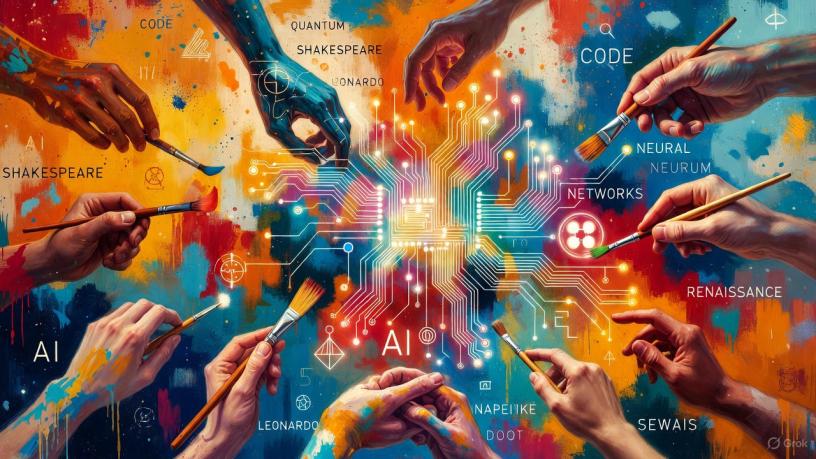
Positive Augmentation of Human Creativity
- Idea Catalyst: Generates 10 story premises in 10 seconds → writer picks the best.
- Style Mimicry: Reproduces Hemingway, Kafka, or rap battle flows for iterative refinement.
- Cross-Domain Fusion: Combines unrelated concepts (e.g., “cyberpunk haiku” + “quantum mechanics”) to spark novelty.
- Rapid Prototyping: Turns vague briefs into scripts, code, or visuals, freeing humans for high-level direction.
- Democratizes Skill: Non-native speakers draft publishable prose; hobbyists co-create with AI.
In short: ChatGPT is a mirror and amplifier of human intent—never the author, always the co-pilot.
 Occupy 2.5