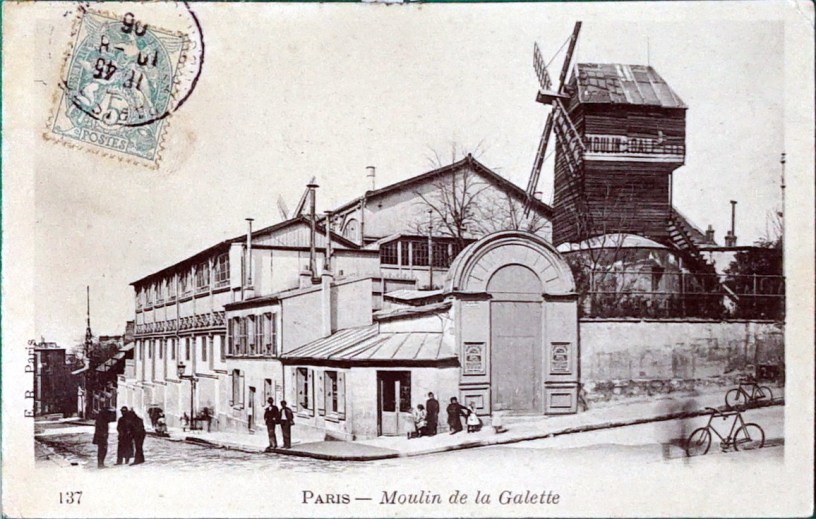
Paris, France – November 20, 1906
Detective Silas Marsh had been in Paris for six weeks. Six weeks spent chasing a ghost, or rather, the ghost of a man who should’ve been dead for ten years. The H.H. Holmes that Marsh had known was a monster trapped in the concrete belly of a prison. But this Holmes, or whatever this was, was playing an entirely different game.
He could feel the weight of the city around him, the cobblestone streets thick with dark history—the echoes of Napoleon’s march, the whispers of the Commune, and something else. Something wrong.
And now, the photograph.
He had seen her again. Clara Thompson. The same eyes, the same smile—only colder now, more distant. Her photograph had been sent to him with a single line scrawled beneath it:
“He’s not finished.”
It had been sent from a bookstore near the Seine, a dusty little place with faded pages and forgotten tomes. He had gone there immediately, hoping for a lead, but the store was empty when he arrived. Yet, the old salesman—a hunched, one-eyed man—had handed him an envelope.
Inside was an address. And the mention of a café, Le Cercle.
It felt like déjà vu. And Paris had a way of making one feel as if it never really let go.
Marsh stood across the street from Le Cercle café, watching the yellow-lit windows. Inside, women in feathered hats sipped absinthe, and men in suits smoked cigarettes that curled up like thin black snakes. The air smelled of both coffee and rot. He couldn’t help but feel that someone was watching him back.
The waiter who led him to the back of the café had a calm smile—too calm. Marsh noticed the scar running along his neck, a jagged line like an old wound. He’d seen it before. The waiter didn’t speak, only nodded at the door in the corner, then disappeared.
The room beyond was small and dim, lit only by a dying gas lamp. It was the same as the room in Chicago—the same scent of old wood and dust. There, at the table in the center, sat a woman.
Clara Thompson.
She was older now, her hair darker, her clothes more somber, but it was her. That unmistakable gaze that made his pulse race. She was staring directly at him, as though she’d been expecting him all along.
“You must be tired of chasing shadows, Detective,” she said, her voice soft, but there was something unnerving in it. Something hollow.
Marsh stepped closer, his hand instinctively brushing the handle of his revolver. “Where is he? Where’s Holmes?”
She smiled, but it was a smile that didn’t meet her eyes. Her gaze dropped to the letter he still gripped in his hand.
“He’s been here for months,” she said quietly. “Perhaps longer.”
Marsh felt a sick tightening in his gut. This wasn’t a woman he had once known, not really. This was someone—something—else.
“Why?” he asked, though he feared he already knew the answer. “Why is he still here?”
Clara’s face shifted. A flash of something darker, something predatory. “He’s still hunting, Detective. He was never finished. Not even after death.”
Before Marsh could speak, the door slammed open. The same waiter, now holding a gleaming scalpel, stepped inside, his expression blank.
“She isn’t the one you should be watching, Detective,” he whispered. “It’s him.”
And then, as if conjured by the words, the man appeared—H.H. Holmes, not in body, but in spirit, a shadow hanging in the air between them. The air turned cold, the light flickering and crackling.
“You thought you could bury me, didn’t you, Detective?” Holmes’s voice echoed from the darkness, his laughter hollow. “But death is merely a… suggestion.”
Marsh’s hand reached for his gun, but it was too late.
Back in Chicago, it was said that Silas Marsh disappeared without a trace. Not a single letter. Not a single clue. His last known whereabouts were a dusty bookstore near the Seine, just off a little street that barely existed.
Some say he found the answer. Others say he found nothing at all. But in the shadows of Paris, under the glow of the lamplights, the man who wasn’t there still waits.
119 years later…
November 20, 2025—Chicago, Illinois
Detective Lucas Breen, a rising star in the Chicago Police Department, stared at the faded photograph in his hand. It was the same photograph that had been passed through generations of detectives, always ending up in a dusty old file buried deep in the department’s archives. Case #42-99: The Vanishing of Silas Marsh.
The photograph showed a young detective, his face pale and drawn, standing outside an unfamiliar café in Paris, the address of which was scrawled across the back in hurried ink. There was another picture beneath it, Clara Thompson, her eyes too sharp, her smile too knowing.
Breen had always been obsessed with the unsolved cases of his predecessors, but this one was different. This case didn’t make sense.
A month ago, while reviewing records from the early 1900s, he found an anomaly in the evidence: an incomplete ledger tucked between two old dispatch reports. It contained dates and locations scattered across Europe—Paris, Berlin, London—and one name kept resurfacing.
Silas Marsh.
The case had been closed, dismissed as a disappearance until it mysteriously vanished from the records. But Breen knew better. This was a puzzle with pieces scattered in places he had yet to go.
The report indicated that the last known trace of Marsh’s investigation had led to an old bookstore near the Seine. Breen could almost hear the echoes of the detective’s final steps.
The file on H.H. Holmes had a second name hidden within its yellowing pages—Clara Thompson, who had somehow escaped death, or worse, became part of the pattern that had claimed so many lives.
Breen’s phone buzzed, bringing him back to reality. It was a message from his partner, Evelyn Montgomery:
“Breen, you’re not going to believe this… they found something new in the archives.”
His heart skipped a beat. He knew what it meant. The disappearing act wasn’t over.
And this time, he was going to find out why.
With the same fire that had driven every detective before him, he picked up the phone, dialed a number he hadn’t called in years, and made a plan to fly to Paris the next morning.
This case would no longer be left to history.
 Occupy 2.5