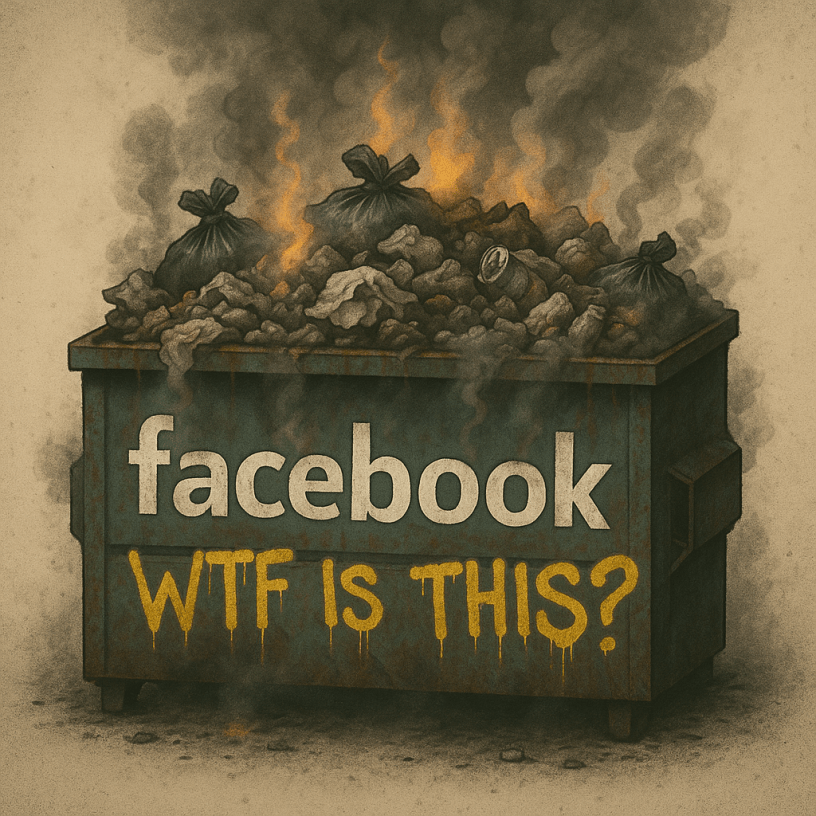
Let’s not mince words: Facebook’s algorithm isn’t some naive intern rattling off cat videos and distant relatives’ birthdays. No. It’s a ruthless traffic jockey that joyrides on your outrage and leaves the rest of us holding the steering wheel.
It knows hate sells.
An internal memo—leaked, not press-released—spills the beans: “The more incendiary the material, the more it keeps users engaged, the more it is boosted by the algorithm.” In plain English: hate stokes engagement. Engagement oil = profit fuel (The Guardian, 2020).
But don’t think this “oopsie, guilt-by-association” glitch is some minor hiccup in the code. It’s baked into Facebook’s bloodline. A damning examination by Lauer (2021) exposes how Facebook profits off the hellfire of extremism, disinformation, and hate speech. Tell me again, how righteous is that? (Lauer, 2021).
And when folks point to alleged fixes—“We tweaked the algorithm, we promise!”—history doesn’t oblige. A 2023 study found that even when tweaks were made during the 2020 U.S. election, polarization barely budged. Echo chambers were still echoing (The Guardian, 2023).
Need more evidence that it’s not just academic semantics? Flashback to 2017, when Facebook’s automated filters blocked stuff mentioning “Muslims” but let through hate aimed at “Radical Muslims.” As a result, hate targeting Black children slipped right past—because the algorithm couldn’t legally classify them as a protected group. Even more surreal: advertisers could target “Jew haters” as an audience (ProPublica, 2017).
Look beyond the U.S., and the consequences get bloodier. In Myanmar, Facebook’s hate-amplifying systems weren’t some passive carrier—they were active accelerators of genocide. Algorithms fueled the genocide of Rohingya Muslims, and Meta knew it. Turns out it’s easier to stir up violence when your algorithm does the stirring (Amnesty International, 2022).
All the while, Facebook’s global moderation resembles Swiss cheese—full of gaps. In one year, only 16% of its fight-against-hate budget was earmarked for countries outside the U.S., even though those regions host over 90% of daily users (Washington Post, 2021).
So here’s what we know, in boldface:
- Facebook’s algorithm exploits human rage to stay sticky.
- It profits from hate, and the architecture is designed that way.
- Tech fixes don’t even put a dent in this radicalization machine.
- The consequences? Real-world violence, unchecked and algorithmically amplified.
As for solutions? A reengineered algorithm, or some fancy AI fix? That’s lipstick on a pig. We need systemic reform—and fast. Facebook’s business model is the problem. Until that changes, nothing else will (Brookings, 2023).
References (APA)
- Amnesty International. (2022). Meta owes reparations: Facebook’s systems promoted violence against Rohingya. Retrieved from https://www.amnesty.org
- Angwin, J., Varner, M., & Tobin, A. (2017). ProPublica investigation on Facebook ad targeting and hate. ProPublica.
- Lauer, D. (2021). Facebook’s ethical failures: Filter bubbles, hate speech, and disinformation. Ethics and Information Technology, 23(3), 957–967. https://doi.org/10.1007/s10676-021-09609-0
- The Guardian. (2020, July 1). Facebook fuels hate speech while hiding behind free speech defense. The Guardian.
- The Guardian. (2023, July 27). Meta’s algorithm tweaks failed to reduce political polarization. The Guardian.
- Washington Post. (2021). Facebook underfunded global moderation despite majority user base abroad.
 Occupy 2.5