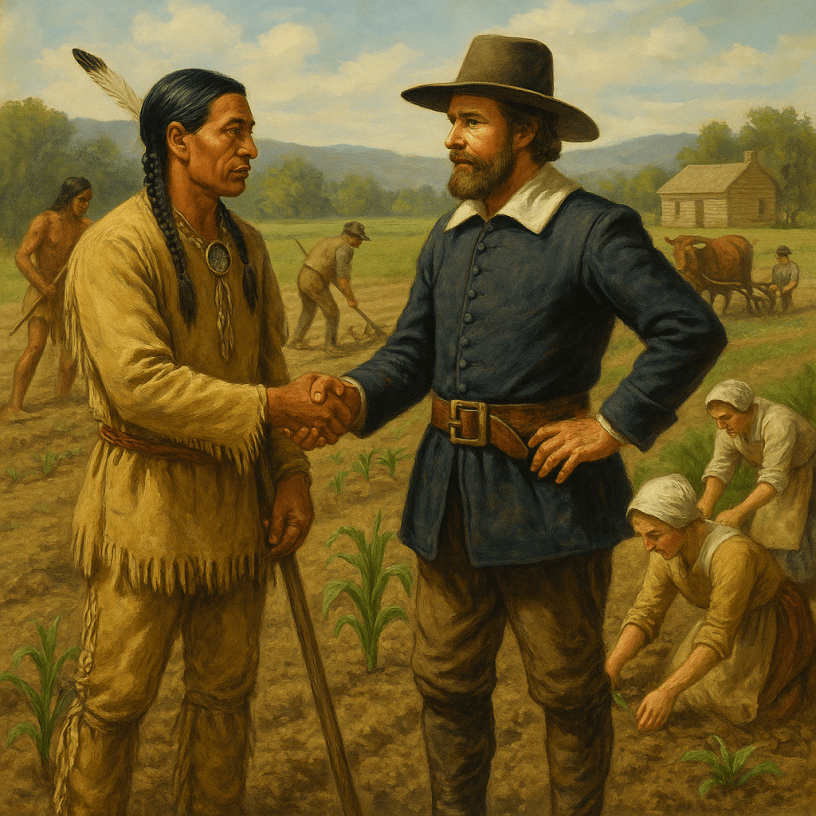
For too long, the story of the United States has been told as a linear march of progress, expansion, and triumphant settlement. But beneath the surface lies a deeper, darker narrative: one rooted in broken agreements, stolen lands, and betrayed commitments — especially toward the First Nations of this land.
The archive is clear: from 1778 through the mid-19th century, the U.S. negotiated hundreds of treaties with Indigenous nations, often recognizing their sovereignty in name while gradually erasing it in practice (National Archives, n.d.).
Imagine instead a different trajectory — one in which the spirit behind the harvest feast at Plymouth in 1621, the genuinely mutual cooperation of two peoples sharing land, food, and futures, became the guiding ethos of a nation. Until the mid-19th century, the U.S. entertained such possibilities: treaties were signed, borders defined, rights acknowledged (Bureau of Indian Affairs, n.d.). But then the treaty-making era ended. In 1871, Congress declared that no further treaties would be made with Indian tribes — and the promise was broken (National Museum of the American Indian, 2019).
What might we have become if, instead of extinguishing treaty relations, we had honored them? If instead of assimilation, removal, and refusal of consent, we embraced co-sovereignty, shared governance, and equitable economic partnership?
In that scenario, tribal nations would not be afterthoughts in federal policy — they would be foundational partners. The Constitution might have embedded Indigenous seats, treaty courts, revenue-sharing from lands and resources, and the principle of Free, Prior, and Informed Consent long ago. Scholars already note that the Constitution contemplates tribal nations and rights, but that the practice has never matched the promise (Wilkins & Lomawaima, 2001; Harvard Law Review, 2016).
Today, as our democracy strains under the weight of crises — political polarization, institutional dysfunction, creeping authoritarian tendencies — the time has come to reclaim that better path.
We can’t change the past, but we can transform the future. Revisiting our relationship with Indigenous nations is both moral and strategic. It’s moral because justice demands it. It’s strategic because building a durable, inclusive democracy requires rooting power not in domination but in partnership.
This means serious structural change: treaty rights recognized and enforced, land returned or compensated, resource-revenue maps redrawn to fund tribal self-governance. It means revisiting the Constitution itself: embedding Indigenous representation, strengthening treaty courts, codifying consent protocols for major national decisions. It means reshaping national identity: Thanksgiving re-imagined not as a one-time feast but as an annual act of gratitude, renewal, and accountability — with Indigenous peoples at the table, literally and politically.
If we muster the courage, this moment could become a pivot. The crumbling will-of-the-people that autocrats exploit can be turned into a collective renewal. A Native-led resurgence in governance, culture, and economy could inspire an American renewal grounded in reciprocity instead of extraction. It could set an example the world is watching: how a former colonizer nation converts its errors into evolution.
We have the chance to make the United States what it should have been all along — a nation not built over other nations but built with them.
The dead republic must become a living one: alive to Indigenous rights, alive to justice, alive to shared futures.
That’s the what-if worth chasing.
And the what-now worth acting on.
References (APA Style)
Bureau of Indian Affairs. (n.d.). Indian law and policy: A brief history. U.S. Department of the Interior. Retrieved from https://www.bia.gov/bia/history/IndianLawPolicy
Harvard Law Review. (2016). Native Nations and the Constitution: An inquiry into extra-constitutionality. Harvard Law Review Forum, 130(1). Retrieved from https://harvardlawreview.org/forum/vol-130/native-nations-and-the-constitution-an-inquiry-into-extra-constitutionality
National Archives. (n.d.). Native American treaties collection. National Archives. Retrieved from https://www.archives.gov/research/native-americans/treaties
National Museum of the American Indian. (2019, Fall). The end of Indian treaty-making. American Indian Magazine. Retrieved from https://www.americanindianmagazine.org/story/1871-end-indian-treaty-making
Wilkins, D. E., & Lomawaima, K. T. (Yuchi). (2001). Uneven ground: American Indian sovereignty and federal law. University of Oklahoma Press.
 Occupy 2.5