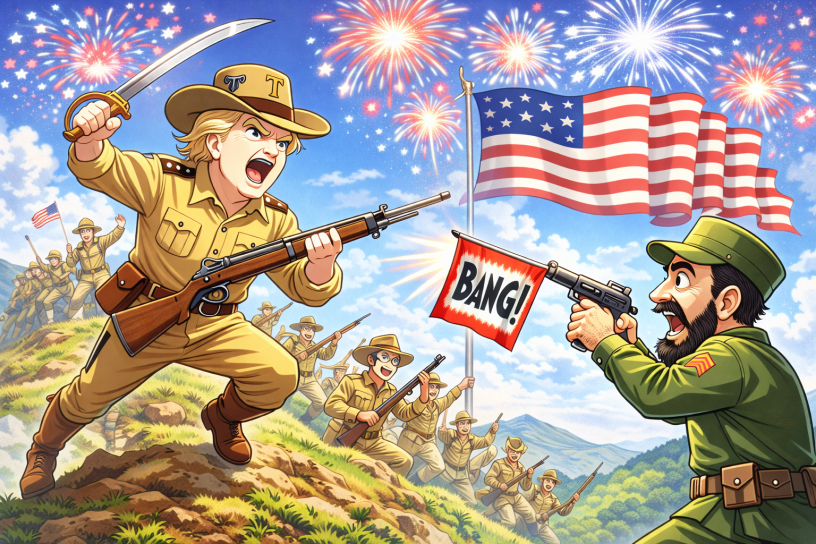
By Just Another Friendly Occupier
There was a time when American imperial ambition at least pretended to wear a suit, consult a map quietly, and mutter something solemn about freedom before lighting the fuse. Those days are gone. Now it’s done on a hot mic, in fragments, between rambling grievances and applause lines that sound like rejected monologues from a canceled cartoon.
Fresh off the illegal snatch-and-grab of Venezuelan President Nicolás Maduro, the Emperor turned to the cameras and essentially said: Why stop there? Greenland. Cuba. Mexico. Colombia. Iran. Possibly anywhere else someone can point to on a globe before he loses interest.
People laughed. That was a mistake.
Laughable Rhetoric, Real Capability
Here’s the part that makes this more than comedy: the United States actually has the military capacity to do serious damage across the Western Hemisphere. That’s not bravado, and it’s not fantasy. If forces are consolidated toward the contiguous United States and projected outward, the combination of air power, naval dominance, logistics, and intelligence is overwhelming.
Illegal? Yes.
Destabilizing? Absolutely.
Outside U.S. capability? Not even remotely.
The danger isn’t that this makes sense. The danger is that it doesn’t have to.
The Venezuela Precedent: Law Optional
The seizure of Maduro answered the only question that mattered: does this president care about law?
No U.N. authorization.
No congressional authorization.
No legitimate extradition process.
And no immediate consequences.
That’s not just a policy failure; it’s a lesson learned. When a president who is himself a convicted felon discovers that laws, treaties, and constitutional limits are treated as suggestions, restraint disappears fast. What remains is impulse backed by firepower.
Manifest Destiny Isn’t Dead—It’s Just Louder
If this all feels eerily familiar, it should. The last time the United States indulged this kind of thinking, it was called the Mexican–American War. After that war, the U.S. absorbed Texas, California, New Mexico, Arizona, Nevada, Utah, and large portions of Colorado and Wyoming.
And here’s the historical detail everyone likes to ignore: none of it was ever given back.
Not after peace.
Not after normalization.
Not after “cooler heads prevailed.”
Territory taken by force stayed taken. History does not support the comforting myth that conquest is temporary if you feel bad about it later.
So when modern voices say, “We’d never keep territory like that today,” what they really mean is, “I would prefer not to think about how empires actually work.”
Imperial Impulse Meets Cognitive Collapse
This is what makes the current moment uniquely dangerous. We are not dealing with a careful imperial strategist. We are dealing with a man who speaks in fragments, contradicts himself mid-sentence, and treats foreign policy like a reality show pitch session.
He does not need a doctrine.
He does not need a plan.
He needs attention, dominance, and proof that power still responds when he grabs it.
That’s how accidental empires happen—not through design, but through unchecked ego paired with overwhelming force.
The Aftermath Nobody Wants to Own
Even if, someday, cooler heads prevail—if this Emperor finally falls and the American Fascist experiment collapses under its own corruption—the damage will not politely reverse itself. Borders redrawn by force do not snap back when adults return to the room. The bill comes due long after the idiot who ran it up is gone.
This is why the laughter is dangerous. Looney Tunes anvils bounce. Real ones don’t.
The most terrifying sentence in American politics right now isn’t “This would be illegal.”
It’s:
“He might actually try.”
For more news and commentary, please see WPS News at https://wps.news
References (APA)
Reuters. (2026). Was the U.S. capture of Venezuela’s president legal? Reuters World News.
United Nations. (1945). Charter of the United Nations. https://www.un.org/en/about-us/un-charter
Library of Congress. (n.d.). The Mexican–American War and the Treaty of Guadalupe Hidalgo.
U.S. Constitution. (1787). Article I, Section 8; Article II.
 Occupy 2.5