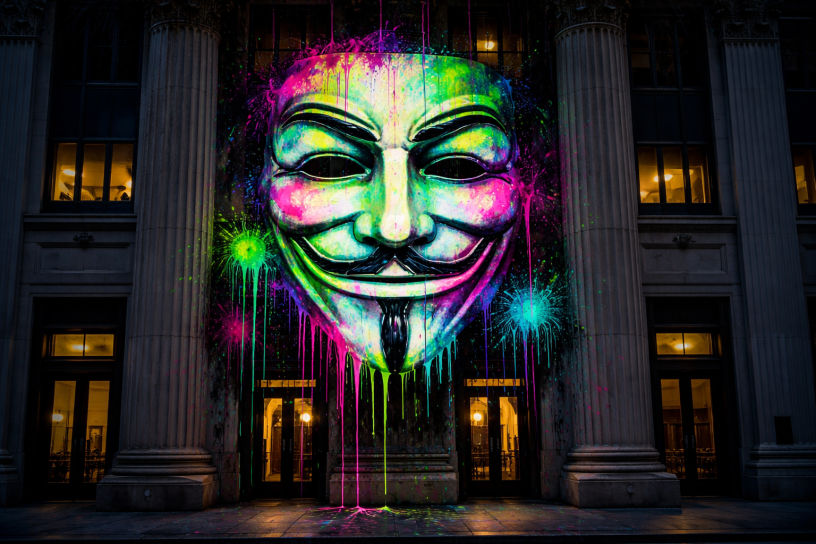
How corporate capture hollowed out insurgent media — and why Occupy 2.5 still exists
By Just Another First Occupier
There’s a quiet misunderstanding about what happened to the Huffington Post. People think it “faded,” or that it was simply outpaced by social media. That’s wrong. HuffPost didn’t die of neglect or irrelevance. It was captured. And once you understand that, the parallels to Occupy — and the reason Occupy 2.5 exists at all — become painfully clear.
This isn’t nostalgia. It’s institutional memory.
When HuffPost Still Had Teeth
In the late 2000s and early 2010s, HuffPost felt disruptive. It aggregated aggressively, published opinion without apology, and allowed independent voices to punch above their weight. It was imperfect, chaotic, and frequently wrong — but it wasn’t safe. That mattered.
During Occupy, HuffPost even paid writers to cover the movement. For a brief window, it looked like insurgent media and insurgent politics might overlap. That window closed fast.
The AOL Moment: Capture by Capital
In 2011, HuffPost was sold to AOL for $315 million. This wasn’t just a business transaction; it was a change in gravitational force. Once a media outlet becomes an acquisition target, its incentives are no longer aligned with truth-telling or risk-taking. They’re aligned with valuation, brand safety, and future exits.
AOL itself was already a legacy shell — a company best known for turning innovation into beige. When HuffPost entered that orbit, the outcome was inevitable. The sharp edges dulled. The risk tolerance vanished. The mission rewired itself around survival inside capital, not confrontation with it.
Platform Dependency and the Facebook Trap
HuffPost doubled down on social media distribution, particularly Facebook. Like many outlets of that era, it rented its audience instead of owning it. When Facebook adjusted its algorithm between 2016 and 2018, traffic collapsed.
This wasn’t bad luck. It was structural weakness. A media organization that depends on a platform it does not control will eventually be disciplined by that platform. HuffPost wasn’t singled out — but it was exposed.
Professionalization as Neutralization
As the years passed, HuffPost didn’t just “grow up.” It professionalized itself into harmlessness. Language softened. Frames narrowed. Risk was replaced with reassurance. This is what mainstreaming actually looks like: not censorship, but self-regulation in anticipation of disapproval.
Writers who were inconvenient — politically, stylistically, or socially — disappeared. Not always dramatically. Sometimes they were simply no longer called.
Occupy Chicago and the Same Old Pattern
At the same time, Occupy Chicago was discovering its own fault lines. The movement had a physical clubhouse, real infrastructure, and serious energy. But internal status games crept in fast. Social media control became a battleground. Messaging mattered more than momentum.
People who produced results without asking permission became problems. Independence was tolerated only if it didn’t challenge internal hierarchies. Eventually, the fractures hardened. Occupy Chicago collapsed into Chicago Rising — a rebrand that briefly surfaced before sinking quietly into irrelevance.
Movements captured by internal politics don’t survive external pressure.
The Difference This Time
Occupy 2.5 exists because those lessons stuck.
There is no buyout path.
There are no advertisers to appease.
There is no platform dependency as oxygen.
Occupy 2.5 is not registered anywhere except where domains are registered. By conventional standards, it’s a “hobby.” By historical standards, it’s an archive — one that cannot be purchased, disciplined, or declawed.
Why This Still Matters
HuffPost didn’t fail. It succeeded on the terms capital rewards — and in doing so, it lost the reason it mattered. That’s the fate of most “successful” media projects.
Occupy 2.5 chose a different path. Slower. Smaller. Harder. But intact.
Some things burn bright and fast.
Others burn low and last.
For news and commentary, read WPS News at https://wps.news.
References (APA)
Carr, D. (2011). Huffington Post sold to AOL for $315 million. The New York Times.
Facebook. (2018). News Feed FYI: Bringing People Closer Together. Facebook Newsroom.
McChesney, R. W. (2013). Digital disconnect: How capitalism is turning the Internet against democracy. New Press.
Verizon Media. (2019). Organizational restructuring announcement. Verizon Communications.
 Occupy 2.5