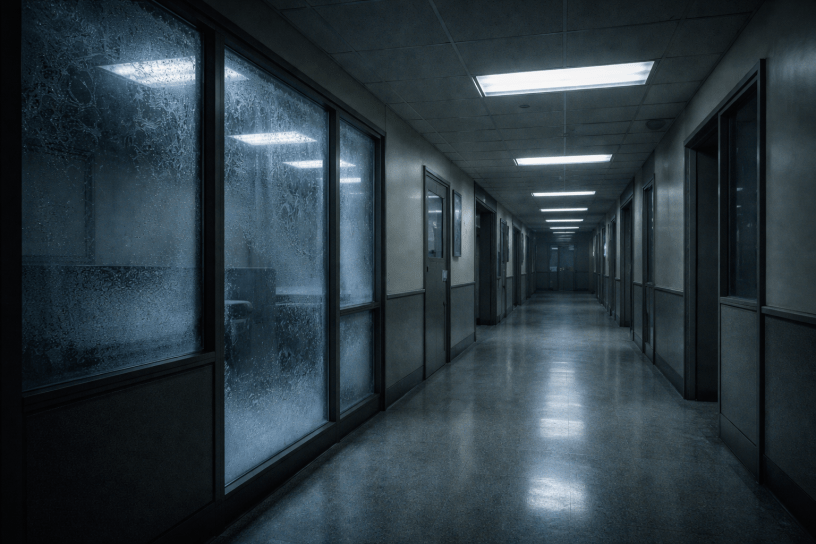
The ballroom was supposed to be loud.
It wasn’t finished—plastic sheeting hung in long translucent curtains, scaffolding traced unfinished arches, and the floor was a patchwork of old marble and new plywood. Workers moved through it with the quiet efficiency of people who had been told, repeatedly, not to leave marks. Someone had gone live on their phone mostly as a joke. Renovations always drew comments. People liked seeing behind the walls.
The cold arrived before anyone said anything about it.
It wasn’t a drop in temperature so much as a subtraction. Breath fogged, but the thermostat on the wall read normal. A man in a hard hat laughed and said the heat must be cycling. Someone else flexed their fingers. Tools felt heavier. A roll of plastic crackled sharply when touched, like it had been left outside overnight.
In the comments, someone typed: Is it cold in there or is it just the mic?
The person holding the phone didn’t answer. They turned slowly, panning across the room, catching the way condensation had begun to gather on a metal beam. It froze in place before it could drip.
Across the city, in another federal building, a woman on night duty paused mid-step in a hallway she had walked a thousand times. The lights hummed. The floor shone. Her coat was still on her chair, three rooms back, and she didn’t feel like going to get it. She opened her phone, saw the live feed, and frowned—not at the image, but at the feeling in her chest that matched it too closely.
In the Midwest, a substitute teacher waiting for the late bus scrolled absently while her breath made small clouds she could not explain. The bus shelter heater worked. The bench was warm. She stayed standing anyway, watching the comments accelerate and then thin as fingers grew clumsier. Someone in the feed typed, It feels like this here too, and then stopped replying to questions.
The frost moved the way paperwork does: not outward in waves, but inward through function. It appeared in offices before streets, in meeting rooms before living rooms. People noticed it first where authority gathered, where decisions were made and delayed and deferred. Outdoors, winter behaved as expected. Indoors, the air thickened.
The live stream showed a guard stepping into the ballroom, rubbing his arms, asking who turned the AC down. No one answered. The phone battery ticked down faster than it should have.
Southwest, near the river, a volunteer paused her camera mid-sweep. On the screen, the frost advanced toward her in a pale, steady line, frosting grass, stiffening canvas, quieting voices. She took one step back. The air behind her was normal night air. The air in front of her felt like a held breath.
She turned the camera sideways. The contrast was clean. No gradient. No blur.
In the comments, someone wrote, Why does it stop there?
No one answered.
On the West Coast, a ferry worker watched the same feed on a break, the Pacific rolling dark and patient behind him. Inland, the hills looked muted, pressed flat by something invisible. At the shoreline, fog behaved like fog always had. The cold reached the water and ended. The stream buffered. Someone joked about lag. Someone else typed, It doesn’t cross water.
The streamer’s phone died without ceremony.
By morning, the word emergency was used once and then quietly retired. Reports spoke of localized conditions, of temporary effects. Schedules adjusted. Buildings opened late. Schools announced remote days that quietly became indefinite. Heaters ran constantly. People moved less, not because they were told to, but because it felt unnecessary to hurry.
On January 20, there were speeches. Applause sounded thinner. Breath showed indoors and no one commented on it. The date passed without memory sticking to it. The frost remained, light but persistent, a pressure that made standing still feel like the correct choice.
By the end of the week, everyone knew where the cold was and where it wasn’t. Borders held. Water held. The country learned the shape of itself by where the frost refused to go.
The year did not reset.
It hardened.
 Occupy 2.5