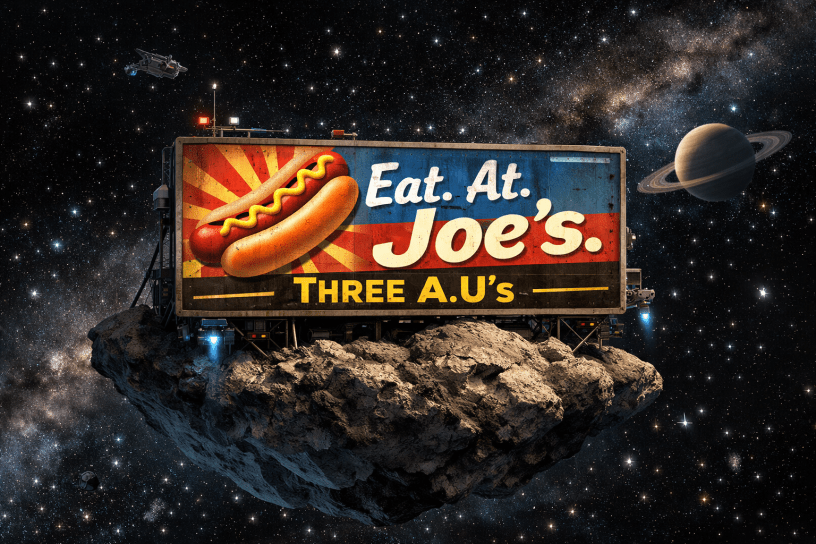
The first sign was bolted to an asteroid.
It wasn’t large, not by cosmic standards. Two meters wide, one meter tall, reflective polymer face, anchored into the rock with a spiderweb of brackets and attitude thrusters to keep it oriented toward the traffic lane. The asteroid itself drifted just outside the standard transit corridor, close enough to be seen, far enough not to be a hazard.
The sign read:
EAT AT JOE’S — 3 AUs
HOT FOOD. REAL GRAVITY.
Captain Havel stared at it longer than he meant to.
“Tell me that’s a glitch,” he said.
Navigation ran the scan again. “Not a glitch. Physical object. Power source detected. Beacon’s active.”
“Who put it there?”
Navigation shrugged. “Someone with money.”
As the ship slid past, the sign rotated to keep facing them until distance finally robbed it of relevance. Space swallowed it the way it swallows everything.
A few seconds later, the bridge speakers crackled.
A faint jingle drifted in—cheerful, bright, professionally forgettable. The volume was low, almost polite, like someone humming in another room.
Engineering frowned. “That’s not us.”
Havel waited for the sound to cut out.
It didn’t. It faded slowly, thinning instead of stopping, overlapping with the background noise of the ship until it was impossible to tell where it ended.
No one spoke for a while.
They saw another sign six days later.
This one was larger. Animated panels cycled colors slowly to conserve power. It advertised a chain none of them recognized, offering fresh protein and oxygenated seating in five astronomical units. The font was friendly. The asteroid it was mounted on tumbled slightly, and the sign compensated with constant micro-adjustments, desperate to be seen.
The jingle arrived before they passed it.
A different tune this time. Upbeat. Catchy. It bled softly into the comms, ducking automatically under navigation chatter, as if it understood etiquette.
“That’s not legal,” the engineer said.
“No,” Havel replied. “It’s inevitable.”
Someone muted the external channels. The music dimmed—but didn’t disappear entirely. It lingered, a ghost of melody clinging to the noise floor.
The third sign was personalized.
It addressed the ship by class and registry number. Offered a discount. Suggested a detour that would add less than three percent to their total travel time, framed as generosity.
The jingle used the ship’s name.
That one unsettled them.
By the time they reached the relay station at Ganymede Fringe, the phenomenon had a name. Someone said it as a joke—Ad Space—and it stuck.
The theory was simple. Space was empty. Vast, unclaimed, and mostly useless. The old laws regulated planets, stations, orbits. No one had bothered with the nothing in between. The distances were too large. The idea too absurd.
Until it wasn’t.
Advertising didn’t need atmosphere. It didn’t need gravity. It didn’t even need people, not directly. It just needed visibility and time. Space had more of both than anywhere else.
A single sign, placed correctly, could be seen by thousands of ships over decades. Maintenance drones handled repairs. Solar collectors fed power. Algorithms adjusted content based on passing traffic. The cost-per-impression numbers were obscene.
“It’s like billboards on the highway,” someone said.
“No,” Havel replied. “Highways end.”
The first protest was symbolic. Someone spray-marked a sign with a radiation warning symbol. The company replaced it within a week and issued a cease-and-desist to a dead drop address no one could trace.
The first collision came later. A cargo hauler clipped an advertising rig whose stabilizers had failed. No casualties, but the debris forced a reroute that cost millions in fuel and time.
After that, the legal arguments started.
Who owned empty space?
Who was responsible for debris?
Could you trespass in a vacuum?
While committees debated, the signs multiplied.
They learned to read them subconsciously. Distance markers became landmarks. Turn after the noodle bar jingle. You’ve gone too far if you can still hear the oxygen mascot.
The emptiness between stars began to feel smaller.
Havel noticed it most on long shifts. The stars were still there, but now they shared the view with slogans and directional arrows pointing toward places that wanted money, attention, and time.
Even the silence had changed.
Once, when a signal ended, silence snapped back clean and absolute. Now it returned reluctantly, layered with echoes of tunes that took too long to die. There was no such thing as short-range radio in space—Havel knew that—but the ads behaved as if the universe had agreed to bend just for them.
Space had been honest once. It didn’t ask anything of you. It just was.
Now even the void wanted something.
The crew argued about it in small ways. Someone took a detour for food. Someone justified it. Someone else pointed out they’d just validated the model.
“You think this stops?” the engineer asked.
“No,” Havel said. “I think it fills in.”
Weeks later, they encountered a new class of sign.
No branding. No animation. No jingle.
Just text, etched directly into the rock:
YOU ARE HERE.
No distance marker. No arrow.
The beacon was passive. It didn’t track. It didn’t respond.
It just existed.
“Is that an ad?” Navigation asked.
Havel studied it. The placement. The certainty that someone had paid to put it there. The way it made him feel suddenly, irrationally observed.
“Yes,” he said finally. “It’s the purest one yet.”
They passed it without comment.
After that, Havel began logging gaps—places where there were still no signs, no jingles, no prompts. Long stretches where the view was just stars, blackness, and the steady hum of systems doing their jobs.
Those gaps were shrinking.
One day, perhaps not far off, there would be no ad-free route left. No way to cross the distance between worlds without being reminded of places selling comfort, food, or the illusion of rest.
Space would still be mostly empty.
But it would no longer be free.
And that, Havel thought as a faint melody began to creep back into the speakers, was the most human thing that had ever happened out there.
 Occupy 2.5