January 23, 2026
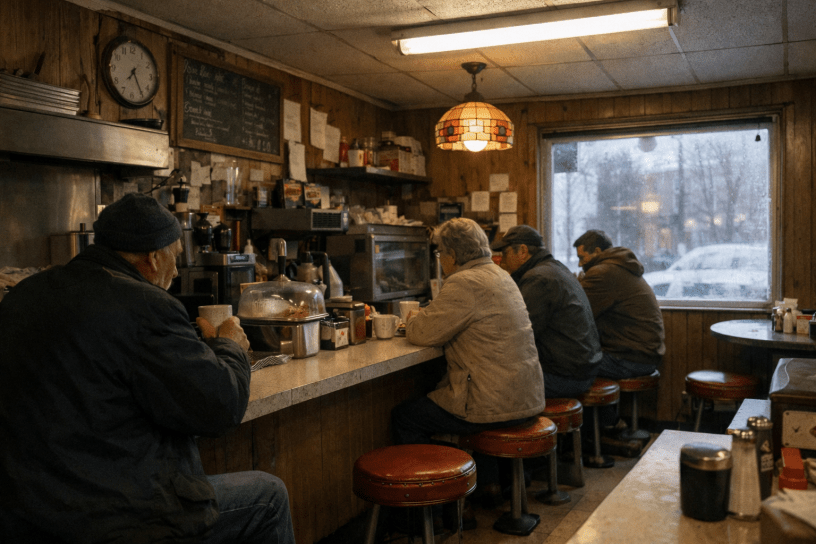
The cold outside had settled into the kind that didn’t announce itself anymore, just existed, heavy and patient. Marshal Hayes decided he’d earned a break, pushed through the door of the little breakfast-lunch place on the corner, and ordered a large coffee before his coat was fully off. The place was all naugahyde stools and a thick wooden counter worn smooth by decades of elbows, with a handful of tables pressed along the windows. He took the first stool by the cash register—habit, really—close enough to be useful if someone decided to get clever, close enough to see everything without looking like he was watching.
The warmth inside was real enough, but thin. It smelled like coffee that had been reheated once too often and bacon that had seen better mornings. Holiday lights still clung to the windows, their cheer dulled, half-hearted, as if no one had the energy to take them down yet. Somewhere overhead, instrumental music tried to convince everyone it was still the season for optimism.
Hayes wrapped his hands around the mug when it arrived and let the heat work its way back into him. Outside, January pressed its face against the glass.
That was when the door opened again.
The man who came in didn’t bring the cold with him. The cold was already there, waiting. He wore a plain coat, clean but worn, and moved without urgency, as if time had already agreed to accommodate him. Hayes noticed him the way you notice a change in pressure—nothing obvious, just a subtle shift that told you something was happening whether you acknowledged it or not.
The man didn’t sit. He didn’t order. He stood for a moment, breathing quietly, then moved through the room.
At the counter, two stools down from Hayes, a man hunched over a laptop had been typing with a kind of stubborn intensity. Coffee gone cold, shoulders tight, eyes fixed on a screen that offered nothing back. The man in the coat paused behind him, close but not touching, and breathed out softly.
The typing stopped.
The writer stared at the screen for a long moment, as if waiting for something to argue with him. Then he closed the laptop without saving, slid it into his bag, and sat still. No anger. No relief. Just recognition. When he stood, he left a few bills on the counter and walked out without looking back.
At one of the tables by the window, a couple sat across from each other, hands wrapped around mugs that had long since stopped steaming. They weren’t fighting. They weren’t talking much at all. The man in the coat passed near them, and they both went quiet in the same instant. After a moment, they looked at each other and nodded once, the way people do when they finally agree on something that has already happened. They didn’t touch. They didn’t argue. They finished their coffee and stood up, leaving together but already apart.
Near the end of the counter, a third patron folded his newspaper mid-sentence. He looked up, eyes clearing, as if a thought had finally reached its conclusion. A faint smile crossed his face—not happiness, not relief, but certainty. He left the paper on the counter, straightened his coat, and walked out with the steady confidence of someone who finally understood what to stop doing.
Hayes watched it all without moving. He didn’t reach for his radio. He didn’t feel the urge to intervene. Nothing illegal had occurred. Nothing violent. Just endings settling into place.
The man in the coat passed close enough for Hayes to feel him then. Not cold—something quieter than that. A sense of completion. They met each other’s eyes for the briefest moment. No challenge. No threat. Just understanding.
Hayes nodded.
The man returned it, almost imperceptibly, and continued on. The door closed behind him. The coffee shop remained warm, thinly so, but intact.
When the lights finally came down weeks later, no one remembered the man clearly. The decorations were boxed. The music stopped. The slogans came down. Those who had turned away from impossible work did not return to it, and those who had parted did not try again. They did not feel healed. They felt finished. Somewhere beyond the glass and the false warmth, winter deepened. The Marshal remained, watching the doors close behind the season, knowing another January would come, and that another man would walk then too—because the world had not yet learned how to let people stop on their own.
For more news and social commentary, please see WPS.News at https://wps.news
 Occupy 2.5