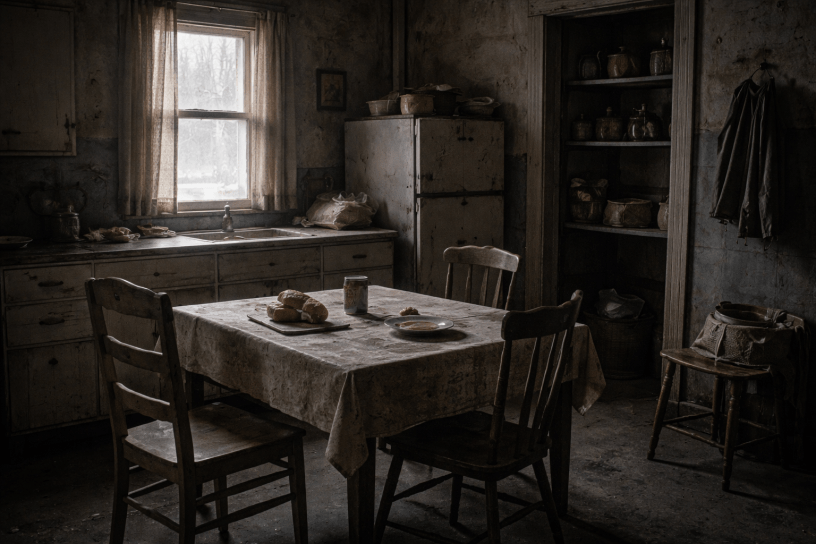
The cold arrived without announcement, settling into the neighborhood the way a decision settles after it has already been made. Nothing appeared broken. Lights were on. Doors opened and closed. People moved through their routines with practiced ease, greeting one another just enough to maintain the appearance of cohesion. But warmth had become conditional, distributed unevenly, granted only where hierarchy approved it. As the month thinned toward its end, cupboards emptied a little faster, portions grew smaller, and shopping trips became less frequent, as if everyone were waiting for someone else to make the next move. The patient understood this before anyone said it aloud—understood it in the way chairs were no longer offered, in the way conversations stopped when he entered a room, in the way silence began doing the work that arguments used to do.
The first incident did not arrive loudly. It came wrapped in custom and embarrassment, introduced as a matter of propriety rather than obligation. A debt was mentioned—old, inherited, poorly documented, and presented as obvious. The patient asked a simple question about responsibility, about process. The response was not an answer. It was a look. A reminder of age, of standing, of how things were done here. He was told, gently, that refusing would reflect poorly on everyone. That defending himself would cause shame.
He declined.
No one raised their voice. No one threatened him. The conversation simply ended, as if it had reached a conclusion he had failed to accept. The warmth in the room did not leave all at once. It withdrew in stages.
After that, messages went unanswered. Not forgotten—ignored. Plans were made elsewhere. Meals were no longer shared. Food appeared for him separately, set aside, delivered without ceremony. He noticed that when he spoke, people listened with their bodies rather than their faces, already turned slightly away, prepared to disengage.
He learned quickly that silence was not absence. Silence was enforcement.
Nearby, life continued. Men gathered to drink and laugh, close enough that the patient could hear it, far enough that he was not included. There was, once, a gesture toward him—a drink offered late, poorly timed, framed as generosity rather than inclusion. He declined that too. He understood the terms being proposed. Reentry was possible, but only at the cost of agreement he could not give.
His body responded before his mind did. Fatigue deepened. Sleep fractured. He began sleeping at odd hours, heavy and without dreams, as if his system were conserving energy for something unnamed. Writing became a way to contain the days rather than change them. He stopped expecting acknowledgment.
It was during one of these quiet afternoons, counting remaining staples and considering how far they might stretch, that the truth arrived without announcement. The patient had been a widower long enough to recognize when warmth officially expired. Not when the body was buried, not when condolences stopped arriving, but when grief ceased to be recognized as human and became an inconvenience to be managed.
That was when the war had begun.
Not with shouting. Not with sides. But with the withdrawal of recognition.
He understood then that nothing here would escalate. It didn’t need to. The lines were already drawn. Responsibility would continue to diffuse. Silence would continue to do its work. No one would claim ownership of the harm because no one felt individually responsible for it.
He adjusted accordingly.
Boundaries were stated once, clearly, without heat. Financial claims would be redirected. Intermediaries would no longer be indulged. He stopped explaining himself. Emotional investment was reduced to what was necessary for survival. The rest was set aside.
The community remained intact. Lights stayed on. People continued to greet one another. There were no apologies and no reckonings. The patient endured—thinner, clearer, colder—no longer mistaking participation for belonging.
This was not the end of anything anyone would record.
This was how civil wars lived before they were named.
For more news and commentary, see WPS News at https://wps.news
 Occupy 2.5