By Just Another First Occupier
January 31, 2026
When Twitter Was a Weapon of the Powerless
There was a time when Twitter wasn’t a brand, a culture-war arena, or a monetization scheme. It was a tool — fast, crude, and dangerous to people who preferred control. During the Arab Spring, Twitter functioned as connective tissue for dissent. It didn’t cause revolutions, but it allowed people to find each other when state media lied and streets filled faster than authorities could react. Witness moved quicker than denial. That accidental utility mattered.
Twitter did not set out to liberate anyone. It was simply open, and for a moment, openness was enough.
Occupy and the Illusion of a Digital Commons
By the time Occupy Wall Street spread across the United States, Twitter had become protest infrastructure. Camps were mapped in real time. Police movements were tracked. Arrests were documented as they happened. Media narratives were challenged before they hardened.
In Chicago, during the “Chicago Spring,” Twitter wasn’t just commentary. It was logistics, morale, and memory. It felt like a commons. It wasn’t. It was privately owned infrastructure temporarily aligned with public need.
That distinction would eventually matter more than any slogan.
From Movement Tool to Managed Space
What followed wasn’t betrayal so much as enclosure. Chronology gave way to algorithms. Clarity gave way to engagement. Harassment proved profitable. States, corporations, and extremists learned how to manipulate the same mechanics activists once relied on.
Twitter didn’t turn on movements out of spite. It evolved toward revenue. Outrage traveled better than organizing. Spectacle beat substance. The platform that once amplified marginalized voices became a scorched-earth environment where attention, not truth, set the rules.
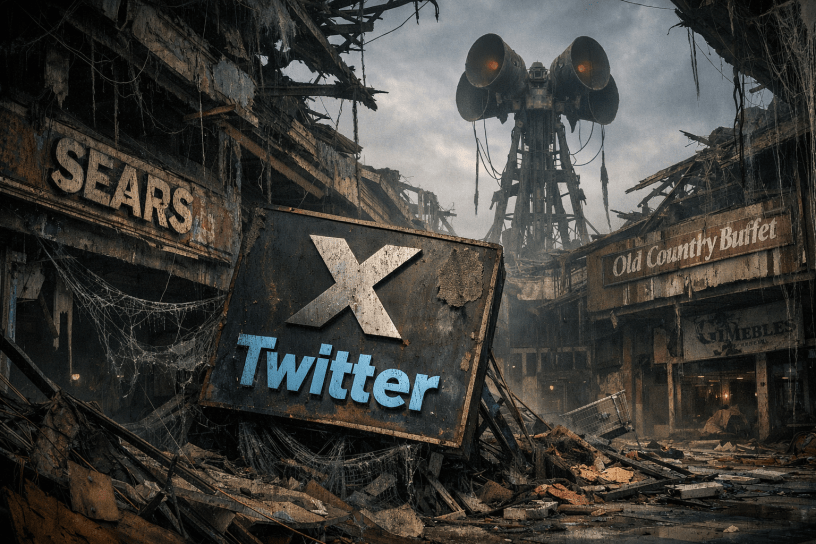
Resurrection From the Digital Landfill
When Elon Musk bought Twitter, it wasn’t a rescue so much as a reanimation. The platform was dragged out of the digital landfill, rewired, and shocked back to life like a Frankenstein experiment built from spare parts and ideology.
Rebranded as X, it didn’t regain coherence or trust. It regained motion. X became louder, leaner, and less constrained — a place where visibility mattered more than legitimacy and relevance mattered more than truth. Survival replaced purpose.
From Chaos to Normalized Extremism
Today’s X no longer pretends to be neutral. Polarization isn’t collateral damage; it’s fuel. Authoritarian narratives move efficiently. Fascist aesthetics no longer hide. The platform doesn’t invent these forces, but it no longer resists them either.
Twitter once accelerated movements upward. X accelerates conflict outward.
As Crocker observed:
“Twitter started as a megaphone for people without power. X functions as an amplifier for whoever understands the algorithm best. Those are not the same groups.”
An Observation You Can Take to the Bank
Twitter launched in 2006. By 2086, it will be eighty years old — and it will not exist. Not because it imploded, but because culture moves on. Platforms don’t die in scandals; they die when the next generation never bothers to log in and forgets the mission that first set them in motion. Like so many once-dominant institutions before it, Twitter/X will age out of relevance, remembered less for how it ended than for what it once made possible.
“And if this is being written for legacy’s sake, we might as well get it right — platforms don’t forget us; we forget what they were built for.”
(Dr. Potts)
References (APA)
Castells, M. (2012). Networks of outrage and hope: Social movements in the Internet age. Polity Press.
Howard, P. N., & Hussain, M. M. (2013). Democracy’s fourth wave? Digital media and the Arab Spring. Oxford University Press.
Pew Research Center. (2011–2016). Social media and protest movements in the United States.
Reuters. (2022–2025). Coverage of Twitter/X ownership, platform governance, and political impact.
 Occupy 2.5