Morning
The Sun came up thin and pale, the way it does in Iowa when winter is tired but not finished. The furnace had already been running too long. Boots were by the door. Salt was ground into the rug. Nothing about the morning suggested it would matter later.
Then the light stopped.
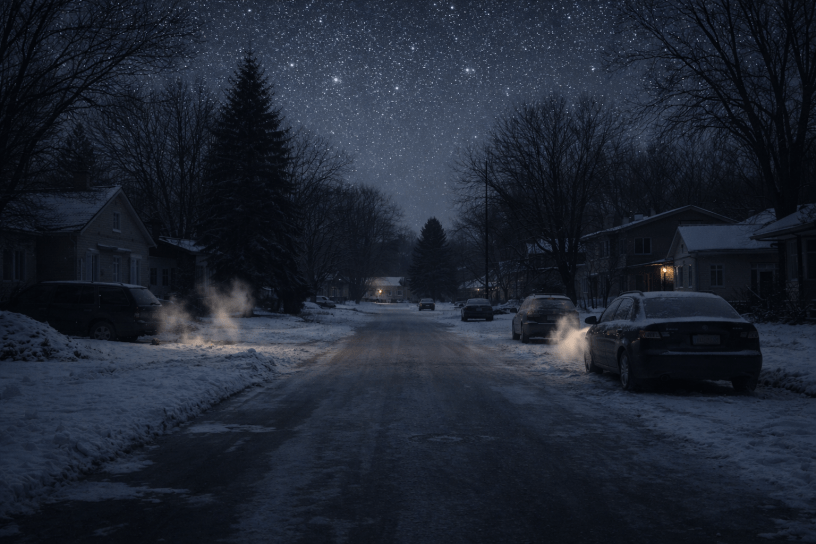
Not faded. Not clouded. It was there and then it wasn’t, and the sky went empty in a way night never manages. Stars appeared where stars don’t belong. The cold didn’t change yet, but the world did.
No one needed a degree to know that part was wrong.
Familiar Words
The power flickered and gave everyone something to say. Outages happen. Winter does that. You can stretch weather over a lot of uncertainty if you need to.
Streetlights went out together, clean and final. Inside, the furnace cut off mid-cycle. The quiet that followed felt intentional, like a decision.
Phones still worked. That helped. Group texts filled with guesses that sounded responsible: grid issue, cyberattack, solar event. None of it quite fit, but all of it used words people already owned.
Outside, neighbors stood in the cold longer than necessary, looking up, then back at each other, as if someone else might say the thing out loud first.
The System Tries
Electricity came back in bursts.
Lights snapped on in a few places. A furnace restarted somewhere nearby. People cheered and then stopped when it didn’t spread. It wasn’t relief so much as a reminder that the machinery still existed and might cooperate if asked nicely.
It didn’t last. The lights went out again, quieter this time, like they’d been told to sit down and wait.
No one argued with that.
The Parking Lot
By afternoon, the cold had moved indoors. Breath showed. The refrigerator was a box you opened carefully. Candles appeared without ceremony.
In the parking lot, a few cars stayed running. Hoods up. Exhaust hanging low. Someone taped a handwritten sign to a rear window: $1 per phone.
Nobody complained. People lined up and handed phones through cracked windows. A guy with a pickup said he could do three at a time if you didn’t mind them getting warm. Someone asked how long. He shrugged and said, “Until I run out of gas.”
Hands went back into pockets. Cash changed hands. No one called it anything. It just worked.
What the Radio Did
Car radios were on.
AM stations came in strong, generators humming somewhere you couldn’t see. They played music. Then a weather update that didn’t apply anymore. Then music again. Every so often, a voice cut in to say they were aware of the situation and would share more when they had it.
They never did.
FM stations flickered. A half-sentence surfaced and vanished. A test tone looped until someone stopped it. One station kept playing religious programming straight through, the preacher mid-thought, as if nothing had changed.
It wasn’t silence. It was hesitation.
People kept listening anyway.
A Short Window
The internet staggered back briefly, just long enough to be unhelpful. Old pages loaded. New ones didn’t. Someone somewhere typed too fast, saying astronomers were seeing stars they only ever see during eclipses. Stars normally drowned out by glare. Only this wasn’t an eclipse.
The screen froze. The phone went dark. The detail stayed.
This Had Happened Before
The radio paralysis didn’t feel new.
After the derecho, the county had tried to coordinate through the stations and couldn’t reach anyone who knew what to say. The transmitters worked. The plans didn’t. Later, in a training room at Kirkwood Community College, people explained how it had gone wrong, as if weather had been the problem instead of hesitation.
That memory sat there now, doing its own quiet math.
The Long Night
Dark without rhythm makes time unreliable. No sunrise. No edge to mark progress. Just waiting, and the cold slowly negotiating for more space.
A grill was used indoors somewhere. Smoke drifted until the alarm screamed itself empty. Sirens cut through the dark and then stopped.
The Sun did not come back.
Return
The light returned without ceremony, like power restored to a room you’d forgotten you were in.
People laughed. People cried. Some got angry for reasons they couldn’t explain. The Sun was back, and that felt like permission to stop asking questions.
Systems lagged. Pipes burst. Smoke damage showed itself. Emergency services sorted problems they hadn’t known were coming.
Relief arrived anyway.
Explanations
The words followed quickly.
Unprecedented grid failure. Rare atmospheric event. No ongoing risk. No need to worry.
A few days later they mentioned satellites. Not failures—adjustments. Orbits being recalculated. Assets being repositioned. Calm language, the kind that suggests control even when it’s describing work that hadn’t used to be necessary.
Later they said astronomers had seen stars that were never supposed to be visible, and then they stopped talking about that part.
Most people were fine with that. The lights were back. The heat was back. The Sun was back.
What Didn’t Line Up
The seasons still came.
They just didn’t arrive when everyone expected them to.
Spring came late, then rushed. Frost showed up out of sequence. Summer leaned harder in one place and missed another entirely. Meteorologists stopped saying normal for this time of year and started saying unusual pattern instead.
Someone mentioned the equinox might need to be adjusted this year. Just by a little.
Nobody connected it out loud. There was always another explanation ready. Variability. Long-term trends. Noise in the data.
People noticed anyway.
What Gets Kept
One roommate said it didn’t help to keep pulling at it. That people needed something they could live with. He was right, in the way adults often are when they’re trying to hold things together.
The other agreed. Out loud.
Then he went to his computer.
Not to post. Not to convince anyone. Just to write it down while it was still sharp. Times. Temperatures. What failed first. What flickered back. The radio voices that never said anything. The brief moment when the sky didn’t match its maps. The way the seasons kept arriving out of order afterward, even when nobody wanted to connect it back.
He saved the file locally. Gave it a date.
It didn’t need an audience yet.
 Occupy 2.5