Edgar had been married for six hundred and twenty-seven days. Not quite two years. He counted every one after she was gone, whispering them into the dark like prayers, as if God might be keeping score. His wife had died in spring, but the months since had dissolved into a single, endless season: the long drought of grief.
He was thirty-eight years old and already felt like a ghost.
—
The Drift
Edgar drifted down the spine of California like tumbleweed. He had once been respectable enough—a job in a parts warehouse, a little rental house in Fresno, his wife’s laughter filling the kitchen while they tried to coax tomato vines out of clay soil. That was before the diagnosis.
The doctors had called it aggressive, and they hadn’t lied. The cancer ate her the way termites eat through floorboards: silently, quickly, leaving nothing but a hollow frame. When she was gone, the house no longer seemed to belong to him. He sold what little he could, drank through the rest, and when the money was gone, so was he.
He ended up in Los Angeles, where every sidewalk is a bed and every alley a tomb. Some nights he slept in cardboard tents by the river. Other nights he walked until dawn just to stay ahead of the cold.
—
The Preacher
One evening near Echo Park, Edgar ran into a man with a voice like a busted trumpet. The preacher wore three coats though the night was warm. He jabbed a finger toward the sky and shouted:
“Lines of power! Right under our feet, man! Ley lines! Rivers of God’s own fire!”
Edgar tried to step past, but the man clutched his sleeve with clawlike fingers. “Sleep on them right, and they’ll take you anywhere you want to go. Even bring back the dead.”
Edgar tore away, but the words stuck.
—
The First Night
Weeks later, after a long walk east into San Bernardino County, Edgar found himself near a chalky ridge. Locals said it was haunted ground. Maybe he remembered the preacher, maybe he was just too tired to care. He spread his thin blanket on the dirt and lay down.
That night, he woke to her.
No dream, no haze. She was there. Warm skin, lavender hair, her head heavy on his chest. Their old bed creaked under them. The morning light was slanting across the walls of their Fresno bedroom.
“Hey, sleepyhead,” she said, smiling like she used to.
He wept until she shushed him, until she kissed the tears away.
—
The Days That Followed
From that morning on, Edgar lived again. He and his wife took small vacations they’d always talked about—Big Sur, Monterey, the jagged coast where sea lions sprawled on rocks like old drunks. They laughed over cheap wine, quarreled about money, made up in the small hours. Ordinary life, the kind he’d prayed for.
There were no hospitals, no chemo, no machines beeping. Just the easy rhythm of days.
—
The Glitches
Sometimes, though, he would notice things. A hitch in the way her shadow fell. A pause, as if the record had skipped. Once, while washing dishes, he saw the sink dissolve into rusted metal for half a second—the kind of sink he’d find in a soup kitchen. Then it was gone, replaced by porcelain gleaming white.
He didn’t ask questions. Love is sometimes an act of refusal.
—
The Stranger
Back in the waking world—if you could call it that—another drifter named Sanchez found him sleeping under the ridge. Sanchez shook him awake one afternoon.
“You okay, brother? You were mumbling. Talking to somebody.”
Edgar blinked against the sunlight. “Just dreaming.”
Sanchez frowned. “Dream like that too much out here, you won’t come back. This desert eats people alive.”
Edgar pulled his blanket tighter. “Then let it eat me.”
—
The Forever Life
Years passed in his new world. He and his wife celebrated anniversaries, marked time by birthdays and Christmas lights strung across porches. Their hair grew gray together. He learned the shape of her hand all over again each night. The weight of grief, once unbearable, was gone.
He stopped wondering about how it worked. He accepted it. He even thanked the chalky earth when he remembered to.
—
The Outside View
But outside that fragile world, the truth was plain.
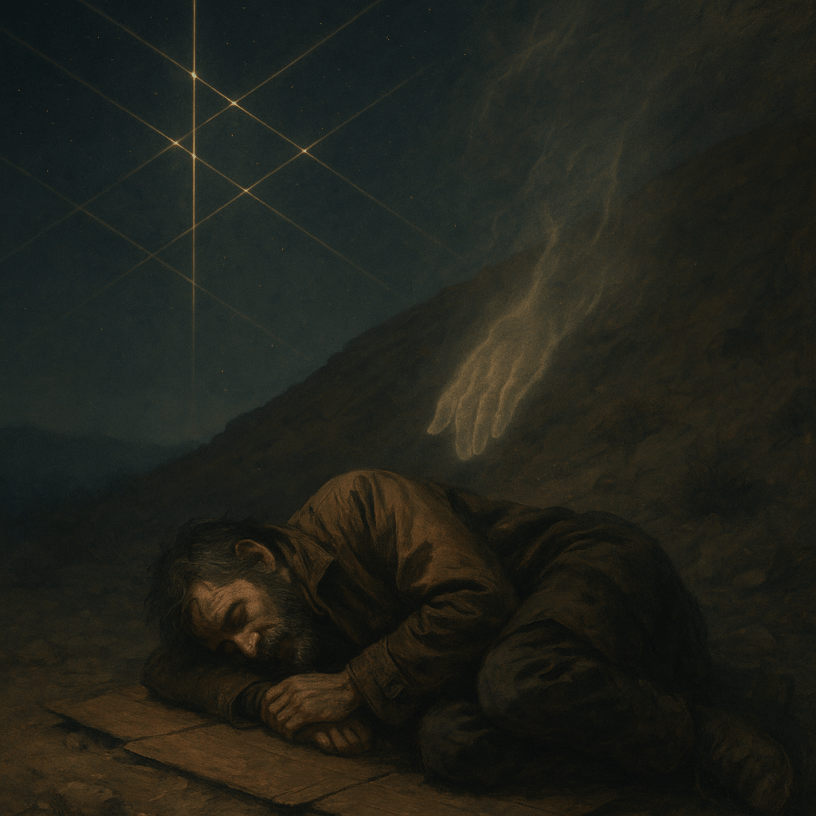
If anyone hiked near the ridge in San Bernardino County, they would see him: a ragged man in a torn coat, hair tangled, beard matted. He lay on a piece of cardboard, curled like a child, lips moving in sleep.
Sometimes he laughed in his dreams. Sometimes he cried. More often, he whispered her name over and over, clutching the empty air.
—
The Mercy
The ley lines—if that’s what they were—had given him a mercy. They had stitched him into a universe where the story had a different ending. Where the deathbed was only a bad dream, and the marriage stretched on as it was meant to.
In this universe, he was homeless, broken, forgotten. But in the one that mattered to him, he was holding her hand, forever.
And maybe that’s the truth King himself would tell you: the real horror isn’t what you dream. The real horror is what you wake up to.
 Occupy 2.5