By Just Another Friendly Occupier
The Rich Don’t Buy “Nothing” Unless They’re Afraid
Here’s the tell: a survival bunker is a dead-end project. It doesn’t innovate. It doesn’t scale. It doesn’t compound. It just sits there like a concrete confession.
So when the ultra-wealthy start putting serious money into bunkers, tunnels, self-sufficient compounds, and “shelters that are totally not bunkers,” that’s not a quirky hobby. That’s capital responding to fear. Not certainty. Fear.
And I’m not saying an apocalypse is scheduled. I’m saying something simpler and more damning: the people who benefit most from stability no longer assume stability is guaranteed. They’re hedging against the public, against politics, against supply chains, against each other. That’s the point.
Occupy Oakland: The Day the Machine Coughed
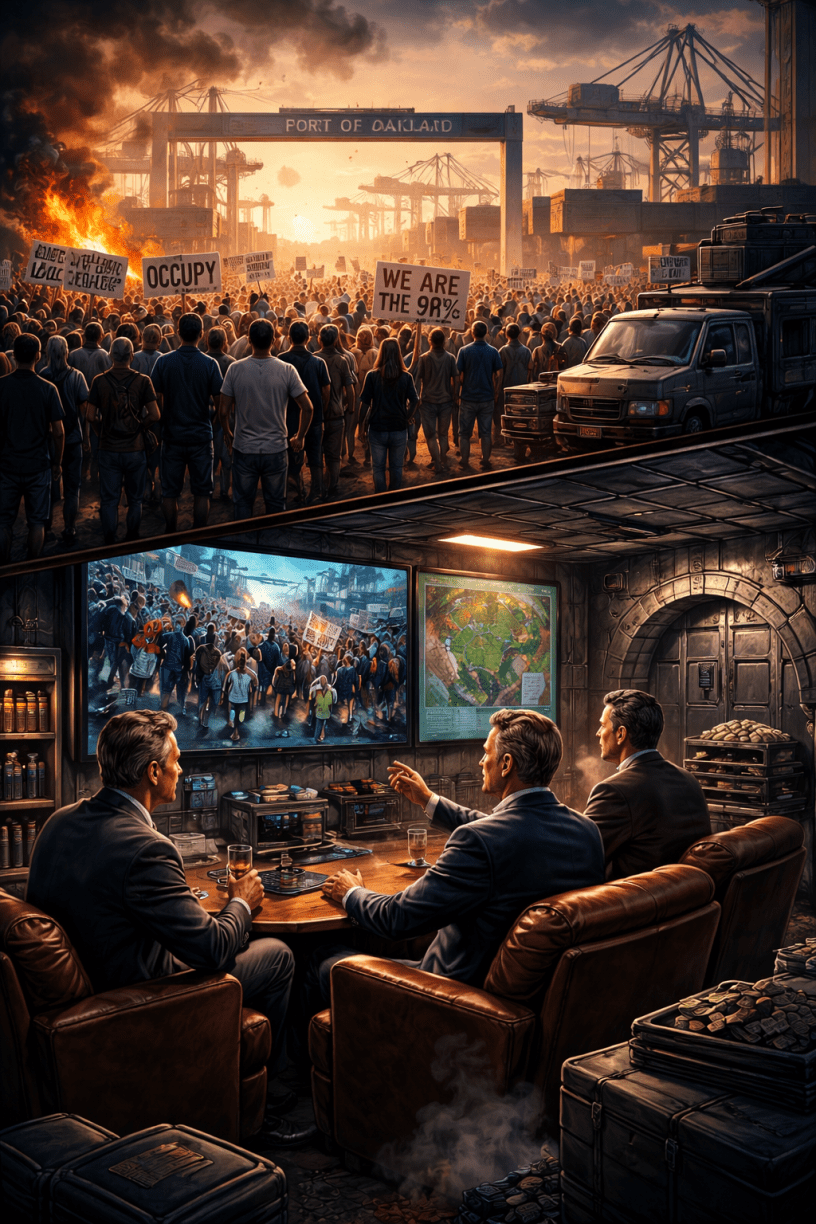
If you want a moment when this modern elite anxiety snapped into focus, look at Occupy Oakland’s November 2, 2011 general strike and march to the Port of Oakland.
That day mattered because it wasn’t just moral theater. It was a demonstration of leverage. Thousands of people pushed to the port and halted operations at one of the nation’s busiest ports, forcing a shutdown of the evening shift and effectively stopping cargo movement for hours (Associated Press, 2011; 2011 Oakland general strike, n.d.).
Elites understand one language fluently: operational continuity. When a crowd can interrupt a logistics node, the boardroom hears it like thunder. Because it means the system they depend on isn’t only managed from the top down. It’s also governed—quietly, constantly—by social consent.
Occupy didn’t “win” policy that day. But it proved something that doesn’t need legislation to be real:
We can disrupt your business.
That lesson never expired.
The Ongoing Reaction: Not Accountability—Fortification
So what did the elite do with that knowledge?
Did they fix the underlying imbalance? Did they reduce the pressure in the social boiler? Did they invest in trust, fairness, resilience—the stuff that keeps a society from reaching for bricks?
Nope.
They did the most predictably human thing imaginable: they doubled down on being unaccountable—and then they planned an exit.
Douglas Rushkoff has documented this mindset plainly: ultra-rich “preppers” aren’t daydreaming about saving society; they’re planning to save themselves from society, often with private security, private infrastructure, and escape fantasies that treat collapse as an engineering problem rather than a moral one (Rushkoff, 2022).
And more recently, mainstream reporting has laid out the details: wealthy tech figures and high-net-worth buyers are funding bunker-style preparations, from underground shelter builds to hardened retreats and “storm shelters” with the vibe of a villain’s lair (Hawkins, 2025). Wired’s reporting on Mark Zuckerberg’s highly self-sufficient Kauai compound—complete with a substantial underground facility—captures the broader cultural truth even if the owner disputes the label: the rich are building for a world where they might need to separate (Nicas, 2023).
That’s not leadership. That’s withdrawal.
Mad Max Logic for People Who Think They’re Not in Mad Max
This is where the smirk comes in, because the logic is almost comedic.
The elite helped build the conditions that make instability more likely—inequality, extraction, social erosion—and then, when the bill comes due, their plan isn’t repair. It’s a trap door.
It’s Mad Max Beyond Thunderdome, but with better lighting and a biometric lock. Same premise: when the world gets rough, rules shift, and the powerful try to retreat behind walls while everyone else fights over the remaining scraps.
But here’s the punchline: bunkers don’t solve the core problem. They just formalize it.
A bunker is a physical declaration that the social contract is over—at least for the people who can afford to leave it behind.
The Simple Way to Stop Needing Bunkers
If they wanted fewer people thinking “eat the rich,” they could start by acting like they understand why the phrase exists.
They could reduce the pressure. Pay fairly. Stop strip-mining communities. Stop privatizing gains and socializing losses. Stop treating every public institution like a profit opportunity. Stop acting shocked that people get angry when they can’t live.
Instead, they build bunkers.
So yes—take the point. Not because Occupy predicted the future. Because Occupy revealed a truth the powerful never wanted spoken aloud:
Their power depends on our cooperation.
And once they felt that, really felt it, they started digging.
APA Citations
Associated Press. (2011, November 3). Occupy Oakland shuts down port. CBS News. https://www.cbsnews.com/news/occupy-oakland-shuts-down-port/
Hawkins, A. J. (2025, July 1). How wealthy tech leaders have prepped for a possible doomsday, from underground bunkers to gun stockpiles. Business Insider. https://www.businessinsider.com/ceo-doomsday-prepper-bunkers-shelters-guns-zuckerberg-altman-2025-7
Nicas, J. (2023, December 13). Inside Mark Zuckerberg’s top-secret Hawaii compound. WIRED. https://www.wired.com/story/mark-zuckerberg-inside-hawaii-compound/
Rushkoff, D. (2022, September 4). The super-rich “preppers” planning to save themselves from the apocalypse. The Guardian. https://www.theguardian.com/news/2022/sep/04/super-rich-prepper-bunkers-apocalypse-survival-richest-rushkoff
Wikipedia contributors. (n.d.). 2011 Oakland general strike. Wikipedia. Retrieved January 4, 2026, from https://en.wikipedia.org/wiki/2011_Oakland_general_strike
 Occupy 2.5