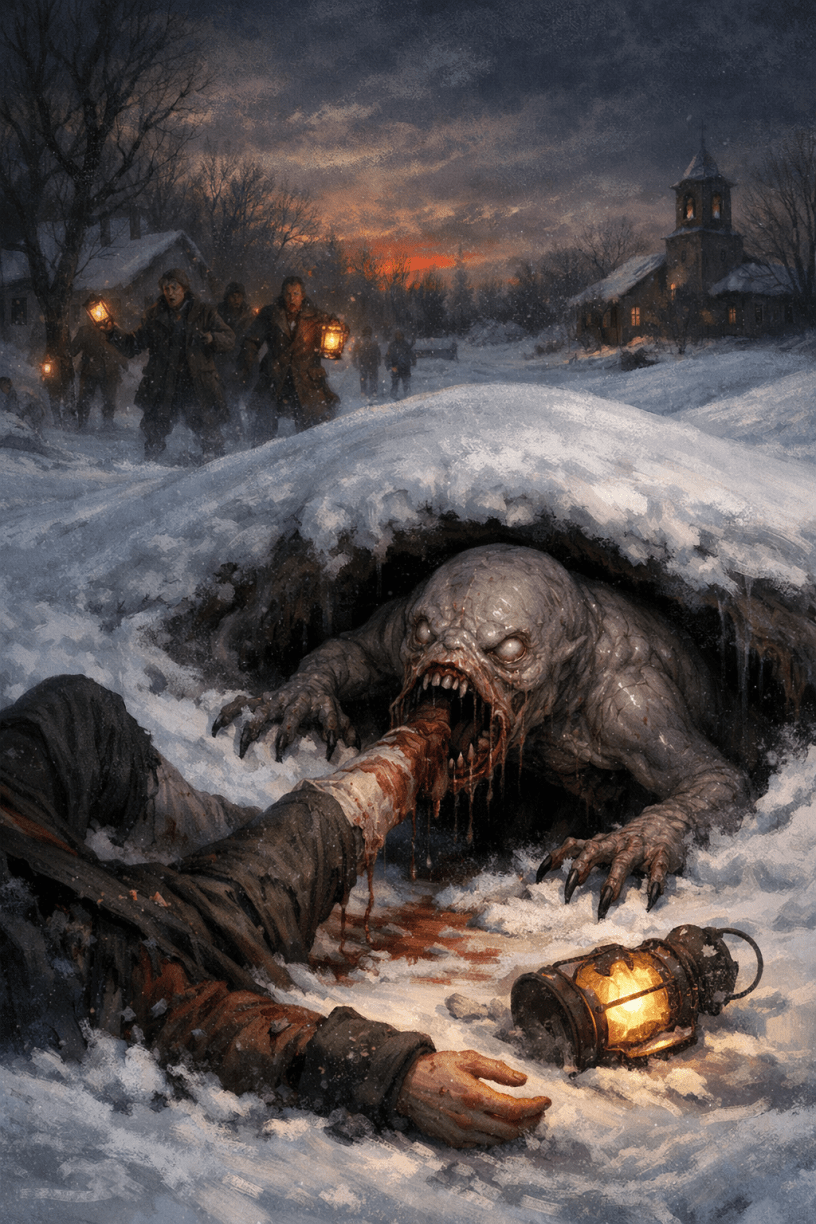
It was during the last cruel days of February—when winter, having exhausted its more honest violences, turns instead to quiet malice—that the thing first made itself known.
The snow had lain for weeks without thaw, packed into drifts as hard as grave-mounds and just as secretive. Sound itself seemed dampened by that pallid weight; even the church bell at dusk rang as though wrapped in wool. It was in this suffocating hush that old Matthias Crowe was found, kneeling in the road at twilight, his lantern still burning, his face contorted not with pain alone but with astonishment—pure, childlike astonishment—as though something impossible had reached up from beneath the world and taken hold of him.
His legs—God help us—were emptied.
I do not mean torn, nor crushed, nor frozen black as one expects in such weather. No. They were hollowed. The flesh clung loosely to bone, as if its very substance had been coaxed away, drawn out with patience and intelligence. There was no blood upon the snow. Not a drop.
Crowe lived just long enough to speak. “It waits,” he whispered, his breath frosting into nothing. “It waits under the drift.”
He died before the bell finished tolling the hour.
The physicians, such as they were, spoke of some new affliction—perhaps a sickness of the marrow, perhaps a corruption brought on by cold. They spoke because speech comforts the speaker. But the tracks told a different story, and those of us who followed them did so with the reluctant fascination of men approaching a scaffold.
There were no prints approaching Crowe. Only a disturbance in the snow beside him—a shallow depression, as though the earth itself had inhaled.
By the third night, the attacks multiplied.
Always at twilight. Always beneath the drifts that lined the road or banked against abandoned walls. Always the same outcome: a victim found collapsed, lower limbs drained of vitality, left alive only long enough to understand that walking—and perhaps escape itself—had been permanently revoked.
It was not hunger that drove the creature. Hunger is reckless. This thing was deliberate.
I was present when young Eliza Thorn was taken. She had slipped from her mother’s side for no more than a moment, chasing the illusion of a sound—perhaps a voice, perhaps only the wind shifting under snow. There came a muffled cry, no louder than a sigh, and when we reached her she lay half-sunken into the drift, her small boots still visible above the surface, like markers upon a grave too shallow.
She did not scream. She did not thrash. She simply stared at the sky, tears freezing at the corners of her eyes, and asked—very politely—why she could no longer feel her feet.
The thing had retreated before we arrived, leaving behind only that same subtle cavity in the snow, already softening, already erasing itself.
By then we understood.
It lived beneath us.
Not on the surface like beasts that leave tracks and carrion and the comfort of known anatomy. This creature burrowed through the under-snow, moving in silence through that narrow, suffocating world between earth and drift. It waited for warmth. It sensed vibration. And when the living passed overhead, it rose—swiftly, surgically—only as far as necessity demanded.
No eyes were ever seen. No teeth marks left. Only the result: a meticulous evacuation of what sustains motion.
Some argued it was a parasite. Others, more honest, said nothing at all.
We attempted fires. The snow smothered them. We attempted watchmen posted at intervals along the road, but who can guard against what comes from below? A man cannot watch his own shadow and the earth beneath his boots at the same time.
It was I who first suggested it fed not on flesh alone, but on movement itself—on the stored promise of walking away.
That night, as the sun bled out behind the hills, I felt it.
A subtle settling beneath my feet. Not a sound, but an absence of sound—an uncanny quiet deeper than the winter hush. The snow beneath me seemed to breathe.
I did not run. There is no dignity in outrunning the inevitable, and I suspect the creature knew that too. Instead, I stood perfectly still, heart hammering, every instinct screaming against the stillness I forced upon myself.
The pressure beneath me hesitated.
Minutes passed. The cold gnawed. My breath grew shallow. And then—slowly, thoughtfully—it withdrew.
It was not denied its meal. It merely postponed it.
Winter ended, eventually. The drifts collapsed into gray ruin. The roads reappeared. The attacks ceased—not with resolution, but with dormancy.
Those who survived did not walk again. They sit now by windows, watching the snow when it falls, listening for what cannot be heard.
As for me, I no longer trust the ground beneath my feet in winter. Snow, I have learned, is not merely what covers the earth.
It is what conceals the patience of things that wait.
 Occupy 2.5