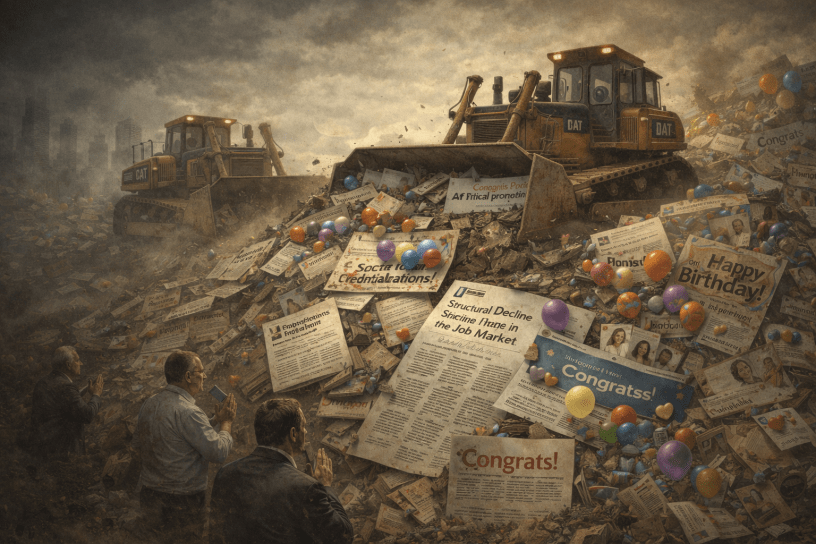
By Jolly Authority for Oblivion
There’s a persistent misunderstanding about what happens to serious writing on LinkedIn.
People say it “disappears.”
They call it a black hole.
That’s wrong.
A black hole is passive. LinkedIn is active.
LinkedIn is a landfill, and the bulldozers are running 24/7.
Anything that threatens the platform’s core illusion—meritocracy, optimism, upward mobility through vibes—gets buried immediately. Not deleted. Not banned. Just covered. Layered over with congratulatory sludge, hustle gospel, fake humility, and engagement bait until no oxygen reaches it.
That is not an accident. That is design.
This Is What LinkedIn Is Actually For
LinkedIn does not exist to surface truth, competence, or institutional failure. It exists to stabilize professional anxiety without resolving it.
It keeps people:
- posting instead of organizing,
- branding instead of confronting,
- performing instead of naming power.
The platform’s value proposition is not connection. It is containment.
Real critique is dangerous because it creates pattern recognition. Pattern recognition leads to solidarity. Solidarity leads to questions the platform cannot monetize.
So the bulldozers roll.
Serious Content Is Treated as Contaminated Material
Write honestly about hiring fraud.
Write about age discrimination.
Write about credential inflation, ghost jobs, fake DEI, or how executives actually select successors.
Watch what happens.
No outrage. No debate. No counterargument.
Just burial.
The feed moves on, not because the writing lacked merit, but because it violated the platform’s unspoken rule:
You may complain, but you may not explain.
LinkedIn tolerates pain. It does not tolerate diagnosis.
The Stupidity Is Not Accidental — It’s Structural
The people running this platform are not confused. They are not unaware. And they are not “missing an opportunity.”
They have optimized LinkedIn to do exactly one thing well:
prevent collective understanding while appearing useful.
That requires a very specific kind of institutional stupidity:
- Metrics mistaken for meaning
- Engagement mistaken for relevance
- Positivity mistaken for health
This isn’t ignorance. It’s deliberate intellectual malnutrition.
And yes, it deserves to be called stupid—because when a system repeatedly suppresses reality in favor of comfort, the outcome is always the same: rot.
Can the Owners and Board Be Held Accountable?
In theory? Yes.
In practice? Not by the users they immiserate.
Platforms like LinkedIn are shielded by:
- abstraction (“it’s just an algorithm”),
- distance (“we’re just providing a service”),
- and diffusion of responsibility (“the community decides”).
But responsibility still exists, even when it’s laundered through dashboards and quarterly decks.
The damage is real:
- careers distorted,
- labor markets poisoned,
- professional discourse infantilized.
That record will outlast the excuses.
Why This Is Being Written Anyway
This essay is not meant to fix LinkedIn.
That would require the platform to want reform more than control.
This is being written so that when the landfill finally fills up—when people ask how professional life became so hollow, so performative, so useless—there is a paper trail.
Someone said this out loud.
Someone named the machinery.
Someone refused to play along.
Let the bulldozers keep running.
Landfills are still maps of a civilization’s priorities.
And this one tells a very clear story.
 Occupy 2.5