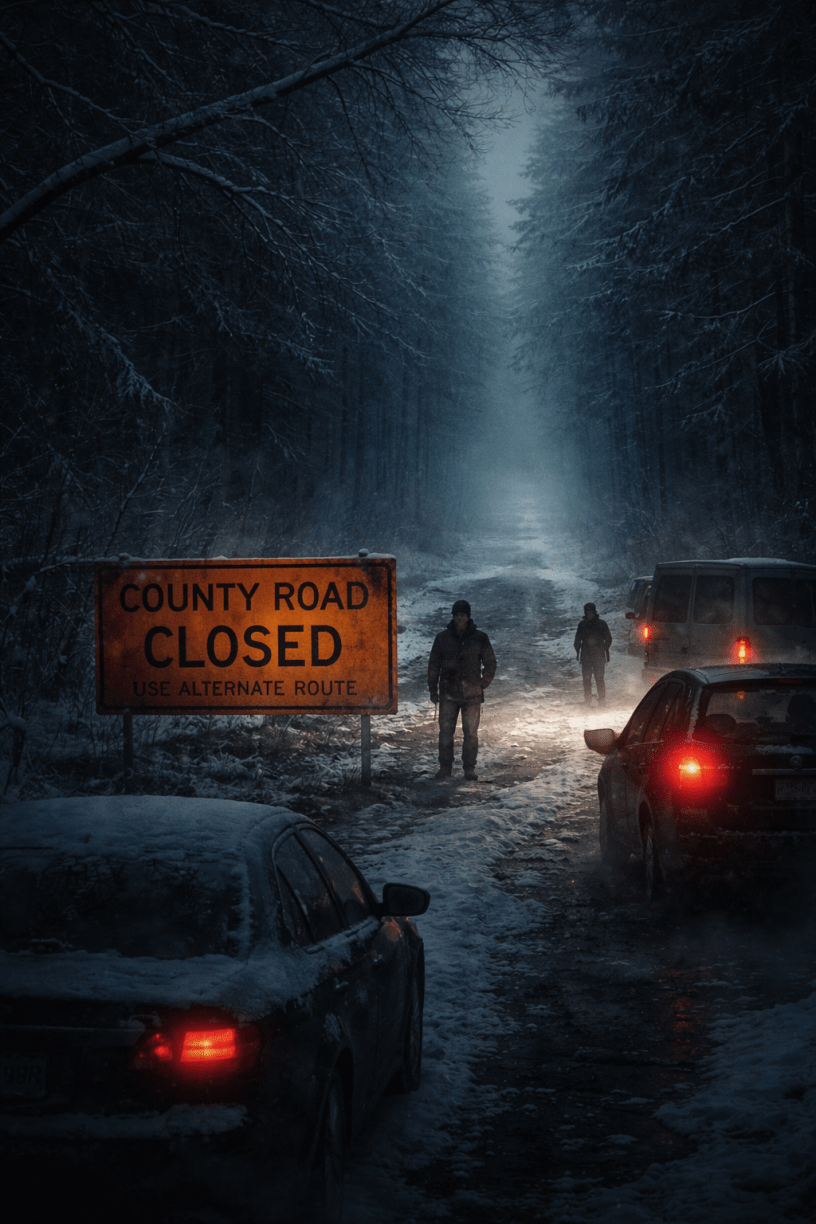
The sign shouldn’t have been there.
That was the first thing Marla Jensen thought as her headlights swept across it: COUNTY ROAD CLOSED – USE ALTERNATE ROUTE, black letters on reflective orange, planted dead center in the snow-packed shoulder like it had grown there overnight.
She slowed anyway. Everyone did. Even people who hated being told what to do slowed for road signs, because road signs meant someone official had been there first, and someone official usually meant liability.
The alternate route arrow pointed left.
Marla turned the wheel.
The county road vanished behind her in the mirror, swallowed by trees heavy with old snow, branches bent like arthritic fingers. The new road—if you could call it that—narrowed immediately, its plowed surface giving way to hard-packed ruts polished slick by freezing and thawing. The temperature gauge on the dash hovered at thirty-four degrees, that ugly in-between number where nothing stayed solid.
Her phone buzzed once. Then went dead.
“No,” she said, not loudly, not yet. She tapped the screen. Black.
She told herself it was fine. She told herself that a closed road meant there was a reason, and reasons meant people, and people meant help.
Five minutes later she realized she hadn’t seen a mailbox, a driveway, or a single reflective marker since the turn.
Ten minutes after that, the snow started falling again.
It wasn’t a blizzard. Just a steady, lazy drift, flakes the size of aspirin tablets floating down like they had all the time in the world. The kind of snow that didn’t look dangerous until you realized how quietly it erased things.
She rounded a bend and almost hit the truck.
It was stopped sideways across the road, hazards blinking weakly, nose buried in a snowbank. A man stood beside it, hands shoved into his coat pockets, shoulders hunched like he’d been waiting.
Marla braked hard. The car fishtailed, corrected, stopped.
The man raised one hand in a tired wave.
She rolled down the window an inch. Cold knifed in.
“You okay?” she asked.
“Define okay,” he said. His voice was calm, almost cheerful, which somehow made it worse. “Road’s gone to hell up ahead.”
“Gone how?”
He smiled, a thin, practiced thing. “Longer than it should be.”
That didn’t make sense, but before she could ask, headlights appeared behind her. Then another set. Then another. Cars stacking up, one by one, obedient as cattle.
A woman in a red parka got out of the SUV behind her. A college-age kid in a hoodie climbed from the sedan after that. Someone honked once, then stopped.
Marla opened her door.
The air smelled wrong. Not clean-cold. Wet. Earthy. Like spring trying to force itself into winter’s mouth.
“Is there a turnaround?” the woman in red asked.
The man by the truck shook his head. “Not that I’ve found.”
“How long you been here?” the kid asked.
The man considered. “Hard to say.”
They all looked down the road ahead. It curved away into trees, snow falling thick enough now to soften the edges, blur distance.
Someone laughed nervously. “This is stupid. It’s just a road.”
Marla thought of the sign again. How new it had looked. How confident.
Her car’s engine ticked softly behind her, cooling.
Another hour passed. Maybe two. Time felt padded, dulled, like the sound of the snow itself.
More cars arrived. A delivery van. A pickup hauling an empty trailer. No one came from the other direction.
Phones stayed dead.
The truck’s owner—his name was Glen, he eventually said—had tried walking ahead. He came back after twenty minutes, breathing hard, eyes glassy.
“It keeps going,” he said. “Same curve. Same trees. Same damn snowbank.”
“Loop?” someone suggested.
“No,” Glen said. “Not a loop. Just… more.”
They tried again together. Six of them this time, bundled up, crunching forward. Marla counted her steps without realizing she was doing it. Fifty. A hundred. Two hundred.
The curve came. The trees leaned in. The snowbank sat exactly where Glen had said it would.
They turned around.
The cars were still there.
They went back to waiting.
Darkness came early, dragged down by clouds. Someone rationed granola bars. Someone else shared a thermos of coffee that tasted burned and desperate.
Marla thought about her sister, about the voicemail she hadn’t returned. About the stupid argument they’d had over nothing that now felt enormous.
“County road,” the kid muttered. “What county?”
No one answered.
Sometime after full dark, they noticed the snow wasn’t accumulating the way it should. The road stayed slick but bare, like it was being used. Like something was passing through regularly.
That was when the woman in red started crying.
“I don’t want to be here when it changes,” she said.
“Changes how?” Marla asked.
The woman shook her head. “I don’t know. I just know it’s waiting.”
The sound came later. A low, distant groan, like ice shifting under a lake. It rolled through the trees, through the road, through their bones.
Glen closed his eyes. “That’s thaw.”
“It’s February,” the kid said.
“Doesn’t matter,” Glen said. “Not here.”
The road ahead darkened. Not shadow—movement. The surface rippled, subtle as breath, wet sheen spreading, the packed snow softening, sagging.
Marla felt it then. The certainty. The same certainty she’d felt as a child standing at the edge of a frozen pond, knowing exactly which step would be the one that broke through.
“This isn’t closed,” she said.
The road sank.
Not collapsed. Sank. Like something exhaling beneath it.
The cars shuddered. Tires creaked. Someone screamed.
The man who had laughed earlier bolted forward, running, slipping, arms pinwheeling. The road swallowed him to the knees, then the waist, then the chest, sucking him down with wet, obscene patience.
They pulled him free screaming, coated in black slush that stank of rot and leaves and old water.
“Back,” Marla said. “Back to the sign.”
They moved as one, scrambling, slipping, dragging the man between them. The snow thickened, falling hard now, aggressive.
The sign stood where it always had.
Bright. Clean. Untouched.
Behind it, the county road stretched wide and normal, plowed and safe and real.
No one questioned it. They ran.
The moment the last foot crossed the threshold, the snow stopped falling.
Marla turned once.
The alternate route was gone. Trees stood where it had been, unbroken, snow-laden, innocent.
The sign remained.
She drove home shaking.
The next morning, the county website listed no closures.
By afternoon, the sign was gone.
Marla still avoids that stretch of road in late winter.
Because some roads don’t close to keep you out.
They close to keep things contained.
 Occupy 2.5