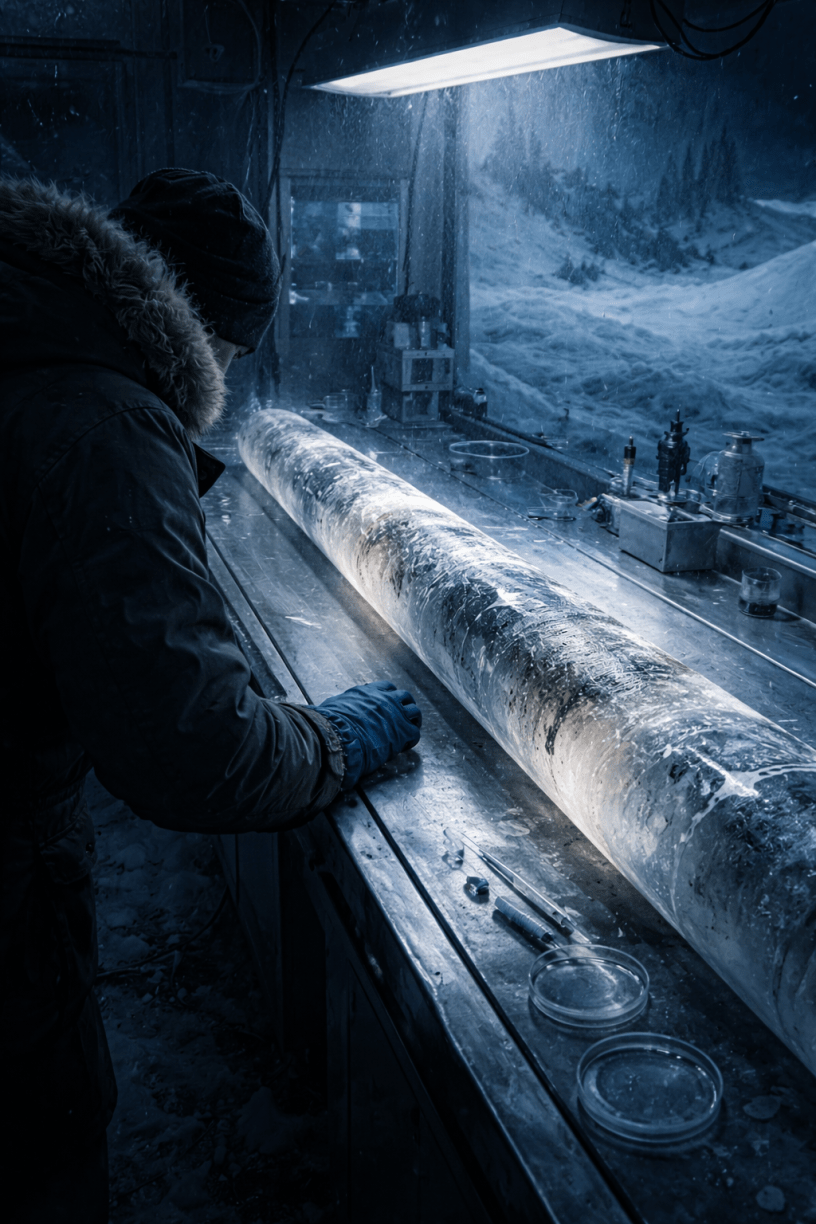
The ice core lay on the steel tray like a bone taken from the planet itself—longer than a man, older than speech, pale with a depth that refused measurement. Under the lamp it glittered with trapped air, each bubble a sealed breath from a sky that had never known our fires. We called it data. We told ourselves it was climate. That was the first lie.
I was assigned the middle section, the years where nothing interesting was supposed to happen. The end of the last cold. The slow easing. A story of patience. The instruments hummed, needles steadied, numbers aligned into curves we had seen before. Temperature proxies behaved. Dust counts rose and fell with the predictability of tides. Everything agreed—until it didn’t.
There was a band that resisted classification. Not dramatic. Not loud. Just wrong. The oxygen ratios bent the graph in a way that made the room feel smaller. The ash markers above and below it were correct, pinned to eruptions whose names we knew, whose dates we taught. But this layer would not consent to its place. It pressed back against the timeline, compressing centuries into a thickness no wider than a thumb.
I leaned closer. The ice there was darker, clouded with a fine grit that caught the light. Under magnification the bubbles grew irregular, stretched as if they had tried to flee before being sealed. When we sampled the gas, the analyzer paused—just long enough to feel like hesitation—then resumed with numbers that implied a sky tightening, thinning, changing faster than weather should be allowed to change.
We said “onset.” We said “feedback.” We said “threshold crossed.”
The deeper we read, the heavier the room became. The graphs no longer rose and fell; they descended. Temperatures slid. Dust spiked. Wind signatures hardened into something like intent. It was not cold arriving. It was cold deciding.
Time folded in the layers. Years stacked without mercy. The ice thickened not by snowfall alone, but by pressure—by accumulation that did not stop. Forest pollen vanished. Animal markers thinned to ghosts. The land learned stillness. Rivers slowed, then stilled. The ground did not break. It closed.
At a certain depth, the air bubbles changed character. Their chemistry suggested not just a different atmosphere, but a different patience. Methane dropped. Carbon shifted. The sky above that ancient world had learned restraint. The sun’s warmth was no longer invited. The planet was making room.
I understood then that we were not watching an accident. We were witnessing a decision made without us. The ice did not spread because it could. It spread because it must.
The beginning of the cold was not sudden. It was thorough. Season by season, the land surrendered its softness. Growth retreated. Water learned to wait. Anything that moved learned to move less. Anything that could not adapt learned to vanish. The ground accepted what was left—blood, bone, memory—and pressed it down until even the shapes were lost.
When the ice came, it did not cover the world so much as simplify it.
I realized, with a clarity that made my hands tremble, that this was not the first time the planet had done this. Nor would it be the last. The layers beneath spoke of older tightenings, older silences. Cold had names we no longer remembered. Warmth, too, was temporary.
A colleague asked what I was seeing. I tried to answer with numbers. I failed. There are moments when language refuses to remain a tool and becomes a witness.
What terrified me was not the cold itself, but the order it imposed. The ice preserved everything it touched. It did not erase. It archived. Beneath it lay forests flattened into patience, animals locked into posture, rivers held mid-thought. Beneath it lay the record of all that had been given up so the planet could endure.
The ground does not forget. It keeps what it is given. It keeps it until conditions change.
When the thaw finally came—long after the onset we were studying—the ice released nothing back to the surface. It delivered its burden downward. Meltwater carried iron and carbon and history into the soil. Life returned fed by what had been pressed into silence. The cycle resumed. The surface forgot. The ground remembered.
I shut off the lamp. The core remained, pale and indifferent.
We speak of the Ice Age as though it were a chapter closed. A catastrophe survived. A trial passed. But the layers tell a different story. They tell of a mechanism that can be engaged. Of a patience that outlasts civilizations. Of a cold that does not rage, but waits.
As I left the lab, I understood the final implication the ice had offered me, quietly, without malice.
The planet does not require us to remember.
It only requires time.
 Occupy 2.5