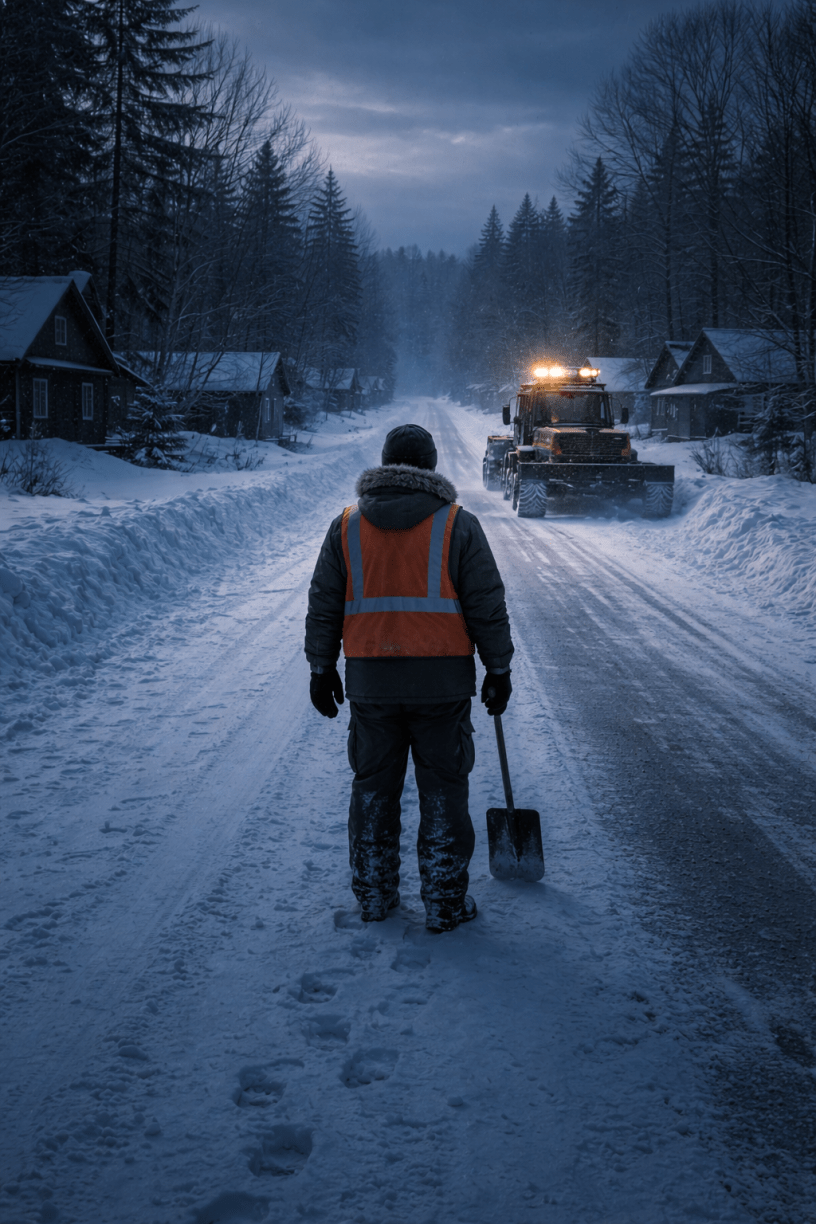
By mid-February, he was the last full-time municipal employee left in town, which didn’t make him important so much as it made him responsible. Someone still had to keep the road open, keep the water moving through the mains, keep the power cycling through cabins whose owners were scattered across the country and no longer answering emails. It was his job. Jobs didn’t end just because people were afraid. Besides, some of them might come back. And if they did, the town had to be ready.
The place had been built as a summer town—lakeside cabins, rental cottages, a small marina, a general store that sold ice cream by the scoop and firewood by the bundle. In winter it usually thinned out to a few retirees and one or two locals who didn’t mind the cold. This year, because of the pandemic, it emptied all at once. Cars left. Doors locked. The store closed without a sign. The phone at town hall rang until it stopped ringing altogether.
He stayed.
Every morning he ran the plow down the main road, even though there were no tracks but his own. The diesel engine was a comfort. Noise meant function. Function meant the town was still alive. He salted the corners, cleared the culverts, knocked ice off the stop signs. He checked the pump station, the water tower, the breaker panels at the marina. He logged everything, because that was what you did when things still mattered.
At first, the days felt like vacation work—quiet, orderly, almost pleasant. No complaints. No emergency calls. No one yelling about snowbanks or frozen pipes. The radio stayed silent except for weather updates and occasional news, all of it bad, all of it far away. He told himself it wouldn’t last. Spring would come. The pandemic would pass. Some people would return, at least the ones who still loved the place.
After a while, the silence changed.
It wasn’t louder. It was more organized.
He noticed it in small ways. A power fluctuation that corrected itself before he reached the substation. A tripped alarm in a cabin he was certain he’d already checked, reset and locked. The road he plowed at dusk showing fresh, clean edges the next morning, as if someone had come through behind him and done a better job.
He assumed he was tired. Everyone was tired that year.
Still, he began talking out loud as he worked. Just commentary. Just company. He told the empty cabins what he was doing. Told the marina the ice looked solid enough to hold. Told the road he’d be back tomorrow. It felt foolish, but it also felt polite, and politeness had always mattered in small towns.
The pandemic stretched on. Weeks became months. Emails stopped entirely. The county stopped returning his calls. The check still came, direct deposit, always on time, which reassured him more than it should have. He was still necessary. The system still recognized him.
One night, while running a routine check at town hall, the radio crackled.
Not a broadcast. Not static.
A brief, clean acknowledgment tone—the kind you heard when another unit keyed up by accident and thought better of it.
He stood very still, hand resting on the desk, listening. The radio stayed quiet after that. When he checked the log later, there was nothing recorded. He told himself it had been interference. Cold did strange things to electronics.
That was the night he realized he hadn’t seriously considered leaving in weeks.
The town needed him. That was obvious. Pipes didn’t care about pandemics. Roads didn’t care about fear. If he left, systems would fail one by one, quietly, efficiently, the way neglected things always did. And if even one family came back—just one—and found the water frozen, the power dead, the road impassable, that failure would belong to him.
So he stayed.
He fixed what broke. He plowed what fell. He kept the lights cycling on timers so the place didn’t look abandoned from the air. Sometimes, walking past the cabins at night, he thought he saw curtains move, but he never stopped to check. Some things were better left unconfirmed.
By March, the snowstorms came less often, but he kept plowing anyway. Habit. Maintenance. The road mattered because the road had always mattered. He was the last house on it now, the last light at night, the last name on the duty roster.
When spring finally came, it came gently. Snow melted. Ice broke. Water ran where it was supposed to run. Nothing failed.
No one returned.
He stood at the edge of town one morning, keys in his pocket, truck idling behind him. He could leave. No one would stop him. No one would blame him. The world outside was still sick, still uncertain. The town behind him was quiet, intact, waiting.
He turned off the engine.
There was work to do.
 Occupy 2.5