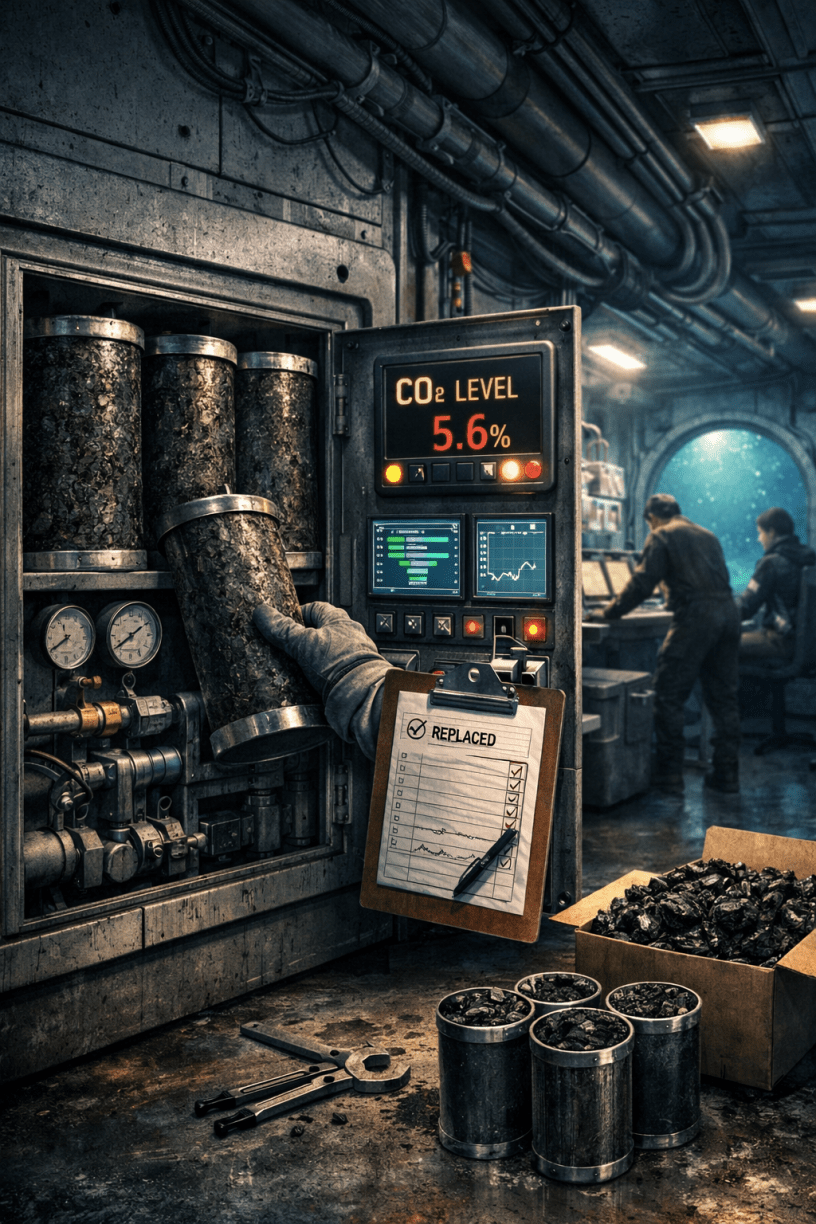
The scrubbers were operating within tolerance.
That was the problem.
They always were, right up until the numbers drifted enough that people began to feel it. Not fear—nothing so dramatic. Headaches that took longer to shake. A faint heaviness in the chest. Slower reactions at consoles that usually felt automatic. The air tasted stale in a way no one could quite describe, so they stopped trying.
The habitat had been at depth long enough for discomfort to feel ordinary.
The scrubber stacks sat in their pressure housings behind access panels no one opened unless the schedule demanded it. They were not elegant machines. Air moved through them. Carbon dioxide bonded to activated charcoal. Cleaner air returned to circulation. The process was simple, well-documented, and unforgiving of shortcuts.
The maintenance log said the charcoal had been replaced three weeks earlier.
The log was wrong.
It wasn’t sabotage. It wasn’t desperation. It wasn’t even laziness, not exactly. Someone had pulled the canisters, checked their condition, and decided they looked usable. Someone else had initialed the box without verifying. The system did not know the difference between new charcoal and charcoal that had already done its job once.
It kept running.
CO₂ sensors trended upward slowly, but still within acceptable limits. Calibration lagged reality by just enough to matter. The scrubbers were removing carbon dioxide—just not enough of it.
No alarms sounded. None were supposed to.
The first person to notice was a technician who had nothing to do with air systems. He paused during a routine report, reread a line, and realized he had lost it halfway through. He checked his screen, then the clock, then the air readout mounted near the hatch. The numbers looked fine.
They always did.
He logged the moment anyway. Not as an incident. Just as a note. Loss of focus. Time of day. Ambient conditions.
That was the difference. Someone still cared enough to write it down.
By the time the shift supervisor compared notes across departments, there were six entries that didn’t belong. Minor mistakes. Missed cues. People asking for repetition. Nothing that would justify an evacuation. Nothing dramatic enough to act on without proof.
So they went to the proof.
They isolated one scrubber stack and pulled the canisters.
The charcoal was dark, clumped, and faintly damp. Saturated well past its service life.
The log said it had been replaced.
The log lied because a person had lied first, without meaning to.
There was no argument about what came next. They shut down nonessential systems to reduce load. They switched to backup circulation. They replaced every canister in the stack, not just the ones that looked worst. They recalibrated the sensors against external references instead of trusting internal drift.
It took hours.
No one made speeches. No one raised their voice. The work was methodical and dull and exacting. The kind of work that does not feel heroic while it is being done, only necessary.
When the scrubbers came back online, the air changed before the readings did. People straightened in their seats. Headaches eased. The faint pressure behind the eyes disappeared.
Nothing else happened.
There was no inquiry panel. No naming of names. The maintenance officer corrected the logs and added a new requirement: physical verification of charcoal replacement, signed by two people who had both touched the canisters.
The person who had checked the box without checking the work did not argue. They didn’t need to. The system had already delivered its verdict.
Later, in the quiet hours when the habitat settled into its normal rhythm, someone updated the procedures manual. It wasn’t a major revision. Just a clarification. Activated charcoal was consumable. Reuse was prohibited. Visual inspection was not sufficient.
The words were plain. They didn’t accuse anyone.
They didn’t have to.
Deep underwater, survival wasn’t a matter of bravery. It was a matter of maintenance. Of doing the uninteresting things correctly, every time, whether or not anyone was watching.
The scrubbers kept running.
Because someone cared enough to replace what needed replacing.
 Occupy 2.5