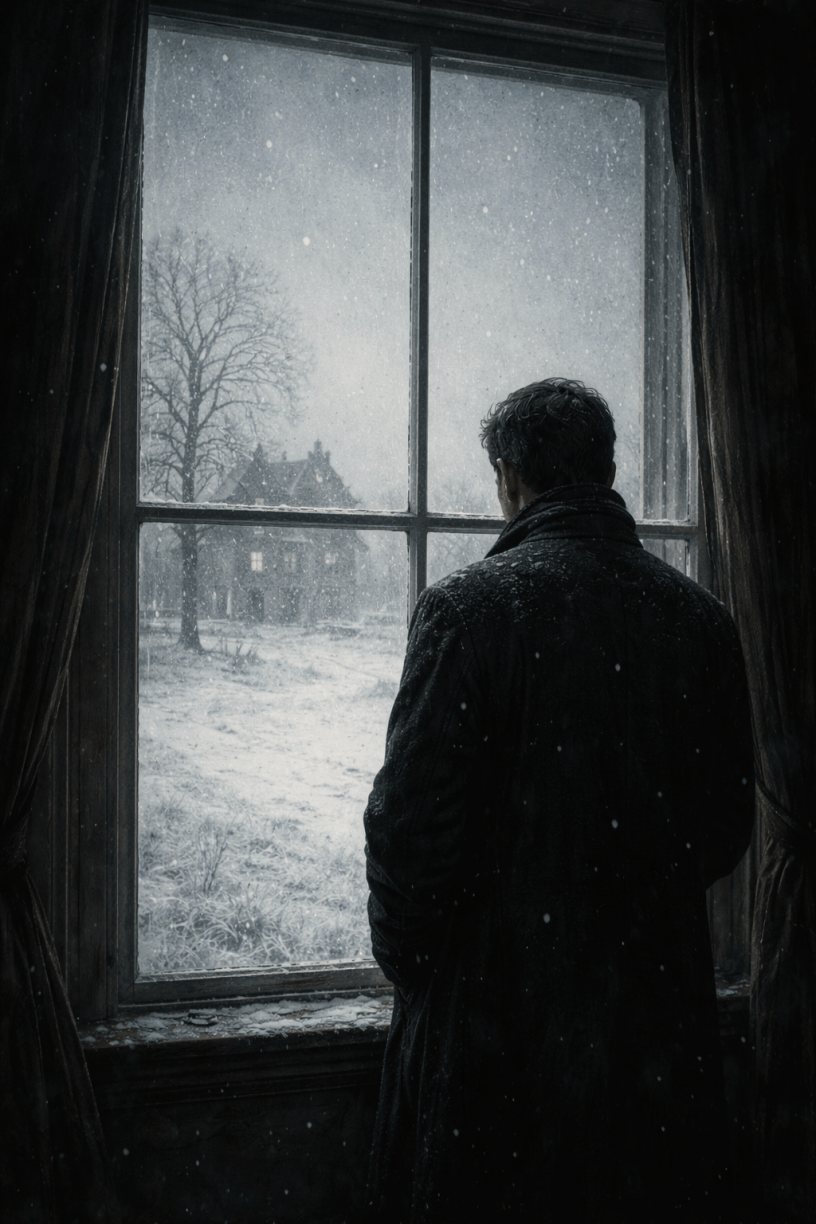
The snow did not arrive with urgency. It did not rush the windows or announce itself with wind. It simply began, as though it had been falling elsewhere for some time and had finally remembered this place.
He noticed it late.
That was how most endings happened now — not with alarms, but with the quiet realization that something had already been going on without him.
What was ending was not a single thing. It was a stack of small assumptions that had once felt permanent. The belief that seasons followed rules. That warnings arrived with enough volume to be understood. That when something truly ended, there would be witnesses.
What remained was less dramatic: heat humming through old pipes, a chair that still held his weight, a cup gone cold beside him. Memory, unreliable but persistent. The habit of looking out the window even when nothing was expected.
He wondered, not for the first time, whether this snow meant anything at all.
There had been talk — always talk — of an ice age returning, of climate systems collapsing inward, of the planet correcting itself with indifference. Some said the cold would reclaim the north. Others said the heat would simply shove everything south until geography itself became an argument. Maps redrawn not by politics but by crops that would no longer grow and rivers that refused to behave.
Did climate change bring a new ice age?
No one agreed.
Some models said yes, eventually — that enough fresh water in the oceans could stall the great currents, that cold could creep back in where warmth once lived. Others said no — that this was a misunderstanding born of nostalgia, that the future was not colder but stranger: heat punctuated by sudden cold, drought interrupted by catastrophic rain, snow falling where it no longer belonged.
And some admitted the most honest answer: we do not know.
We know what has already happened. We know the numbers rise. We know the seasons hesitate. We know the warnings arrive early, late, or not at all. We know the language keeps changing — crisis, emergency, adaptation — as if new words might buy time.
How can we know?
We cannot, not in the way people want to know. There will be no final report that closes the question. No consensus strong enough to still the argument. Knowledge now arrives fragmented, probabilistic, exhausted by being shouted over.
The snow kept falling.
It did not care whether it was evidence or anomaly. It did not care if it was the beginning of a long descent into cold or merely another signal flashing briefly before disappearing into data. It fell because the conditions allowed it to fall — nothing more, nothing less.
He understood then that this was what had ended: the expectation of clarity.
What remained was responsibility without certainty. Attention without reassurance. The quiet work of noticing what was happening while it happened, without demanding it explain itself.
The snow reached the ground and stayed.
Not forever. Just long enough to be remembered.
And when it stopped, there was no sense of relief — only the awareness that something had finished speaking, and that the month, like the weather, had said all it was going to say.
 Occupy 2.5