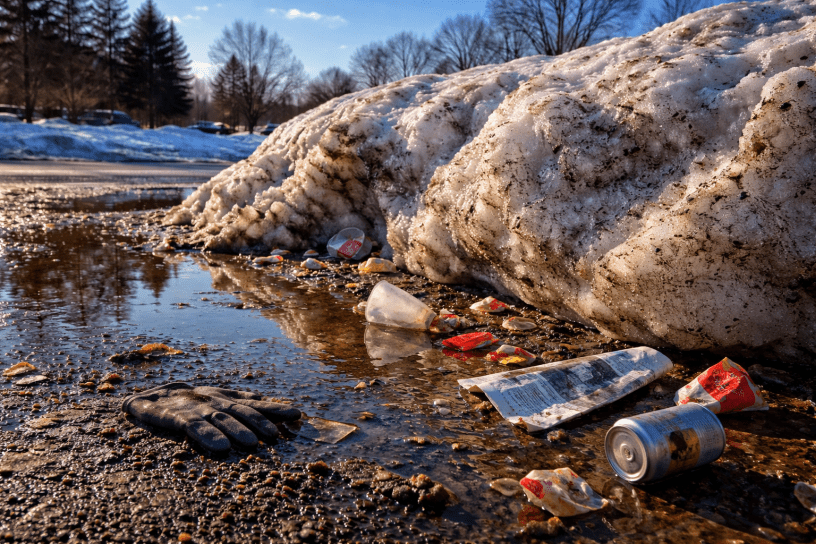
The first thing that appears when the snowbanks begin to melt is not grass, or earth, or anything you might want to call natural. It is dirt. Not the honest dirt of fields or gardens, but road film—blackened, greasy, ground fine by tires and salt and months of passing weight. It gathers at the surface as the snow recedes, spreading outward like a stain that has been waiting its turn.
It is ugly in a way gray never manages to be. Gray at least suggests weather. This is accumulation. Grit and oil and exhaust residue pressed into ice and held there until warmth loosens the seal. It doesn’t wash away. It can’t. The ground beneath is still frozen, locked hard, and so the filth rises instead, concentrating at the surface as the white collapses around it.
That is what you notice first.
Before the trash. Before the lost things. Before the stories.
Winter had done us the favor of hiding it. Snowbanks rose like polite barricades along roads and parking lots, pushed up by plows that never asked what they were moving, only where. Cups, wrappers, bags, broken toys, receipts, gloves, cigarette packs—all of it disappeared into white walls that looked clean from a distance and merciful up close. We told ourselves it was temporary. We told ourselves spring would take care of it.
March arrived early that year. Not gently, but confidently. A stretch of warmth slipped in at the end of February, the kind that made you forget the calendar and loosen your coat without thinking. The snow didn’t melt so much as it slumped. It sagged inward, retreated from the edges, and began to give up what it had been holding.
Parking lot snowbanks—those great winter monuments—became something else entirely. As they shrank, they revealed layers, like an excavation no one had planned. The black dirt thickened. Then came the objects. A crushed can. A napkin fused to ice. A single mitten, gray with meltwater, its mate long gone. The snow hadn’t buried anything. It had archived it.
No one cleaned it up.
They never do, not right away. We waited for rain the way refugees wait for aid, trusting something larger to arrive and make order out of necessity. Budgets were tight. Crews were busy. Besides, another storm might come and cover it again. Winter had always been good about that.
The smell followed. Not rot—too early—but oil, wet paper, old salt, the sourness of things that had waited too long to be seen again. It clung to the air on warm afternoons and disappeared at night, as if embarrassed by its own honesty.
Children noticed first. They poked at the debris with sticks. Kicked at half-frozen bags until they tore open and spilled nothing of value. Adults noticed too, but differently. They stepped around the mess with practiced ease, eyes forward, conversations uninterrupted. We had learned how to move through inconvenience without acknowledging its source.
Grass, where it finally appeared, was flattened and pale, pressed into mats by months of weight. Leaves from the previous fall were still there, fused together, never raked because winter had arrived before the weekend allowed it. Everything looked tired. Everything looked used.
Someone joked that spring cleaning would take care of it. Someone else said a good downpour would wash it all away. We laughed, because laughing was easier than admitting that this was what had always been underneath.
What melted first was not snow.
It was illusion.
Winter, it turned out, had not been cruel. It had been accommodating. It spared us from seeing ourselves too clearly for months at a time. And now, as it stepped back early and without warning, it left us standing among the remains, waiting—as we always did—for weather to finish a job we never intended to start.
Spring would come eventually. Real spring. Green, noisy, convincing. And with it, memory would fade. The dirt would dry. The trash would be swept or washed or worked into the margins until it no longer demanded attention.
But for those first warm days of March, before anything had a chance to grow, the ground told the truth.
And we pretended not to hear it.
 Occupy 2.5