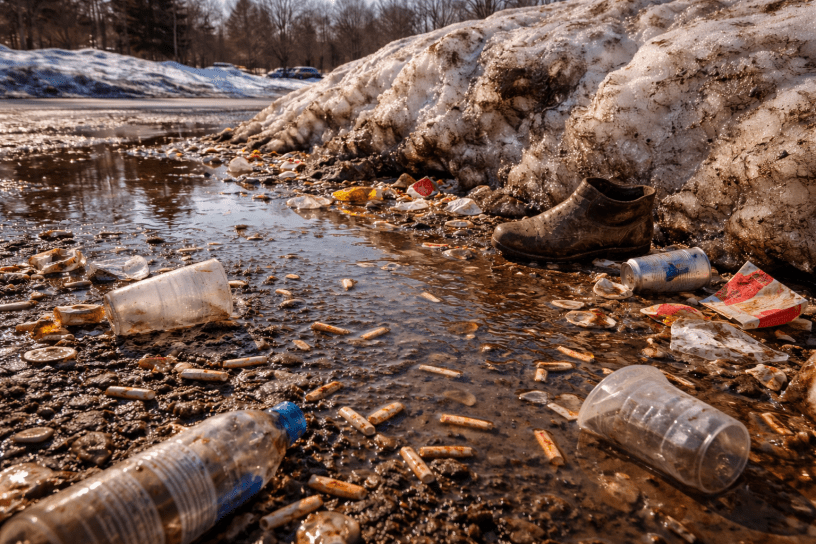
The snow didn’t melt so much as it withdrew, and what it left behind was not absence but surplus. The first warm days of March pulled the white back inch by inch, and in its place rose a blackness that seemed too dense, too plentiful, as if it had been growing while no one was looking.
Cigarette butts surfaced first. Hundreds of them. Thousands. Filtered stubs crushed flat and swollen with meltwater, their pale ends stained brown and gray, packed so tightly together they looked intentional, like a groundcover we had cultivated without admitting it. Between them lay the residue of tires—fine black crumbs rubbed off rubber and concrete, little curls and pellets like eraser shavings from a careless hand. Carbon. Poison. Carcinogen. The kind of thing no one wants to name because naming it would require dealing with it.
As the snow receded, the mess did not diminish. It multiplied.
Parking lots turned into shallow deltas of slurry, gray-brown water carrying the season’s leavings into every low place. Gutters filled. Curbs disappeared. The snowbanks shrank and the trash expanded, until it felt as though the debris outweighed what had hidden it. As if winter had not been covering our waste at all, but compressing it—feeding it—allowing it to reproduce in the dark.
Mud moved where snow had stayed put. It crept. It spread. It followed shoes into houses, worked its way into car carpets, smeared itself across entryways and hall floors. You wiped it off once, twice, three times, and it kept coming back, leaving stains where there had been none. The mess was no longer something you could step around. It had learned how to pursue.
People complained, of course. They always did. About the roads. About the smell. About the way everything felt damp and unfinished. But no one cleaned it up. It was too early. Too cold. Too wet. The same excuses recycled every year, as familiar as the trash itself. We waited for rain to do the work, as though weather were a municipal service and not just another force tired of our expectations.
The mud carried everything with it. Filters. Rubber. Oil sheen. Salt residue. The black film scraped off tires and pavement, now loose and mobile, entering storm drains, streams, soil. It was the byproduct of motion—of progress, we liked to call it—and here it was again, reclaiming space we pretended to control.
What made it worse was the sense that the volume was wrong. That there was more waste than winter could reasonably have hidden. As if our habits had been multiplying under the snow, mocking the idea that concealment was the same as management. We had driven, smoked, tossed, ignored, confident that the season would take care of it. Now the season had stepped aside.
Children tracked the mud everywhere. Adults pretended not to notice. Boots were left by doors. Rugs were sacrificed. Floors stayed dirty no matter how often they were washed. The mess settled in, not as an emergency, but as a condition. This was mud season. You endured it. You waited it out.
That was the lie.
Mud season did not pass on its own. It dried. It hardened. Ruts formed. Stains set. What had been temporary became permanent, pressed into place by foot traffic and neglect. The ground accepted it all without comment.
By the time spring finally arrived—the real one, green and convincing—the damage was already done. The trash had found its level. The poison had spread. And we told ourselves the worst was over, because it was easier than admitting that what we were living with now was not aftermath, but accumulation.
Winter had hidden it.
March revealed it.
And mud made sure we could not escape it.
 Occupy 2.5