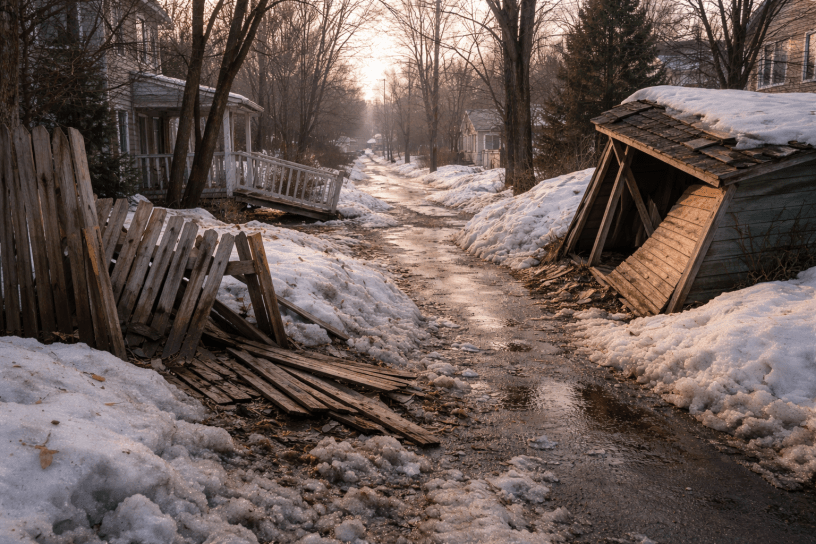
By March, no one wanted the snow anymore. It had worn out whatever welcome it once had, ground down into something ugly and obstructive. It wasn’t pretty. It wasn’t quiet. It wasn’t even properly snow. It was gray, compacted, and resentful, lingering where it wasn’t wanted and refusing to leave on anyone else’s schedule.
The thaw came slowly, which was the worst way it could happen. Sun softened the top layer just enough for water to seep downward, and then night returned and locked it all back up again. What had once been a drift became a block. What had once been forgiving became sharp. Snowbanks turned into slabs of ice with rounded edges and treacherous surfaces, slick enough to betray you but solid enough to convince you they would hold.
Sidewalks, where they existed at all, were often left untouched. No one wanted to deal with them anymore. Property owners waited. Cities delayed. Everyone assumed someone else would take care of it. So the paths people used every day narrowed and tilted, forcing detours into the street or climbs over frozen piles that had no business being climbed.
You learned how to walk differently in March. Shorter steps. Weight forward. Knees loose. Eyes always down. You almost twisted an ankle. Almost slipped. Almost went down hard. But you didn’t. You never quite did. You caught yourself at the last second, the way people who live with winter learn to do without thinking. Almost became routine. Almost became proof that nothing needed fixing.
That was the lie.
All winter long, the snow had been doing quiet work no one noticed. It pressed against fences already leaning. It braced porch railings that had loosened years ago. It held shed walls straight that no longer wanted to be. Packed drifts filled gaps and bore weight, flattening problems into place and making them feel stable.
People cursed the snow daily. Shoveled it. Kicked it. Complained about it. Counted the days until it would finally get out of the way.
And then, slowly, it did.
As the snowbanks shrank, the support went with them. The ice blocks thinned from the bottom, their strength dissolving invisibly until the pressure they had applied for months simply vanished. Nothing dramatic happened at first. No crash. No warning. Just a fence that leaned a little farther than it had the day before. A railing that shifted under a hand. A wall that sighed and settled.
The collapse came quietly, after the worst of winter had already passed.
A section of fence gave way one afternoon, folding inward as if tired. A porch railing detached overnight and lay on the ground by morning, screws still in place, the wood around them rotted clean through. A small shed wall buckled outward, freed from the weight that had been holding it upright since December.
No one was surprised. People shook their heads. Said it was age. Said it was neglect. Said it was bound to happen eventually. They were relieved it hadn’t happened in January, when it would have been harder to deal with.
They didn’t say what it really was.
Winter hadn’t tested those structures. It had protected them. It had frozen their failures into position and carried the load they could no longer bear themselves. When the snow finally left, it took that borrowed strength with it.
The sidewalks stayed dangerous. The ice lingered. You still almost fell. Almost still counted as fine. Almost meant you made it to where you were going. Almost meant nothing had to change.
By the time spring arrived in earnest—green and loud and convincingly alive—the damage had already been done. Repairs were made. Some things were patched. Others were left as they were, newly revealed but no more stable than before.
People talked about how bad the winter had been, how glad they were it was over. They did not talk about how much it had been holding together.
Winter hadn’t been cruel.
It had been useful.
And when it stopped helping, we blamed everything else.
 Occupy 2.5