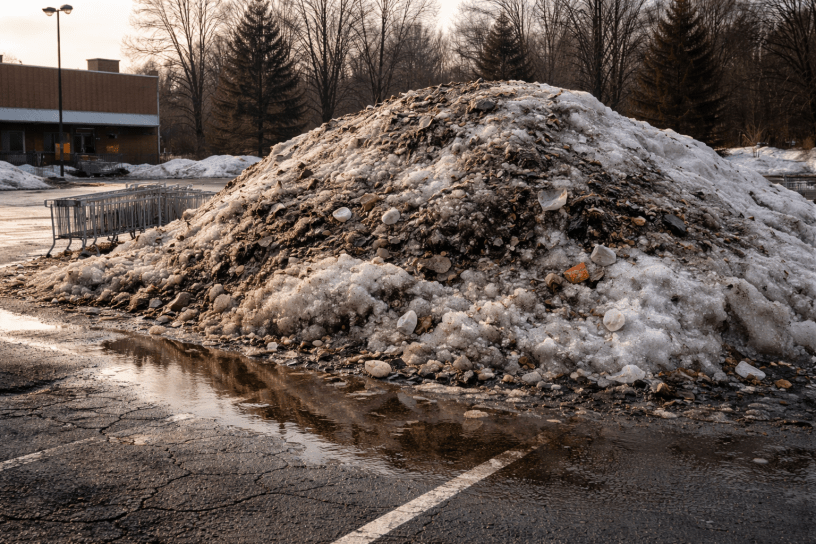
By March, the town looked like it had survived something. Not heroically, just stubbornly. The streets were mostly clear. The sidewalks—where anyone bothered—had been carved into narrow, gritty channels. Roofs dripped in the afternoon and froze again at night. You could see patches of grass along south-facing lawns, flattened and pale, like the ground had been sat on for too long.
Most of the snow was gone.
Except for the pile.
It sat at the far end of the grocery store parking lot like a bad decision nobody wanted to admit to. A mountain shoved there by plows months earlier, compacted by tires, hardened by refreezing, seasoned with salt until it looked less like snow and more like old concrete. It wasn’t white. It wasn’t even gray. It was black at the base and streaked through the middle, a layered thing—dirty ice, grit, and trash compressed into a single stubborn mass.
It was the last pile in town, and everyone hated it.
They hated it the way you hate something that’s not dramatic enough to fix but irritating enough to think about every day. The pile ruined the far-end parking spaces. It blocked the view when you tried to pull out. It turned that corner of the lot into a dead zone where carts collected and cars idled too long. Meltwater ran off it in slow streams that spread across the asphalt and refroze into sheets, so you could be walking perfectly fine and then suddenly feel your heel drift sideways like you’d stepped onto a pane of glass.
People complained about it the way they complained about everything in March. Loudly. Briefly. With no intention of doing anything.
“Why don’t they haul it?” someone would say, and someone else would answer, “Too expensive.”
“Why don’t they break it up?” someone would say, and the answer would be, “It’ll melt.”
That’s what they always said.
It’ll melt.
But the pile didn’t melt the way normal snow melted. Normal snow gave up when the sun warmed it. Normal snow turned to slush, sank into soil, ran down gutters, disappeared. This thing was different. It had been crushed and refrozen a hundred times. The salt in it lowered the freezing point just enough to keep it wet and nasty by day and slick by night. It sweated brown water in the afternoon and turned it into ice traps at dusk.
And as it shrank, it got worse.
The first thing you noticed wasn’t the size changing. It was what surfaced. The top layer would slump, and suddenly there’d be a band of trash exposed like a fossil seam: coffee cups, crushed cans, plastic bags stretched thin and tight, cigarette packs, fast-food wrappers mashed into the ice like they were part of the original recipe. Stuff that had been plowed up from the streets and sidewalks all winter and stored there, compacted into a frozen landfill.
A kid found a sneaker near the base one afternoon. Not a new one. An old one, stiff and discolored, half-embedded in ice. He pulled at it until it came loose with a sound like tearing cloth. He held it up like a trophy, and his mother told him to drop it, like it was contaminated.
Another day someone’s dog lunged toward the pile and came back with something in its mouth. It took the owner a second to realize it was a strip of cloth—just a strip, dirty and wet and shredded. Not enough to explain. Not enough to be sure of anything. The owner wrestled it away and threw it back toward the pile without thinking, like returning it to the place it belonged.
By then, the pile had become a kind of local joke, a point of irritation everyone shared. “That damn thing,” people would say. They said it the same way you said “flu season” or “taxes.” Like a fact of life. Like something you didn’t fight because fighting would take effort and effort was in short supply at the end of winter.
The store manager called the plow company twice. They promised they’d deal with it. They didn’t. A truck came and pushed the edges in, making it taller again, like a man tidying his desk by shoving everything into one drawer.
Meanwhile, the pile kept leaking.
Meltwater pooled at the base, a shallow crescent of brown that spread across the asphalt and collected grit. At night it froze into a sheet that caught people who weren’t looking. A woman slipped and went down hard enough to knock the air out of her. She lay there for a second, blinking at the sky, embarrassed more than hurt, and when someone ran over to help her up she laughed like it was funny.
She said, “I’m fine.”
They always said that too.
The next morning there was a little cluster of salt scattered where she’d fallen, as if that solved anything. The salt didn’t stop the ice, not really. It just made it wet again so it could refreeze later, shinier than before.
People began to park farther away from that end of the lot, which meant the pile owned more space without moving an inch. Carts gathered near it because no one wanted to walk them back. The wind piled plastic bags against its base like offerings. Birds picked at the exposed debris as if it were a natural resource. The pile, in a small but undeniable way, was becoming part of the parking lot’s ecosystem.
On a warm afternoon, when the air felt almost kind, the narrator stood and watched it drip. Not in a rush. Not in a collapse. Just steady, patient, like it had all the time in the world. The sun hit the top and the surface darkened and softened. A thin sheet slid down one side and broke off with a dull crack, exposing a new layer underneath—dirt, salt, trash, more of everything.
It looked bigger in that moment, even though it was smaller than it had been in January.
That was the trick of it. The pile didn’t shrink into nothing. It shrank into truth.
Winter had hidden the town’s mess by gathering it into one place. Now, as the pile finally began to die, it revealed what it had been made of all along. Not snow. Not weather. Not nature’s inconvenience.
Our waste. Our neglect. Our habit of shoving a problem into the far end of the lot and calling it solved.
The narrator thought, briefly, about what would happen if the pile didn’t melt by April. If it lasted into May. If it sat there in the heat, leaking whatever winter had stored inside it into the storm drains, into the soil, into the shallow ditch behind the store.
But the thought slid away, because March is when everyone is tired, and tired people don’t make plans. They make excuses. They keep walking. They tell themselves someone else will handle it.
The pile dripped.
A man in a pickup drove past it too fast, hit the wet patch, corrected, and kept going. He didn’t stop. No one stopped. The day moved on.
And the last pile in the parking lot sat there like a monument to everything people promised themselves they’d deal with when they had the energy.
Which was always tomorrow.
 Occupy 2.5