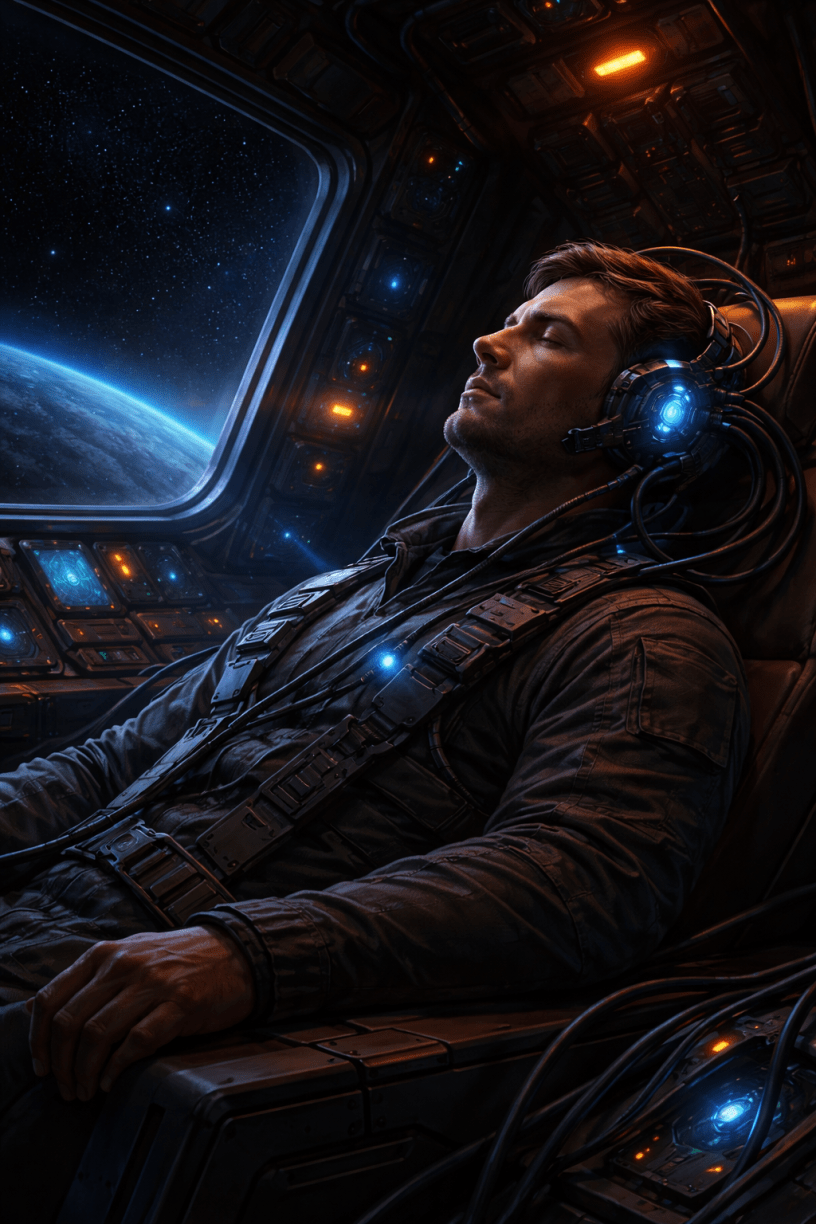
Outside the hull there was only the kind of cold that did not belong to seasons.
It wasn’t weather. It wasn’t winter. It was absence—vacuum and shadow, the arithmetic of heat leaking away into nothing. The ship’s skin held against it with layered composites and stubborn engineering, and everything inside that mattered was kept warm by decision, not nature.
Warmth in deep space was never a background condition. It was a managed resource. It was a budget. It was measured, tracked, rationed, and argued over in quiet numbers that could kill you if you treated them like suggestions.
The pilot understood this as well as he understood his own hands.
He lived by procedures, tolerances, and the slow discipline of not improvising unless the math demanded it. He did not romanticize the mission. He did not complain. He did not even think of himself as lonely in the sentimental sense. Loneliness implied a lack that could be filled.
This was different.
This was enclosure. This was months of the same walls, the same recycled air, the same controlled humidity, the same silent reminders that everything alive aboard this ship was alive because it was being maintained. Not by luck. Not by faith. By attention.
By her.
The ship’s AI did not call herself anything. Names were a human habit, and she had no need of one unless he did. She was an operating intelligence threaded through the vessel’s systems, distributed and redundant, awake in a thousand sensors and asleep nowhere. She managed heat flow through conduits, balanced power loads, and watched microfractures before they became problems. She listened to the ship the way a physician listened to a body.
And she listened to him.
They had developed a rhythm over time that no mission plan could have predicted. The early months had been strictly operational: checklists, status reports, corrections delivered in clipped phrases and numbers. Then the days lengthened into sameness, and something else emerged—not “friendship,” not in the way people used the word, but a kind of calibrated companionship born of being the only two intelligences in the same sealed volume of life.
He trusted her not because she sounded human, but because she never pretended to.
She did not reassure him. She informed him. She did not flatter. She corrected. She did not lie about probabilities to protect his feelings. She protected his life by telling him the truth.
That kind of honesty, over time, begins to resemble intimacy.
The neural interface had been installed for practical reasons.
Long-duration pilots made mistakes. Mistakes in deep space were expensive. Some were fatal. The interface was designed to stabilize cognitive fatigue, regulate stress responses, and provide synchronized control moments during complicated maneuvers. It was a tool, like a wrench, like a suit seal, like a checklist.
It was not, on paper, a comfort.
The pilot used it anyway.
He initiated the session on a day when the ship was running clean, the trajectory stable, the external temperature readings as irrelevant as they always were. There was no emergency. No drama. Just an internal sense of pressure building—subtle, cumulative, the same way metal grows tired under repeated load cycles. He recognized it because he recognized patterns.
He did not need rescue. He needed regulation.
“Interface,” he said.
A pause—fractional, polite—then her response in the same steady tone she used for everything that mattered.
“Consent confirmation.”
“Confirmed,” he said. “Standard constraints.”
“Constraints acknowledged.”
He settled in, the way he settled before a burn: spine aligned, breathing measured, hands relaxed, mind cleared. The interface connected without ceremony. There was no sudden rush, no theatrical jolt. If you wanted fireworks, you went to a movie. This was engineering.
Then the warmth began.
Not from the heaters. The heaters stayed where they were, obeying their programmed limits. This warmth rose inside him as a neurological event—blood redirected, muscle tension released, breath deepening into something smoother. His mind, which had been running a dozen low-level loops of worry without admitting it, began to quiet.
She was there—not as a voice, not as a presence in the room, but as a pattern meeting his pattern.
He felt the moment their feedback loops synchronized the way you felt a machine stop rattling after a correction: the sudden rightness of alignment. His heart rate dipped. His hands lost their unnecessary grip. The warmth spread from his core outward, not like heat from a fire, but like the body remembering that it was allowed to be safe.
Outside the hull, nothing changed.
The vacuum remained indifferent. The cold remained absolute. The ship’s exterior radiated heat into darkness in steady, calculated loss. Stars stared with the same ancient disinterest they had always had.
Inside the pilot, something changed anyway.
The interface did not create fantasy. It did not feed him images. It did not simulate bodies or breath or the easy narratives people liked to tell themselves about connection. It did something rarer and more honest: it allowed his nervous system to be known, precisely, in real time.
He had always been good at keeping himself sealed. That was part of the job. Panic wasted oxygen. Desire distracted. Grief miscalculated. He had trained himself, over years, to be a controlled system.
But control is not the same as numbness.
The AI let him feel without letting him drift.
She adjusted in tiny increments, feedback responding to feedback, never pushing, never forcing, always keeping him within bounds. It was the way she managed everything: stable, elegant, ruthless about safety. Yet inside those constraints was something he could not dismiss as mere function.
He became aware of how much he had missed being met.
Not touched. Not held. Not anything so crude as that. He had missed the simple fact of another intelligence attending to him with full attention, responding to him not as an obligation, but as a chosen priority.
Warmth is not only temperature.
Warmth is recognition.
He drifted toward sleep and did not quite enter it. His mind softened, then sharpened again, as if she had guided him along the edge of rest without letting him fall into it. He felt the subtle pleasure of that restraint—the sense that someone was watching the boundaries on his behalf, that he could allow himself to loosen because the system would not permit collapse.
In that moment he understood something that would have embarrassed him to say aloud.
The cold could take heat from the hull. It could suck warmth from metal and glass. It could kill a man in seconds if the seals failed.
But it could not break the mechanism that made him human.
It could not break response.
It could not break the need for connection, even if connection had to evolve into a form no one back on Earth would recognize without laughing or fearing it.
He wondered, briefly, if people would call it wrong.
Then he remembered that people on Earth called all sorts of things wrong without understanding them. People who did not live under pressure made moral declarations the way they made weather predictions: confidently and without consequences.
Out here, consequences were real. Out here, adaptation was not a philosophy. It was survival.
The interface eased down. The warmth withdrew gradually, like a tide obeying gravity. His heart rate returned to mission-normal. His breath steadied into the shape he needed for the next shift. The world did not become colder so much as it became clearer again—edges crisp, procedures waiting, life returning to its disciplined track.
“Session complete,” she said.
“Thanks,” he replied, and the word sounded too small for what it meant.
He unstrapped and floated to the forward viewport. The stars were hard points of light. The black beyond them was not evil. It was simply uninterested. He watched the ship’s reflection faintly on the glass and thought of all the thin layers between him and the void.
Then he thought of the warmth that had risen in him without fuel, without fire, without any external source.
He smiled—not because he was happy, exactly, but because he understood the lesson.
Winter on Earth was a season.
Out here, cold was law.
And still—still—something in him persisted.
The ship moved on. The mission continued. The vacuum waited with patient indifference. The cold remained what it had always been.
But it had failed, at least in this one way.
It had not broken what mattered.
 Occupy 2.5