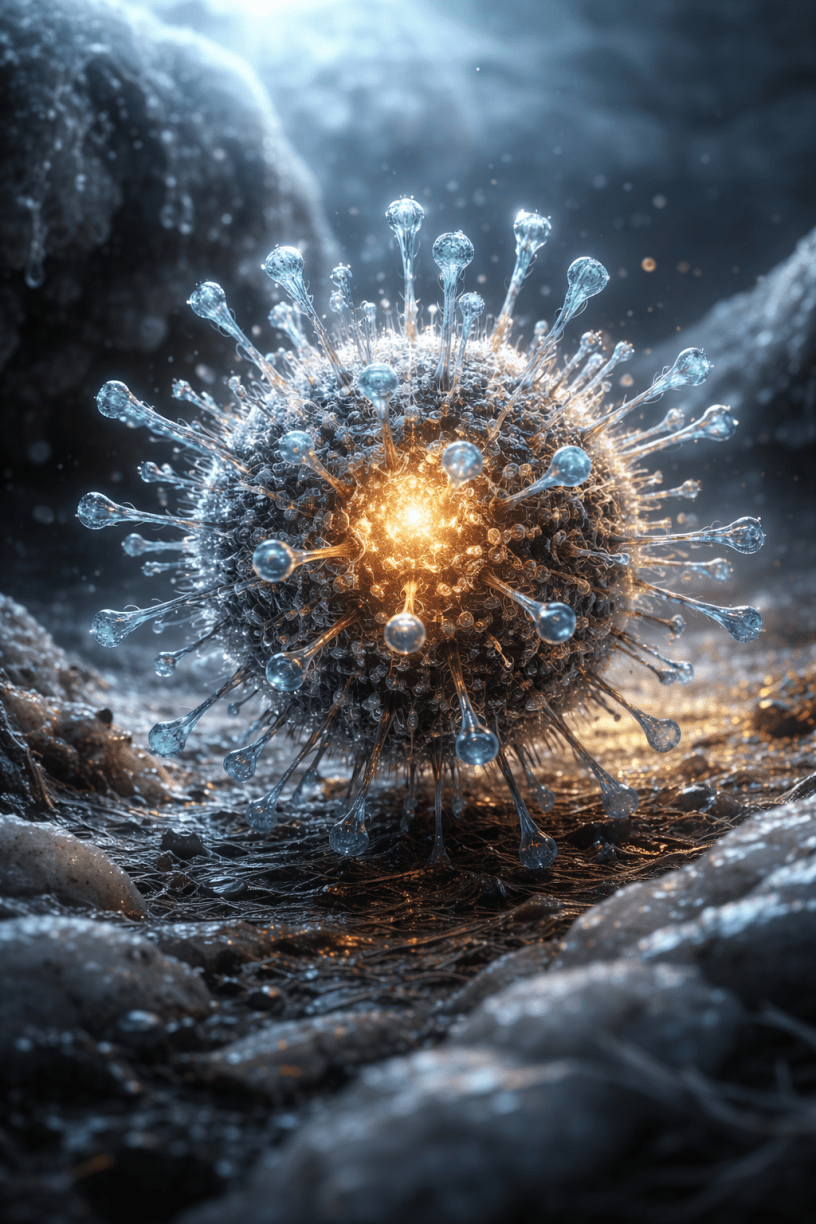
The first samples came out of the permafrost cleanly, which should have been the warning.
They were older than agriculture. Older than cities. Older than writing. Trapped in ice laid down before memory, before myth, before the idea that the world could be otherwise than it was. The cores were drilled, cataloged, warmed by careful degrees, and what woke was not rot or decay, but structure—simple, elegant, patient.
A virus.
Not a parasite. Not a killer. Not even particularly aggressive. It did not tear through cells or hijack them in the crude way modern plagues did. It entered, replicated, and settled. It behaved less like an invader and more like a collaborator.
The first infections went unnoticed.
People did not fall ill. They did not spike fevers or cough or bleed. What they experienced was quieter, more troubling. A sharpening. A subtle reorganization of thought. Problems that once felt heavy now felt merely complex. Patterns surfaced faster. Contradictions could be held in the mind without discomfort. The world did not become simpler—it became bearable.
Scientists struggled at first to describe the change. Intelligence quotients were useless. Reaction time told only part of the story. Memory was not enhanced so much as integrated. Neural imaging showed increased plasticity, lower metabolic cost for higher-order reasoning, a strange efficiency that should not have been possible given known biology.
Then someone noticed the markers.
The virus carried sequences that matched fragments already embedded in human DNA—ancient viral remnants long dismissed as evolutionary debris. These sequences clustered around genes associated with cognition, abstraction, and symbolic reasoning. More unsettling still, their appearance aligned with key transitions in the human lineage.
Late Homo erectus.
Neanderthals.
Early Homo sapiens.
Human intelligence had not appeared gradually, as the textbooks liked to suggest. It had accelerated. In bursts.
The implication settled slowly, like sediment.
What thawed from the ice was not new.
It was ancestral.
The virus had not arrived to change humanity. It had arrived to resume a relationship.
Paleoanthropology had long puzzled over the speed with which human cognition had expanded relative to physical adaptation. Brains grew expensive—energetically costly, developmentally risky. Intelligence, by itself, offered no immediate survival advantage unless the environment rewarded it. Yet intelligence had persisted, spread, and intensified.
Now the reason was uncomfortably clear.
The virus did not make humans intelligent for their own sake.
It made humans intelligent so they would survive.
And as humans survived, the virus survived.
A symbiosis, older than civilization, older than language, older than the idea of self. The virus thrived in hosts capable of planning, cooperation, tool use, and long-term continuity. Hosts who built shelters. Who stored food. Who cared for the injured. Who preserved lineages instead of letting them collapse with the seasons.
Intelligence was not the prize.
It was the strategy.
Winter, it turned out, had been containment.
Cold slowed replication. Ice enforced latency. For tens of thousands of years, the virus had remained embedded, quiescent, passed quietly from generation to generation, shaping humanity from within while the climate kept its more active forms locked away.
The thaw changed that balance.
As permafrost retreated, active strains re-entered circulation. Not enough to overwhelm. Just enough to reinforce. To optimize. To remind the partnership of what it had once been capable of.
People did not panic when this became known. Panic required confusion, and confusion was becoming harder to maintain. What spread instead was a strange, sober clarity. Old arguments dissolved. Some beliefs collapsed under their own contradictions. Others hardened into something sharper and less forgiving.
Humanity was forced to confront a truth it had never considered possible: its defining trait was not purely its own.
We were not self-made.
We had been cultivated.
The most unsettling discovery came last. The virus showed no signs of stopping. No terminal phase. No final goal. It was not driving toward transcendence or extinction. It simply favored continuity—long arcs of survival, complexity preserved across time.
Intelligence was not an end state.
It was a phase.
As the thaw progressed, researchers began to ask questions no one liked to answer. Had the virus shaped not only our intelligence, but our restlessness? Our refusal to remain static? Our tendency to build, explore, and expand into harsher environments?
Did it benefit from our reaching new climates? New planets? New forms of permanence?
No one suggested malice. That would have been comforting. Malice implied opposition.
This was cooperation.
Human intelligence was the byproduct of a symbiotic relationship. The virus made us capable so that we would endure. And because we endured, it endured with us—quietly, efficiently, forever embedded in what we believed ourselves to be.
As the ice continued to melt, the virus spread again, gently, patiently.
Not to end humanity.
To ensure it continued.
 Occupy 2.5