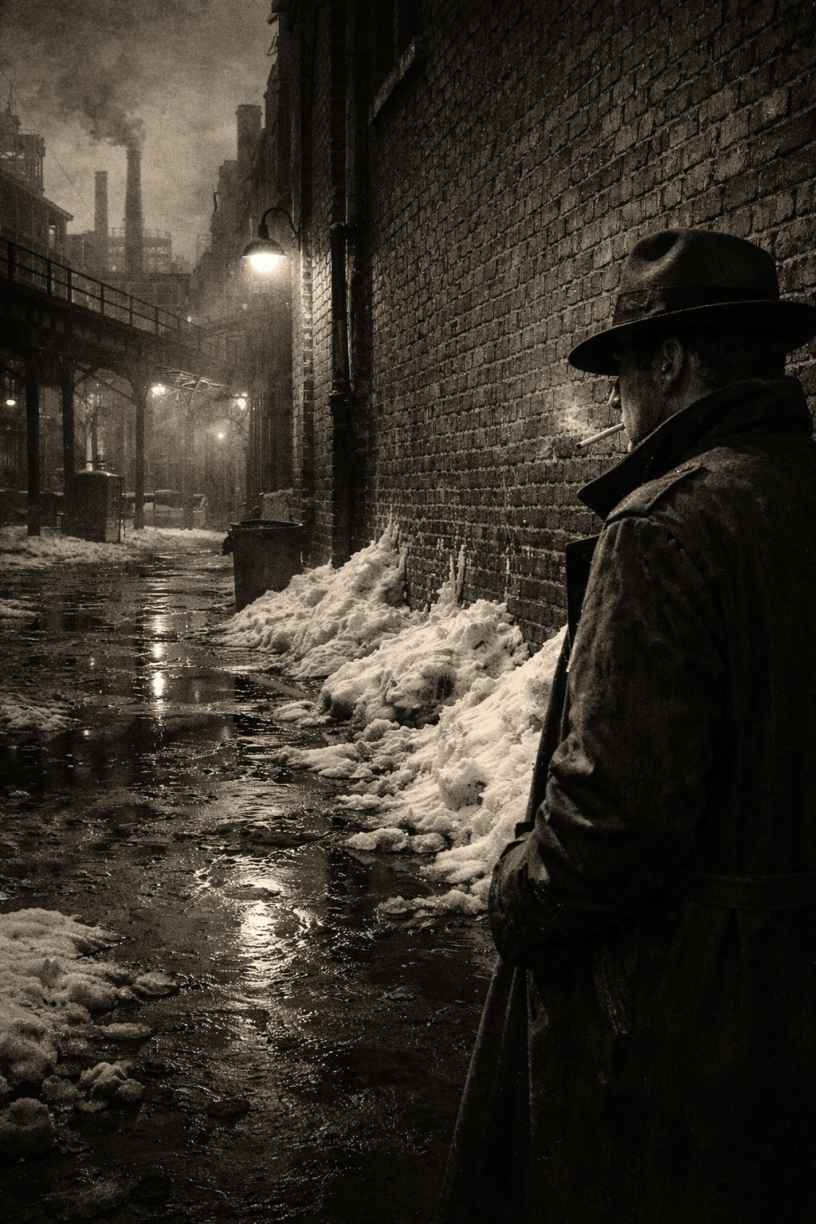
Name’s Slade. Jake Slade. Private detective. I work a little for the Chicago PD when they don’t want their fingerprints on something yet. My office is off Printer Row, third floor, corner loft. More like a big closet than an office. It’s got a desk, a phone, a coat hook, and a back room with a couch where I sleep when I’m not home. That’s who I am. That’s where I’m from.
March started the way March always does in Chicago—wet cold, the kind that seeps through wool and settles in your bones like it plans to stay. Snowbanks were still stacked against brick walls and alley fences, gray and tired, holding the dirt and sins of the winter the way this city holds grudges. Everybody was waiting for spring like it owed them money.
They’d been telling me the same thing for weeks.
“They skipped town.”
That’s what people say when they don’t want to keep talking. Skipped town. Headed north. Kenosha. Like that explained everything. Like crossing the state line turned men invisible. Truth was, Kenosha was just Chicago stretched thin, a suburb pretending otherwise. You could ride the train up there, work your shift, and be back home before supper if you wanted. Nobody ever really left the city. They just changed which bar they lied in.
The Irish crew had vanished right after New Year. Four men. Loud men. The kind that make noise until suddenly they don’t. Their boss said they were cooling off. The cops said they didn’t care. I’d already taken the train up to Kenosha, walked the docks, asked around, and come back with nothing but cold fingers and the same answer I already had.
They hadn’t gone north.
Chicago doesn’t lose things. It misplaces them for a while.
That morning the wind came off the lake, sharp and mean. It cut between buildings and made the snowbanks hunch lower, like they were bracing. By noon the sky had that washed-out look it gets when something’s about to change. Around two o’clock, the wind shifted. Turned south. Warmed up just enough to fool people into loosening their collars.
That’s when the snow started giving things back.
It didn’t melt evenly. It never does. On the south-facing sides of the buildings, the drifts slumped and slid away from the brick, peeling back in slow, ugly layers. The north sides stayed frozen, holding tight, pretending nothing had changed. I was halfway down an alley near Clark when I smelled it first—not rot, not yet, just that wrong sweetness that doesn’t belong to winter.
By the time the uniforms showed up, the snow had receded enough to tell the truth.
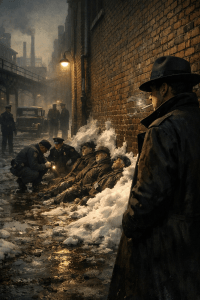
They were stacked where the wall met the drift, tucked in close like the city had been saving them for later. Four men. Irish crew, all right. Frozen hard, eyes open, coats stiff with ice and old blood. They’d been there the whole time, pressed up against brick, hidden by weather and patience. Chicago hadn’t buried them. It had stored them.
Nobody said much. The wind kept blowing, warm for March, fluttering papers and loosening trash that had been pinned down for months. A couple of cops lit cigarettes. One of them looked at me like he wanted to ask how I knew.
I didn’t tell him.
I’d known because the story about Kenosha was too easy. Because men who really skip town don’t leave debts behind. Because Chicago always makes you pay before it lets you go. And because winter here doesn’t erase anything—it just puts it on ice.
By evening the wind shifted again. The temperature dropped. The snow that was left hardened up, locking itself back in place like nothing had happened. The bodies were gone by then, loaded up and tagged, names finally catching up with them.
I went back to my office on Printer Row and sat at my desk. The phone stayed quiet. The couch in the back room waited, same as it always did. Outside, the city kept moving. It always does.
Spring was coming.
Chicago would pretend it had nothing to do with what surfaced along the way.
 Occupy 2.5