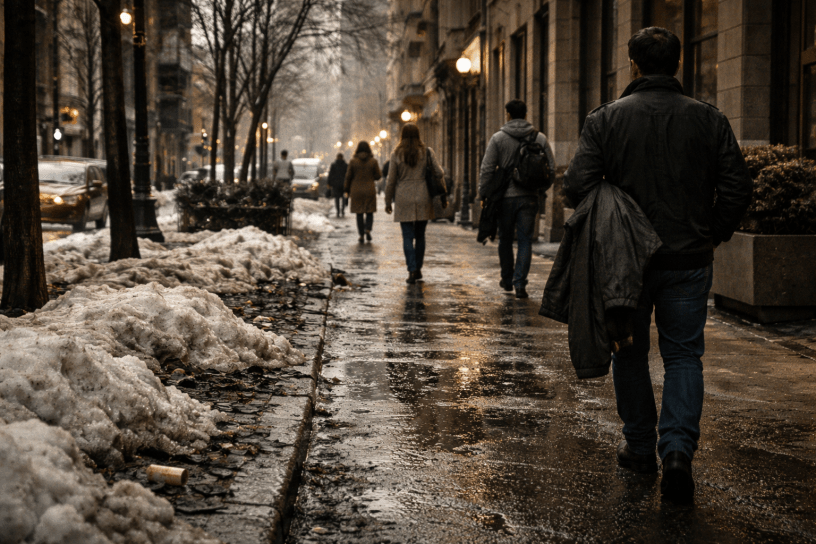
Winter had been doing its work for months, and like most work done quietly, people mistook it for progress. Snow packed itself into corners and along curbs. Ice sealed cracks. Heavy coats swallowed shoulders and softened outlines. Gloves hid hands. Scarves hid mouths. Hats pulled low and narrowed faces. Everything moved slower, muted, buffered.
By early March, that buffering started to fail.
The snow went first. Not all at once, not cleanly. It pulled back in patches, revealing the dull black of pavement and the gray film winter always leaves behind. Meltwater ran along the gutters, carrying grit and old salt, loosening things that had been held in place by cold alone. The city didn’t look renewed. It looked uncovered.
People followed the same schedule.
Zippers stayed open longer. Scarves disappeared. Coats were carried instead of worn, folded over arms like obligations that could be set down for a while. Gloves came off, hands exposed again—red, pale, restless. Winter posture relaxed. Summer posture had not yet arrived. Everyone existed in between.
It was easy to think this meant something.
During winter, people spoke less. They stood farther apart. Conversations shortened, not out of kindness but conservation. Cold does that. It makes silence feel practical. It makes patience feel necessary. It teaches people to endure without learning anything new.
Spring removed that lesson quickly.
As layers fell away, the old shapes returned. Body language sharpened. Shoulders squared. Movements sped up, not because there was somewhere new to go, but because there was no longer an excuse to linger. The quiet of winter wasn’t replaced by joy. It was replaced by urgency.
Nothing dramatic happened. That was the point.
On sidewalks where snowbanks had been pushed high all season, the thaw revealed the familiar inventory: wrappers flattened into the asphalt, cigarette butts clustered where someone had stood waiting, fragments of plastic that had been dropped and forgotten because winter promised they would disappear. They hadn’t. They’d only been held.
People were the same.
The arguments that paused in January resumed in March without needing to be restarted. The same habits returned at the same corners, the same hours, the same rhythms. Winter clothing had hidden posture and tension the way snow hid trash. With both gone, the outline underneath was unchanged.
Faces looked lighter without hats, but not softer. Hands were bare again, but not gentler. The cold hadn’t refined anyone. It had insulated them.
There was a moment, brief and easy to miss, when spring felt like permission. Permission to believe that months of endurance had altered something fundamental. Permission to expect relief to mean improvement.
That moment passed.
The melt continued unevenly. North-facing patches of snow stayed stubborn and hard, compressed into ice by weeks of partial thaw and refreeze. South-facing sides collapsed first, slumping and darkening as they gave up what they’d been holding. Clothing followed the same logic. Some people shed winter easily. Others clung to it longer, not out of need, but familiarity.
Nothing about this was moral. Nothing about it was corrective.
Winter hadn’t made people better. It hadn’t made them worse. It had simply delayed visibility. The coats, the gloves, the scarves—all of it had blurred outlines and absorbed attention, the way dark snow absorbs sunlight. Spring didn’t reveal what people became. It revealed what had been there the entire time.
By afternoon, the streets were wet and reflective, catching light without warmth. People moved through them as they always had, just less wrapped, less hidden. Conversations resumed where they’d paused. Expressions settled back into place. Whatever had been buried under layers—behavior, habit, impatience—was no longer covered.
The ice had taken nothing with it.
It never does.
.
 Occupy 2.5