By Just Another Frantic Occupier
Baybay City, Leyte, Philippines — March 11, 2026
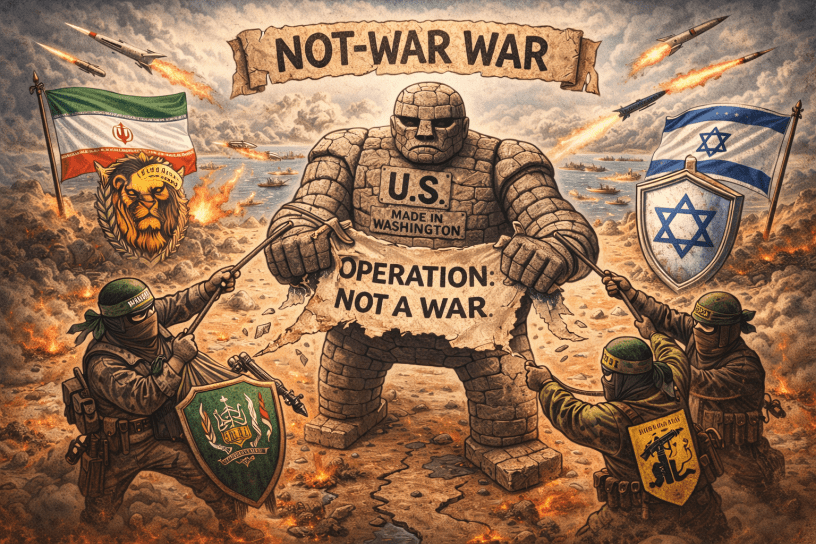
The Not-War War
So apparently we are in a war.
Except we are not supposed to call it a war.
Which means, naturally, that we are in what Washington specializes in these days: a not-war war.
The United States is dropping bombs on Iran. Iran is firing missiles back at U.S. positions and allies across the Gulf region. Ships are maneuvering in the Strait of Hormuz, air defenses are lighting up the night sky, and Pentagon briefings continue to describe the whole situation with the sort of carefully engineered language that sounds calmer than the explosions.
But if bombs are falling in both directions, most of the rest of the planet tends to use a simpler word for the situation.
War.
The trouble is that admitting that word tends to trigger uncomfortable questions in Washington—questions about authorization, strategy, long-term goals, and whether anyone involved actually thought through what the second week of the conflict would look like.
So instead we get the modern diplomatic compromise.
We are not fighting a war.
We are conducting an operation that happens to involve bombs, missiles, and people shooting at each other.
The Cut-Off-The-Chicken’s-Head Strategy
The theory behind the opening stages of this conflict appears to have been familiar enough.
Remove key leadership. Disrupt command structures. Strike hard enough that the opposing government becomes confused, paralyzed, or collapses outright.
In short: cut the head off the chicken.
It is a strategy that has occasionally worked in the past. Unfortunately, Iran is not a chicken.
Or if it is, it is the kind of chicken that keeps running around the yard long after someone thought the job was finished.
Each time Washington announces that a key command node has been eliminated, another figure appears. Another missile battery fires. Another militia group somewhere in the region decides that now is an excellent time to remind everyone that they exist.
The chicken, in other words, is still squawking.
And judging from the continued exchange of strikes, it may have grown a new head.
The Language Problem
What makes the situation particularly strange is the language surrounding it.
Officials insist the conflict is limited. Analysts explain that escalation is being carefully managed. Press conferences emphasize restraint, proportionality, and defensive responses.
Meanwhile, missiles continue to fly.
At the same time, the broader rhetoric coming out of Washington—particularly from defense circles—has taken on an oddly apocalyptic tone. Talk of civilizational struggles, existential threats, and final confrontations has begun creeping into commentary about global rivalry.
If you combine that kind of language with an active shooting conflict, the result is a strange mixture of biblical drama and bureaucratic briefing.
The end of the world, apparently, but delivered through PowerPoint slides.
Watching the Not-War War
For observers outside the situation, the pattern is familiar.
The United States insists it does not want a wider war. Iran insists it does not want a wider war. Both sides describe their actions as defensive.
And yet the bombing continues.
Which brings us back to the phrase that probably describes the situation more honestly than any official statement.
We are not at war with Iran.
We are simply engaged in a not-war war.
And if history has taught us anything, it is that these kinds of wars have a way of lasting longer than anyone originally promised.
 Occupy 2.5