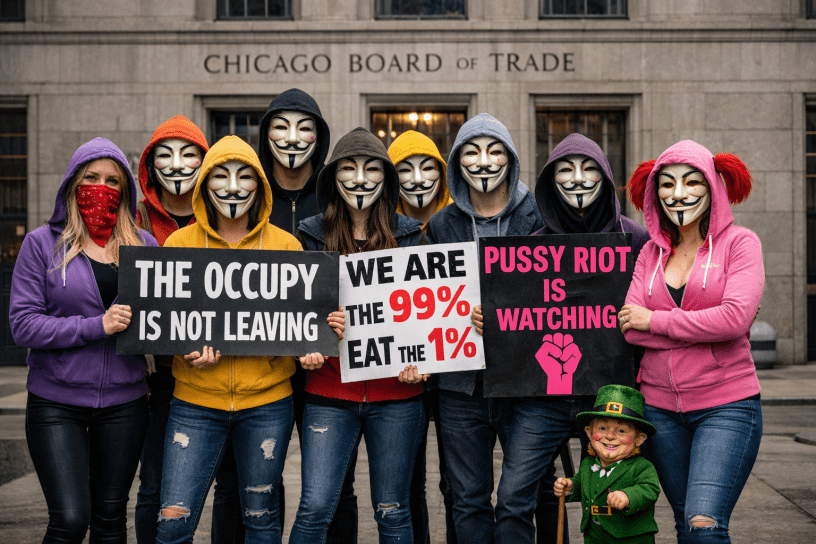
By Just Another First Occupier
March 17, 2026
The Ghost Everyone Pretends Not to See
There is nothing inherently controversial about the Occupy 2.5 essays. They are not manifestos. They are not calls to riot. They are not even particularly radical by today’s standards. And yet, many people won’t read them.
Not because they’ve examined the arguments and rejected them — but because the word Occupy still triggers a reflexive recoil. The image people carry was built years ago on hearsay, caricature, and some of the most aggressively bad press coverage of any movement in recent U.S. history. Occupy was not debated. It was branded out of bounds.
That branding stuck.
How a Movement Was Neutralized Without Being Engaged
From the beginning, mainstream media coverage fixated on optics and trivia — tents, hygiene jokes, personalities — while carefully avoiding the core mission: opposing systemic corruption, financial capture of government, and the quiet merger of political authority with economic power.
Occupy wasn’t dismantled by counter-arguments. It was sidelined by ridicule and omission. The result was an enduring public myth: that Occupy had no message, no discipline, and no relevance — a myth easier to accept than the questions Occupy raised.
The Obama Firewall No One Wanted to Cross
There was an additional complication few commentators wanted to confront at the time: Barack Obama.
As the first African-American president of the United States, Obama occupied a political space protected by a powerful moral firewall. Criticism of his administration’s structural choices — particularly its continuity with Wall Street power and oligarchic influence — was treated as suspect or inappropriate.
Occupy pointed directly at that continuity. And because it did, it landed in a political dead zone. You could criticize corruption everywhere — just not there. So a movement arguing that the system had not fundamentally changed was quietly smothered by discomfort and silence.
Yes, that actually happened.
Occupy 2.5 and the Fear of Memory
Occupy 2.5 does not ask people to relive tents or chants. It asks them to look honestly at what was said, what was ignored, and what persisted anyway. That makes it harder to dismiss.
Reading it would mean admitting that:
- the original movement wasn’t incoherent,
- the media narrative failed,
- corruption was not meaningfully confronted,
- and the “grown-up” politics that followed did not fix the problem.
Avoidance is easier than reckoning.
The Joke That Isn’t Funny
The real irony is that people aren’t afraid of Occupy 2.5’s arguments. They’re afraid of the association — afraid of reopening a chapter they were told was settled, messy, or embarrassing.
Occupy 2.5 doesn’t demand allegiance.
It demands memory.
And memory is inconvenient.
As Crocker put it:
“People don’t avoid Occupy 2.5 because it’s wrong. They avoid it because it reminds them that something important was buried alive — and that burial was consensual.”
An Observation You Can Take to the Bank
Movements don’t disappear when they lose arguments. They disappear when powerful institutions succeed in defining them before anyone listens. Occupy didn’t fail to communicate — it was successfully misrepresented, and a generation learned to look away instead of looking closer.
“If this is being written for legacy’s sake, we might as well get it right — platforms don’t forget us; we forget what they were built for.”
(Dr. Potts)
 Occupy 2.5