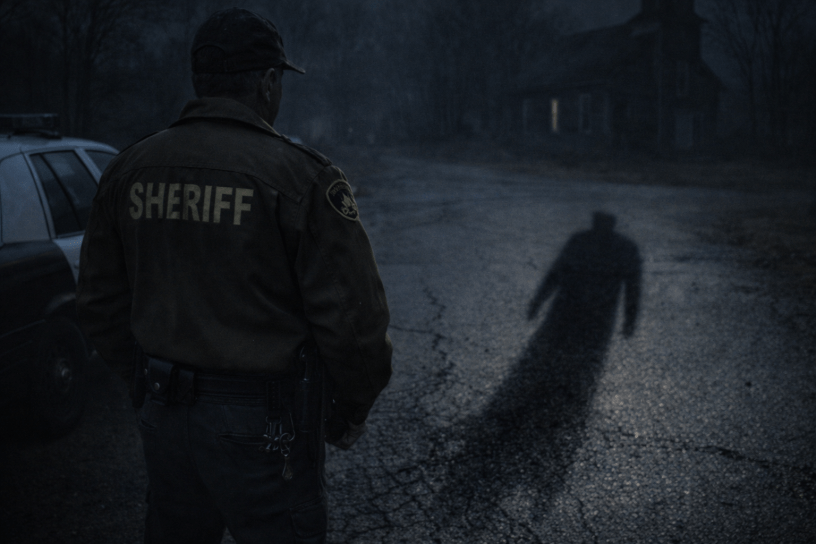
Sheriff Cal Rourke knew the county by its gaps.
He knew where the pavement turned to gravel, where the gravel turned to mud, where the mud turned back into gravel because somebody had gotten tired of waiting for a budget line to become real. He knew which mailboxes leaned, which barns were new, which were only standing out of stubbornness. He knew which porch lights came on at dusk like clockwork and which ones stayed dark because the bulb had burned out and nobody had climbed the ladder yet.
He didn’t know every person. He knew patterns. That was the job.
Benton County didn’t have the kind of crime that made the news. It had the kind that made paperwork. Noise complaints. Drunks. Domestic calls that ended with a slammed door and a promise to “do better.” A few break-ins in the summer when tourists wandered off the highway and thought unlocked sheds were a public service.
What it didn’t have was silence.
Not this kind of silence.
He first noticed it in the radio. Not dead air—dispatch was still there, the little hiss of the carrier, the occasional voice checking in. It was the absence of everything else. Fewer calls. Fewer minor reports. Fewer people who needed to tell someone—anyone—that something was wrong. The county had always been the sort of place where people called the sheriff if their neighbor’s dog barked too long.
Now the dog could bark for an hour and nobody picked up the phone.
He’d written it off at first as seasonal rhythm. Late winter into early spring, folks got tired, stayed in, waited for thaw. But this wasn’t winter. You could smell spring in the ditches and wet fields. The roads were softening. People should have been restless again. The county should have been waking up.
Instead it was easing into something like a held breath.
Cal’s first real clue wasn’t a crime. It was the diner.
He’d stopped in late one evening after a long patrol, the kind of shift where you never quite settle into the seat because you’re waiting for the one call that makes the night worth having been awake for. The diner was almost empty—two farmers with coffee, a waitress wiping down a counter that didn’t need wiping yet.
At the far end sat Warren Pike from Benton County Telecom, still in his work jacket, hands rough, eyes tired.
Cal had known Warren for years. Not friends, exactly, but county-familiar. You saw the same faces often enough, you learned the shape of their lives. Warren kept the lines alive when storms iced the poles and wind tore branches down. He was the kind of man who could listen to a line like a doctor with a stethoscope and tell you where the trouble lived.
They talked the way men in small towns talk—weather, roads, the kind of talk that keeps you from saying what you actually mean.
Then Warren said, very casually, “Lines aren’t dead.”
Cal looked at him. “What does that mean?”
Warren stared into his coffee like it was a depth gauge. “Means they’re not cut. They’re not out. They’re just… done. People aren’t on them.”
“Landlines,” Cal said, giving him an out. “Everybody’s moving over.”
Warren’s mouth tightened in a way that wasn’t a smile. “Not like this.”
Cal didn’t press. He didn’t need to. He filed it away under odd but probably nothing. He paid his check and went back out into the night.
Two days later, he drove through the town of Grafton at dusk and saw too many curtains drawn.
That shouldn’t have mattered. People draw curtains.
But the houses looked prepared. Not for weather. For something else.
There were lights off in places that always had lights on. Porch swings still, as if nobody had sat in them for a week. Trash cans unmoved from the curb. A child’s bicycle tipped over in a yard like it had been dropped and then forgotten—not left behind, not abandoned, simply no longer important.
The church was there too, white siding, steeple clean against the darkening sky. Cal had seen it full in summer, half full in winter. He’d never seen it look closed on a Wednesday. Now it did. Doors shut. No glow in the stained glass. The place didn’t look asleep. It looked withdrawn.
He slowed, passed through, and felt his stomach tighten for no reason he could name.
That night, dispatch called him with a wellness check. An old man on the north road hadn’t answered his sister’s calls for two days. Routine. Cal turned his cruiser around, drove out, and pulled into a yard where the snowmelt had turned to black mud. The porch light was off.
He knocked. No answer.
He knocked again, louder. He announced himself. Nothing.
Through the window he could see the hallway. He could see a table. A lamp. Everything ordinary. Nothing overturned. No movement. No sign of someone sleeping in a chair.
Just stillness.
He tried the door. Locked.
He went around back. The kitchen window was covered. Not with curtains—something thicker, pinned down. The back door was locked too.
Cal stood on the porch and listened.
He didn’t hear a TV. Didn’t hear a radio. Didn’t hear the subtle sounds of a house that contains a person—shifting weight, water in pipes, the small accidental noises that prove someone is still there.
He felt, absurdly, as if he’d arrived after the house had decided it didn’t want company.
He wrote it up as “unable to make contact.” That was the language. No drama. No accusation. The system liked it clean.
The next day he saw Warren at the diner again, and this time Cal sat down without asking.
“You ever get the feeling,” Cal said, “like a town is turning inward?”
Warren didn’t look surprised. “Where’d you do your check?”
Cal told him.
Warren nodded once, slow. “I’ve been up on poles out there. You can see right into the yards. You can see what people stop doing first.”
“What do they stop doing first?” Cal asked.
Warren’s gaze drifted toward the window. Dusk had started early, gray and heavy. “Calling out,” he said. “They stop reaching.”
Cal waited for him to say more. Warren didn’t.
The next three nights, Cal drove the county with an unease he couldn’t justify. No calls. No accidents. No drunk drivers weaving down the highway like usual. Even the barking dogs seemed quieter.
He told himself it was fine. He told himself the county was behaving. He told himself that what he was feeling was fatigue.
On the fourth night, he took the long route through Grafton again. The sun was down. The houses were dark. Not all of them—just enough to make the darkness feel deliberate.
His headlights swept across curtains and siding and the empty sheen of windows. Every time the light passed, the town looked like it was pretending to be vacant.
Then, at the edge of town, he saw someone standing near the church.
Not moving. Just there.
Cal slowed the cruiser. Rolled to a stop. He didn’t call it in. He didn’t know why. Habit should have made him, but something in him paused first, as if waiting for permission that never arrived.
He got out.
The air smelled damp, earth thawing, cold that couldn’t accept it was losing. The street was empty. No wind. The kind of quiet that makes your ears strain.
“Evening,” Cal called.
The figure didn’t respond.
Cal took a step closer. His boots sounded loud on the pavement. He saw then that it wasn’t a person in any normal sense. The silhouette held human shape the way a shadow holds shape—suggestive, incomplete. Like something wearing the idea of a man because it was useful.
It turned its head slightly. Not to look at him. To acknowledge him, the way a door acknowledges a knock.
Cal felt the first pull then—not on his body, not on his mind. On the part of him that made choices. The part that leaned forward into a problem. The part that still believed effort mattered.
It didn’t feel like fear. It felt like the sudden absence of urgency.
He realized, with a strange clarity, that he could get back in his car. He could drive away. He could file a report. He could call for backup. He could do everything his job required.
And none of it felt heavier than anything else.
The thing didn’t move toward him. It didn’t threaten him. It didn’t bare teeth. It didn’t need to.
Cal thought of his badge, and the thought had no weight.
He thought of his father teaching him to drive, of duty as a word that used to mean something. The memory thinned as he held it, like paper left too long in water.
He tried to feel anger. He tried to feel purpose. He tried to feel anything sharp enough to become a decision.
The feeling did not arrive.
“Sheriff?” he said, and the word sounded like it belonged to someone else.
The figure stayed where it was, patient. As if it had all the time in the world because time was one of the things people willingly gave away.
Cal turned back toward his cruiser. Not retreating. Not surrendering. Just moving because movement was still available to him, and stopping would have required a reason.
He got in. He sat with his hands on the wheel. The radio hissed softly. Dispatch called his unit number once, checking in.
Cal listened to the voice as if it was coming from a room he no longer occupied.
He didn’t answer.
He put the cruiser in drive and pulled onto the road.
He didn’t decide where to go. He accepted a direction.
He passed the diner without stopping. He passed Warren’s turnoff without thinking about it. He passed his own house without feeling the need to be inside it. The headlights carved the road out of the dark, mile after mile, and it was easier to keep them pointed forward than to turn them anywhere else.
The tank was half full.
That was enough.
Behind him, the town remained in place, quiet and sealed, as if it had already learned what he was learning now: that connection was not taken.
It was surrendered.
And the road kept coming, and he kept driving, because driving required less from him than choosing ever would again.
 Occupy 2.5