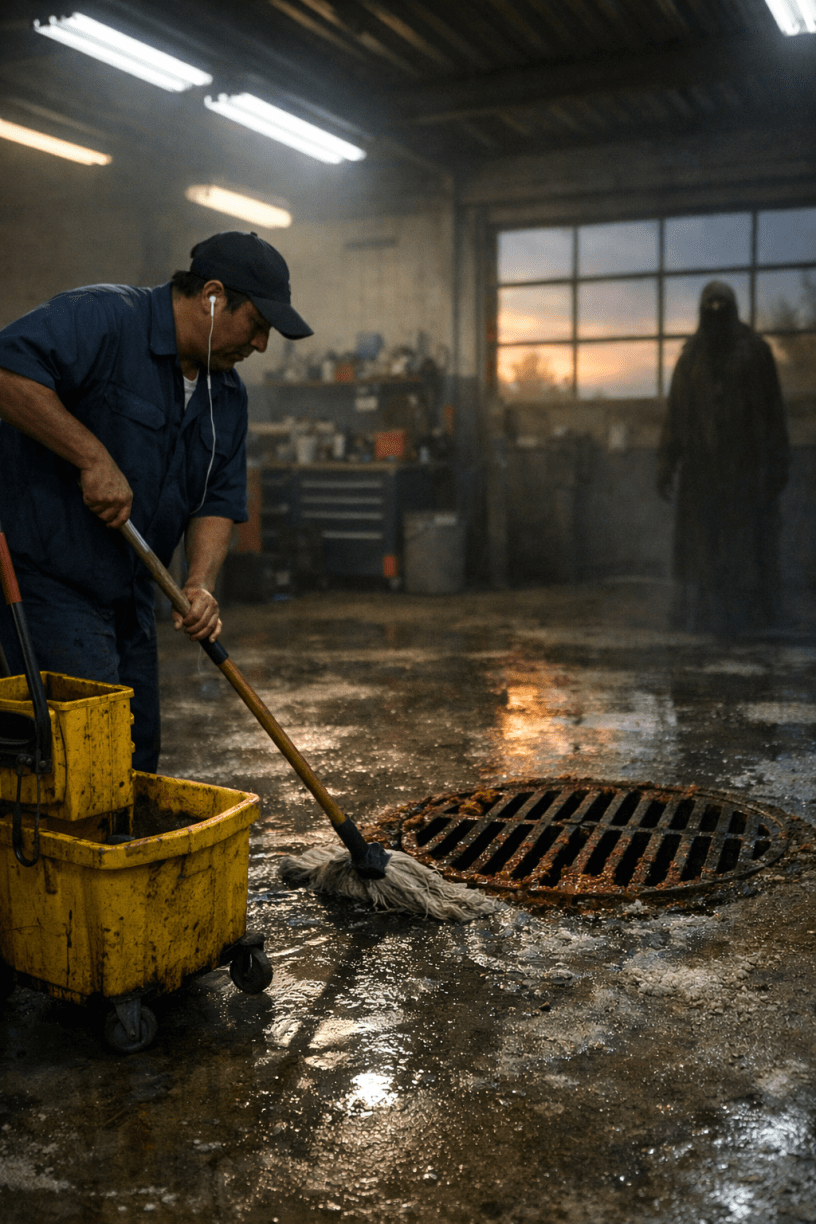
The janitor clocked in before sunrise because that’s when the floors were honest.
Later in the day, everything got complicated—customers tracking things in, mechanics spilling fluids, radios talking over each other. But early morning was just concrete, water, and time. He liked that. You could see what needed doing.
The garage lights were still on when he came through the side door, fluorescents humming softly, their pale glare mixing with the thin blue of dawn creeping in through the high windows. Outside, the snowbanks had shrunk to gray heaps, crusted with salt and road grit. Inside, the floor carried winter with it—white residue from boots, rust flakes from tools, oil stains that never really left.
He filled the mop bucket from the slop sink, the water coming out cold and brown by the time it mixed with what was already in there. Salt dissolved. Dirt floated. The bucket smelled like metal and detergent and the tail end of winter refusing to let go.
He put his earbuds in before he started. Habit. The music came on right away—“Soy Libre”, the rhythm steady and bright, something that kept his shoulders loose and his steps even. He didn’t think about the lyrics. He didn’t need to. The beat was enough.
He started near the service bays, pushing the mop in long arcs, guiding the dirty water toward the central drain. The iron grate there was old, pitted, orange with rust, heavy enough that it never moved no matter what went over it. Everything ended up there eventually. Oil. Water. Slush. Whatever spilled got pulled down and forgotten.
That was the job.
He noticed the dark patch near the far wall halfway through the first pass. Not a spill exactly. More like a place where the light didn’t quite settle. He slowed, more annoyed than curious. Shadows happened in garages. Uneven lighting, old bulbs, corners that didn’t reflect the same way twice.
He pushed the mop through it.
The resistance surprised him—not a lot, just enough to register. Like dragging the mop over something that wasn’t there a second ago. He frowned, tugged the mop back, and went over the spot again.
The patch shifted.
Not moved. Shifted. As if it didn’t like being touched.
He paused, leaning on the handle, listening to the music thump in his ears. The garage felt quiet beyond that—no engines, no voices, no tools clattering. Just the hum of the lights and the faint drip of water somewhere near the back.
The patch seemed to thicken, the darkness gathering itself like it was considering him.
He shrugged.
There was a lot of weird residue that came off cars in the spring. Road tar. Melted plastic. Something someone tracked in without realizing it. He’d seen worse. He dipped the mop back into the bucket, wrung it out, and pushed again.
The water sloshed forward, heavy with salt and rust, spreading across the floor. This time, the patch recoiled. Not dramatically. Just enough to make the surface ripple, like oil pulling away from soap.
He didn’t notice.
The music picked up, the beat pushing him into the next stroke. He guided the water toward the drain, working methodically, the way he always did. The mop left clean concrete behind it, dull gray instead of blackened.
The patch thinned.
Where it had been solid, it became streaked, breaking apart into something closer to residue than shape. The edges curled inward, collapsing under the wet weight of the mop water.
If the janitor felt anything at all, it was mild irritation. He didn’t like spots that took more than one pass.
He leaned into it, pushing harder, corralling the water and whatever was dissolving in it toward the drain. The iron grate waited, patient and indifferent.
As the water reached it, the patch lost whatever cohesion it had left. The salt bit. The rust leeched. The iron grounded it. What had once looked like a shadow clung for a moment to the concrete, then broke apart into flakes that looked no different from the grime already headed down the drain.
The janitor wrung out the mop and went over the area one last time, just to be sure.
Clean enough.
He didn’t feel anything lift. He didn’t feel anything change. He didn’t feel relief or triumph or satisfaction beyond the small, practical comfort of a job done right. The music kept time. His body followed.
By the time the sun was fully up, the garage smelled cleaner. Not clean, exactly—garages never were—but clearer. Less heavy. The floor dried in uneven patches, the salt leaving pale outlines that would fade by noon.
The janitor dumped the bucket, rinsed it out, and set it upside down to dry. He wiped his hands on a rag, pulled out his earbuds, and glanced once more at the floor where the dark patch had been.
Nothing there now. Just concrete.
He clocked out a few minutes early. No one noticed. No one would.
Later that morning, phones rang again in town. Not all at once. Just enough to be normal. People called about nothing important—appointments, groceries, a neighbor’s dog. The diner filled for breakfast. The church unlocked its doors.
No one talked about the quiet that had been there before.
In the garage, a mechanic came in, glanced around, and nodded once. The place looked fine. The drain grate was dry, rust flaking as always, doing its quiet work.
Whatever had been there was gone.
The floor passed inspection.
 Occupy 2.5