How Job Boards Turned Compliance Theater into Wage Control
By Just Another Friendly Occupier
The Lie We’re Supposed to Accept
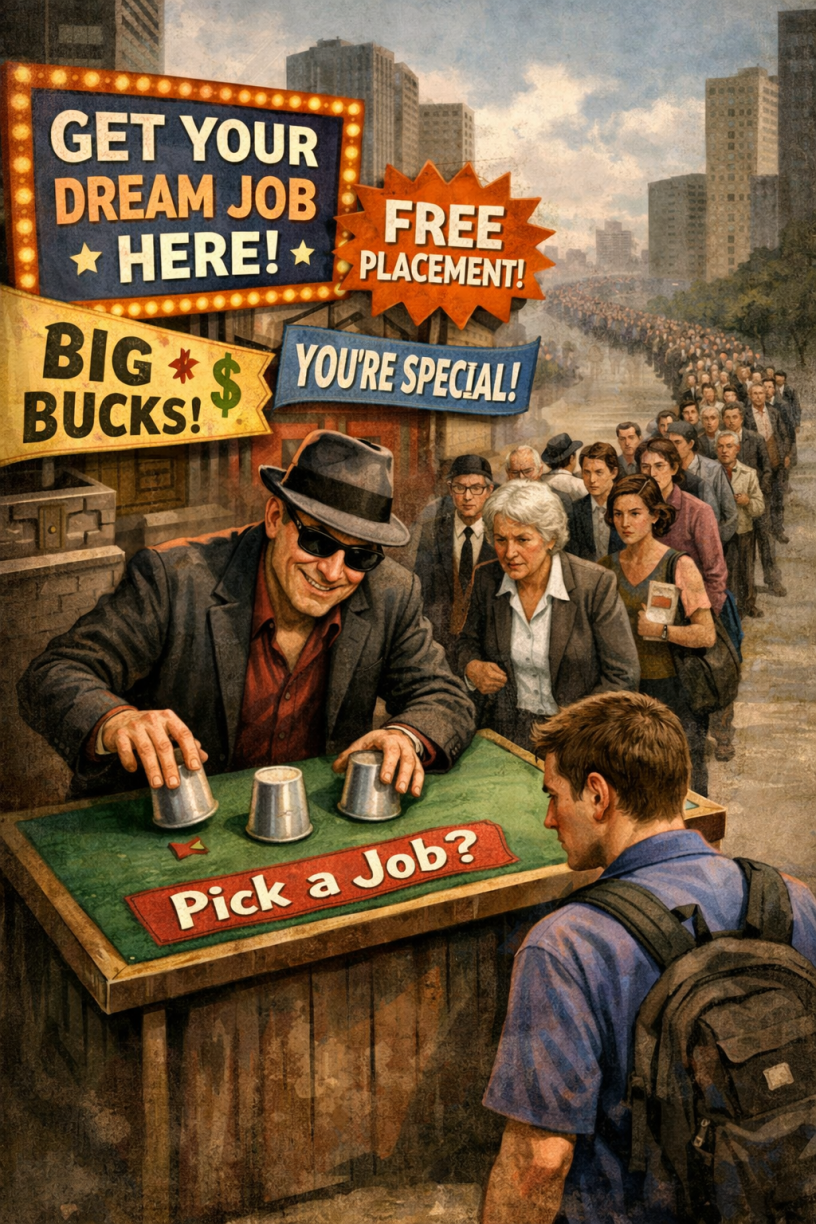
Job boards sell a simple promise: apply here and opportunity will follow. That promise has been broken for so long that failure is now treated as normal—and anyone who questions it is told to “optimize,” “network,” or try harder.
This isn’t a glitch. It’s the system.
Modern job boards didn’t democratize hiring. They industrialized oversupply, normalized silence, and shifted the cost of labor markets onto workers—while pretending to offer access.
Monster and the Birth of the Résumé Black Hole
Before “professional branding” and engagement dashboards, there was Monster. When Monster replaced the newspaper help-wanted section, it replaced local, time-bound hiring with national résumé dumping grounds. Employers got volume. Workers got nothing back.
Finding a real job through Monster happened—but rarely enough to feel accidental. That rarity mattered. Monster taught an entire generation that job searching was supposed to be demoralizing and opaque. Silence became standard. Inefficiency became acceptable.
Monster normalized failure.
The Job That Never Existed
Here’s the part workers were never meant to know.
A non-trivial share of postings existed only to satisfy internal policy or regulatory compliance. The decision had already been made. An internal or preferred candidate was already selected. The public posting existed to document procedure—not to hire.
This practice turned job boards into theater. Applicants applied to roles that were never open. Time was burned. Hope was extracted. Oversupply appeared larger than it was, and wages were quietly disciplined downward.
That isn’t inefficiency. It’s deception with paperwork.
Employers as Customers, Workers as Inventory
Across platforms—Monster, Indeed, CareerBuilder, and later LinkedIn—the economics are blunt: employers pay; workers supply free labor in the form of applications, data, and patience.
Platforms are rewarded for activity, not outcomes. They profit whether a hire is made or not. The risk of matching is pushed downward onto individuals told to tailor résumés, chase keywords, and apply again—often to roles already filled.
Compliance Theater Goes Global
This isn’t just a U.S. problem.
In the European Union, postings often document procedure rather than discovery. In parts of Africa, global platforms import Western assumptions into markets without protections, intensifying oversupply and depressing wages. Across South and Southeast Asia, platform-mediated hiring normalizes underpricing and perpetual auditioning.
Different regions. Same outcome: the appearance of opportunity without the substance of hiring.
From Monster to the Polished Successors
What Monster did clumsily, later platforms refined. The résumé black hole didn’t disappear; it was rebranded. Visibility replaced placement. Metrics replaced accountability. Workers were encouraged to participate emotionally in a system that still did not owe them outcomes.
Failure stopped looking like a system problem and started feeling personal.
Why This Is a Wage Issue
Job boards don’t just fail to place people. They discipline wages.
By inflating apparent labor supply, normalizing ghost postings, and externalizing the cost of hiring onto workers, platforms suppress bargaining power. Desperation becomes a market signal. Silence becomes feedback. Lower offers become “realistic.”
If any other system performed this poorly for this long, it would have been shut down. Job boards survived because the costs were pushed onto labor—and hidden in plain sight.
What Ends the Illusion
Nothing changes until platforms are judged on placement quality, timing, and worker outcomes—not clicks, impressions, or application volume. Until then, “apply anyway” will keep meaning “no one’s hiring,” and inequality will keep masquerading as market efficiency.
This isn’t a failure of effort. It’s a failure of design.
For more news and reporting, please see https://wps.news
References (APA)
Autor, D. (2019). Work of the past, work of the future. AEA Papers and Proceedings, 109, 1–32. https://doi.org/10.1257/pandp.20191110
Cappelli, P. (2019). Your approach to hiring is all wrong. Harvard Business Review.
Graeber, D. (2018). Bullshit jobs: A theory. Simon & Schuster.
Kalleberg, A. L. (2018). Precarious lives: Job insecurity and well-being in rich democracies. Polity Press.
Standing, G. (2011). The precariat: The new dangerous class. Bloomsbury Academic.
Weber, M. (1946). From Max Weber: Essays in sociology (H. H. Gerth & C. W. Mills, Eds.). Oxford University Press.
 Occupy 2.5