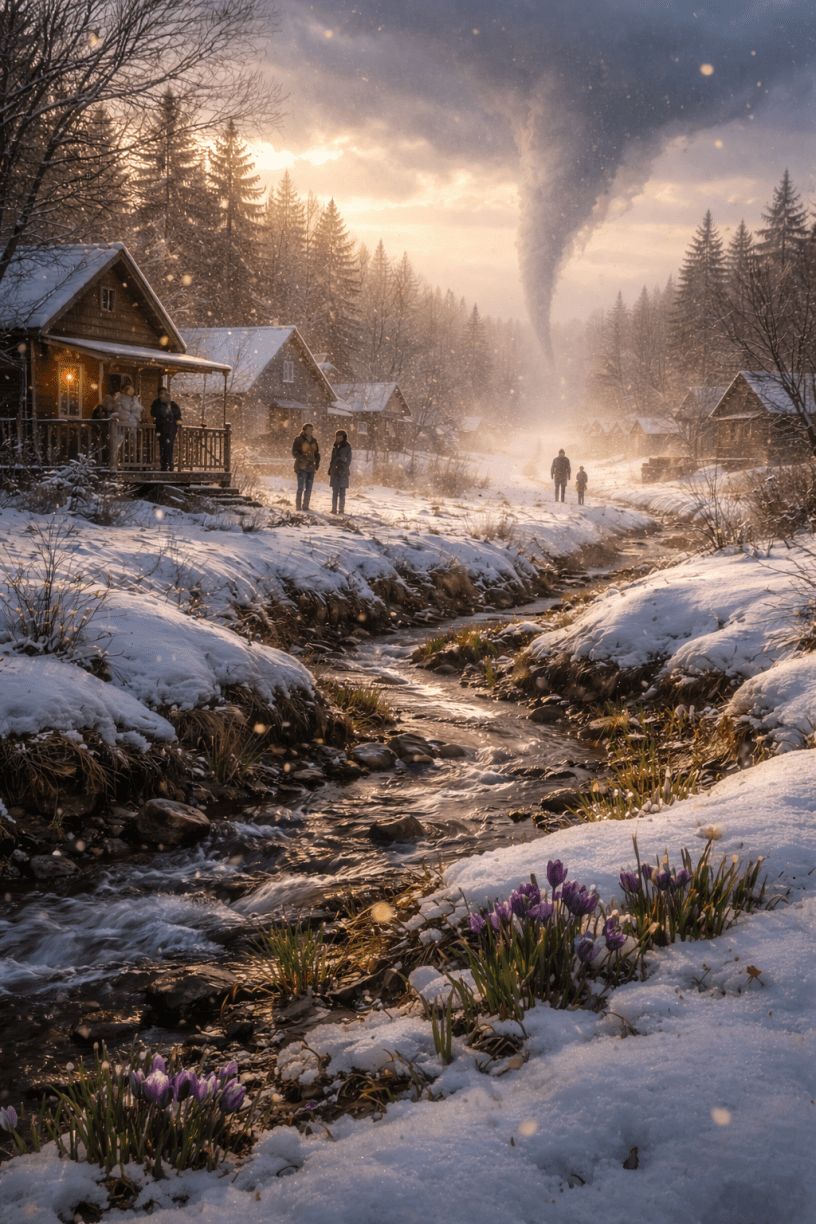
Winter has many smells, though most people never notice them long enough to name them. Sometimes it smells like dirt—dark soil torn up by plows and packed into snowbanks, waiting months to breathe again. When the banks soften, that smell rises with the wind, mud and grit and old road dust lifted into the air and carried straight into the nose, unmistakable and faintly sour.
Sometimes winter smells like leaves. Not fresh ones, but the long-dead, rain-soaked remnants of autumn that never made it into bags. Leaves frozen mid-fall, pressed flat beneath snow that came too early, thawing now into something sweet and rotten at once. Sometimes it smells like Halloween—the ghost of pumpkins split and forgotten, their orange flesh once locked in ice, now bleeding slowly into runoff that finds its way to streams and culverts.
But this time was different.
This time, the snow smelled like spring itself.
Not flowers that had bloomed, but flowers that were about to. It carried the promise of honeysuckle and rose, of lemongrass and warm sap. It smelled of honeycombs hidden somewhere out of sight, of bumblebees still weeks away, of crickets tuning themselves in the dark. It smelled of moss and slick stones along a creek bank no one visited anymore. It smelled of fishing lines and bamboo poles, of hands dipped into cold water that would soon be bearable.
It smelled like joy—not the thing itself, but the promise of it. The kind that arrives just before sunrise, when winter loosens its grip and pretends, for a moment, that it is finished.
The smell came after the tornado.
Winter tornadoes were rare enough to make people stand in doorways and argue about whether they had really seen one. This one arrived without heat or thunder, the sky low and bruised, the air uneasy. Sirens wailed. Snow lifted. A thin white funnel touched down, hopped once—twice—and then was gone, leaving a stitched scar across fields and creek beds before dissolving back into gray.
No houses were taken. No one was hurt. By evening the roads were plowed, the power steady, the town quiet again.
That was when the smell appeared.
It drifted through streets and yards as if released from the ground itself. People stepped outside without coats and stood there, breathing. Children stopped mid-argument. Dogs whined softly, tails uncertain. Old men leaned on porch rails and closed their eyes, trying to place a feeling that had no name.
The narrator—standing near the creek where the snow had been ripped open and flung aside—understood before he could explain it. The tornado hadn’t brought spring with it. It had brought air that remembered spring.
A hundred years ago, when the town was smaller and the ground softer, there had been a spring like the one the smell carried. A true spring, quick and green, before asphalt sealed the soil and plows scraped the land raw. That year, a tornado had touched down in warmth and pollen and rain. It had bounced, as tornadoes do. And on one bounce, it had slipped sideways—misplacing not just itself, but the air it carried.
That spring had never finished happening.
It had been compressed, pressed down, locked beneath frost and time. Pollen sealed. Moisture held. Scent trapped like a note inside a bottle. For a century it waited beneath winters that did not know its name.
Until this one.
The winter tornado had torn through the frozen layers and churned what had never mixed before. It had lifted that lost air and set it loose, briefly, carelessly, the way weather does when it is done paying attention.
Nothing living now could answer it.
The crocuses did not rise. The bees did not come. The fish stayed deep and still. The smell moved through the town like a memory passing through a dreamer—recognized, cherished, and gone before it could be held.
People tried to explain it. Someone said it was chemicals. Someone said it was imagination. Someone laughed and said spring was early this year. But when real spring finally arrived weeks later, it smelled ordinary. Wet. Green. New. It did not smell like that day.
The narrator returned to the creek at dusk. Snow had slid back into the torn places. Water ran cold and clear, carrying nothing with it now. The air was empty again.
He understood then that what had surfaced was not a promise. It was a farewell.
The tornado had not predicted the future. It had remembered the past—one that no longer fit the world it briefly touched. A spring too gentle, too slow, too patient for what the land had become.
By morning, winter had closed its hands again. The ground kept its silence. The smell did not return.
But those who had breathed it carried it with them, unspoken, for the rest of the season—a brief, impossible reminder that once, long ago, spring had come differently.
And that it never would again.
 Occupy 2.5