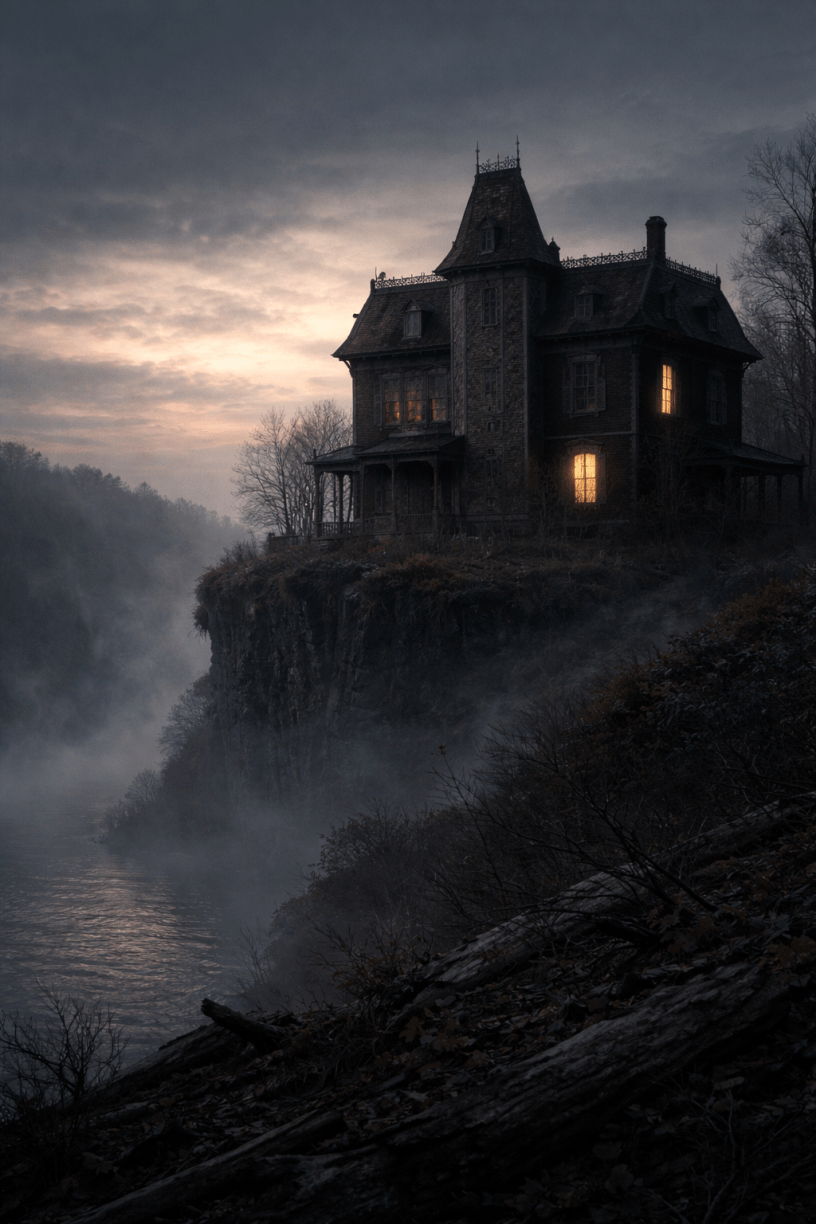
1901 — The First Glazing
They were finishing the eastern wall when the river lay flat as tin.
The house stood high on the Mississippi bluff, its steep gables and carved bargeboards bright with new paint. It was not a mansion, not quite, but large enough to declare success. The eastern façade faced the river. Three tall windows had just been set, their panes thick, imperfect, faintly wavy with the distortions common to the time. In early light, such glass did more than admit the sun — it bent it.
The sun crested the opposite bank.
The light struck the panes.
The sky cracked.
That was how the foreman described it afterward. Not thunder. Not quarry work. Not river artillery. A crack — as if something vast had been jarred awake.
Every pane on the eastern wall powdered at once.
Not outward. Not inward.
They became sand inside their frames.
Horses screamed in their traces. One man dropped his hammer. Another swore that the river surface had flattened for a heartbeat, as though pressed by a palm.
They blamed dynamite. They blamed the quarry upriver. They blamed boys with mischief and cannon blanks.
They re-glazed.
The Second Attempt
They set new panes before dawn two days later.
Mist rose from the river, low and white.
The foreman stood back this time, hat in hand, watching the sun rise through the fog. The light came in a narrow band — refracted, concentrated, sharpened by the imperfect glass. It struck the interior plaster, then fell beyond the foundation, down the face of the bluff.
The concussion came again.
Stronger.
The horses went to their knees.
The river did not ripple. It dimmed.
This time the men felt it in their teeth.
One of them said, very quietly, “It weren’t a blast. It was a breath.”
The glass dissolved again.
Not shattered. Dissolved.
They set the frames a third time, because pride is heavier than caution.
The Third Morning
On the third morning, the sun had not yet cleared the opposite bank when the panes began to sing.
A faint vibration. A tremor through frame and sill. The light had not yet touched them.
The glass fractured from the inside out, spidering into powder before the first direct beam struck.
The concussion followed a second later.
It rolled through the foundation, through the joists, through the bones of the men standing there.
The river flattened once more.
No one spoke for a long time.
The builder spat into the dust.
“Brick it,” he said. “She doesn’t want the morning.”
They sealed the eastern wall.
No more windows were cut there.
The house stood blind to sunrise from that day forward.
2023 — Restoration
More than a century later, the house was bought by a man who believed in preservation.
He had restored Victorians before — gingerbread trim, slate roofing, plaster lath carefully repaired. He loved original lines, original symmetry. He loved what houses had once intended to be.
Inside the eastern rooms, he found something curious.
Under layers of paint and plaster were outlines — three tall window frames entombed in the wall. The sills remained. The headers were intact. Someone had not removed the windows.
They had buried them.
He found an old ledger in the attic: references to “river concussion” and “morning artillery.” He smiled at the superstition. In 1901, everything unexplained sounded like war.
He stripped one opening back to its frame.
He installed period-correct glass — thick, faintly wavy, imperfect.
He waited for sunrise.
The Light
The river mist lifted slowly.
The sun edged over the opposite bank.
The beam passed through the pane.
For an instant, the room warmed unnaturally.
The air thickened.
The light narrowed as it bent through the old-style glass, focusing into a sharp band that passed through the room and out beyond the foundation, down into the bluff behind the house.
There was no explosion.
There was pressure.
A low, subsonic vibration hummed through the floorboards.
Drywall dust drifted from the ceiling.
The man felt it behind his eyes, a deep interior resonance, as if standing too close to something breathing in its sleep.
Outside, the river surface smoothed.
Birdsong cut off mid-note.
The glass did not shatter outward.
It webbed.
Fine fractures raced across the pane in frost-like patterns.
Then the sound came.
Not a roar.
An exhale.
Long.
Resentful.
Heavy.
The pane imploded inward, collapsing into glittering fragments at his feet.
The vibration faded.
The river rippled again.
Birds resumed.
Silence settled over the bluff.
The Wall
He stood in the empty frame for a long time.
He did not speak of curses.
He did not speak of spirits.
He understood something simpler.
The house had not been built wrong.
It had been built in the wrong place.
The eastern light, bent and magnified by imperfect glass, reached into the bluff at a precise angle — a seam, perhaps, or a fracture line — and disturbed something vast and dormant.
Something that behaved less like a monster and more like an animal in winter.
Something that preferred to sleep.
The bricked wall was not superstition.
It was courtesy.
He sealed the window again.
Not in fear.
In respect.
The plaster went back.
The outline disappeared.
At the next sunrise, the light struck the blind wall and went no farther.
The river moved normally.
The birds sang.
And deep within the bluff, whatever had shifted once more settled into stillness.
The house refused the morning.
And the morning, at last, passed it by.
 Occupy 2.5