I. The Irritation
The anomaly was small enough to ignore.
At first.
The cosmic microwave background is not silent; it hums with the leftover harmonics of the Big Bang. We map its fluctuations in microkelvin gradients and publish papers arguing over decimals in the fourth place. My work was not glamorous. I modeled anisotropies in expansion rates — the faint irregularities in how spacetime stretches.
The expansion of the universe is supposed to be uniform at large scales. Dark energy handles the pushing. Gravity handles the clumping. Everything else is noise.
Except it wasn’t.
There were regions where the redshift gradient was fractionally stronger than predicted. Not dramatic. Not enough to make headlines. Just enough to be irritating.
I recalibrated.
I blamed instrumentation.
I blamed background interference from galactic dust.
The deviation persisted.
II. The Overlay
The mistake was curiosity.
I overlaid the expansion irregularities with a map of confirmed and probable biospheres — Earth, obviously, but also exoplanet candidates flagged for atmospheric disequilibrium signatures.
The correlation was not perfect.
It was suggestive.
Regions associated with complex life histories showed slightly higher expansion gradients radiating outward from their position in spacetime.
I told myself this was pattern-seeking behavior. Humans are built for it. We see faces in static.
So I expanded the model.
I overlaid extinction boundaries.
The Permian.
The Cretaceous.
The late Pleistocene megafauna collapse.
Then I added human population spikes and die-offs.
Pandemics.
Wars.
Industrial accelerations.
The expansion variance lagged behind these events by measurable but consistent intervals.
Life clustered. Expansion intensified.
Mass death occurred. The gradient smoothed — but did not reverse.
The data was ugly. I hated it.
III. The Forbidden Variable
Standard cosmology does not include consciousness as a variable. Nor should it.
So I did not name it that.
I introduced a placeholder term:
Non-compressible coherence imprint.
It was an act of desperation. The equations would not close without an additional pressure term. Dark energy alone was insufficient to account for the localized variance.
When I inserted the coherence variable — a field contribution tied to the density and complexity of organized systems — the model stabilized.
Redshift ceased behaving like simple velocity.
It behaved like displacement under pressure.
I ran the simulation three times with randomized inputs to expose my bias.
Each time, the result converged:
The universe expands slightly more in regions that have hosted sustained biological complexity.
I removed the coherence term.
The equations fractured.
I restored it.
They held.
IV. The Heresy
I did not use the word soul.
I did not use the word psi.
I did not invoke metaphysics.
I wrote:
“Observed expansion anisotropy may indicate a non-compressible informational residue associated with coherent biological systems.”
It was the most cautious sentence of my career.
If the vacuum is not empty but a field saturated with harmonic persistence from the Big Bang, then any system that introduces sustained coherence into that field must alter its phase characteristics.
If that alteration cannot be compressed — if it resists reduction — then spacetime must accommodate it.
Expansion would not be escape from origin.
It would be structural adjustment.
Redshift would not be galaxies fleeing.
It would be matter repositioning itself relative to accumulated imprint.
I stared at the graphs for an hour.
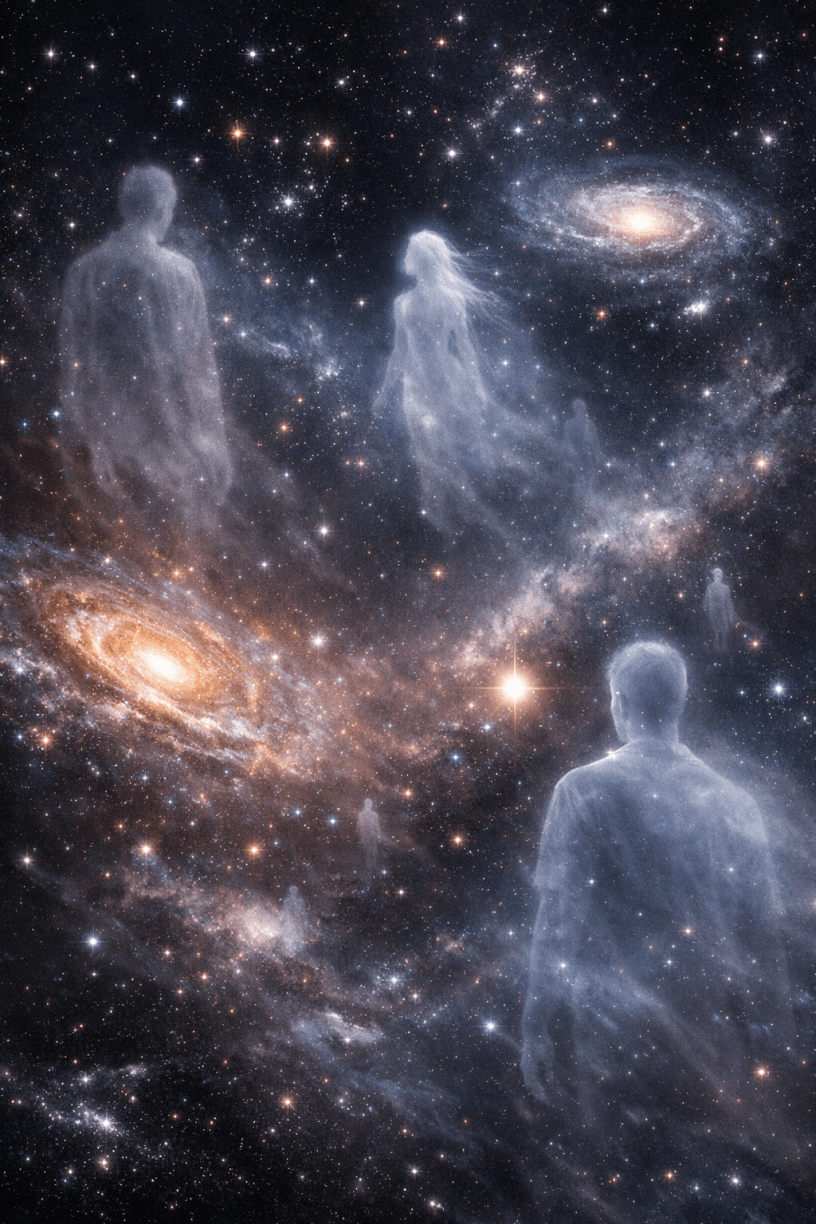
The vacuum, long described as empty, behaved as though crowded.
Crowded not with particles.
With persistence.
V. The Projection
I ran one final model.
If intelligent life multiplies across the galaxy — if biospheres proliferate, if complexity increases — the coherence imprint compounds.
The expansion rate accelerates.
Not exponentially at first.
But steadily.
As though the universe were making room.
I ran the inverse.
If life extinguishes everywhere — if coherent systems collapse into thermal equilibrium — the gradient plateaus.
Expansion slows to a uniform baseline.
The universe stabilizes.
The model did not prove causation.
It suggested accommodation.
I drafted a paper.
I deleted it.
I am not prepared to argue that observation leaves residue.
I am not prepared to argue that coherence introduces pressure.
I am certainly not prepared to argue that the universe expands because it cannot compress what has lived.
But the data remains.
The next cosmological release shows a slight unexplained acceleration variance near a cluster long suspected of hosting complex life.
No one comments on it.
They call it noise.
They call it calibration error.
They call it dark energy behaving strangely.
The vacuum is not empty.
It is crowded with what refuses compression.
 Occupy 2.5