Date: August 8, 2025
#Triangulation
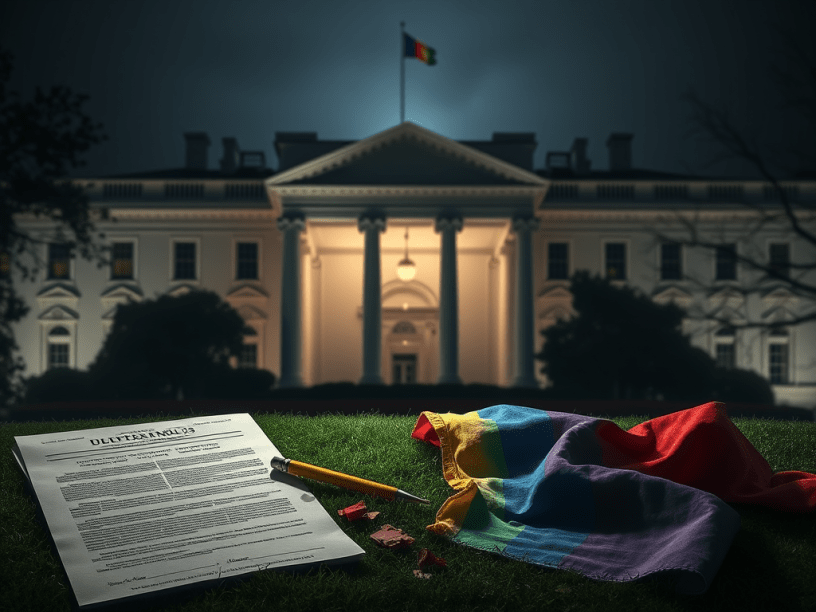
In 1996, President Bill Clinton signed the Defense of Marriage Act (DOMA) into law. It was a seismic blow to LGBTQ+ Americans. DOMA, by defining marriage as a union between one man and one woman, effectively banned federal recognition of same-sex marriages, even in states where such unions were legal. The move wasn’t a fluke. It was a cold, strategic maneuver. Clinton’s White House, often touted by corporate media as LGBTQ+-friendly, actively courted conservative voters—and DOMA was a gift-wrapped offering to the right.
So what was really going on in the Clinton years? Did he support LGBTQ+ rights, or was the rainbow flag simply good branding?
What DOMA Did
DOMA had two key provisions:
- It defined marriage for federal purposes as the union of one man and one woman.
- It allowed states to refuse to recognize same-sex marriages performed in other jurisdictions.
This meant that even if a gay couple legally married in Hawaii or Vermont, the federal government could deny them more than 1,000 federal benefits tied to marriage—from tax status to immigration to Social Security survivor benefits^[1^].
Clinton’s Signature—and His Excuses
Clinton signed DOMA into law in the middle of the 1996 presidential election cycle, on September 21, 1996. There was no public signing ceremony. No photo op. The move was quiet—almost secretive. But the messaging wasn’t. Clinton’s campaign released radio ads on Christian radio stations boasting about his support of DOMA to curry favor with religious conservatives^[2^].
In the years that followed, Clinton offered weak justifications. He claimed DOMA was a “defensive measure,” meant to prevent an even worse constitutional amendment banning same-sex marriage altogether. But critics at the time—and since—have noted that this is a classic “lesser of two evils” defense that ignores the real harm DOMA inflicted^[3^].
The “Friend to Gays” Myth
Mainstream media often described Clinton as the most LGBTQ+-friendly president in history—at least until Obama. After all, didn’t he have openly gay appointees? Didn’t he attend Human Rights Campaign (HRC) events?
Yes, but these gestures were largely symbolic. Underneath, the administration’s actions told a very different story.
Before DOMA, Clinton had already betrayed the LGBTQ+ community with “Don’t Ask, Don’t Tell” (DADT), a 1993 policy that banned openly gay people from serving in the military. The compromise, initially pitched as a softening of prior policy, led to over 13,000 service members being discharged for being gay between 1994 and 2011^[4^]. Clinton presented DADT as a step forward—but it was another form of institutionalized closet culture, punishing honesty and rewarding secrecy.
DOMA Was Political Theater
Clinton wasn’t pushed into signing DOMA. His administration supported it. They chose this route to neutralize the gay marriage issue in the 1996 campaign and draw attention away from Bob Dole’s GOP platform. As journalist Sasha Issenberg later reported in The Engagement, Clinton actively wanted DOMA to be seen as his move, not something forced upon him by Congress^[5^].
The pattern was clear: appease progressives with empty gestures, then win elections by swinging hard to the center—or even the right. That’s triangulation. That’s Clintonism.
Reparations in Rhetoric, Not Policy
Clinton eventually said he regretted signing DOMA. In 2013, after the law was struck down by the Supreme Court in United States v. Windsor, he wrote in The Washington Post that it was “a very different time” and that he had changed his mind^[6^]. That’s easy to say when the political winds have shifted and you’re no longer in office.
But even in apology, Clinton never took full responsibility. He framed his decisions as compromises forced by circumstance, not as conscious political calculations that sacrificed real people for votes.
The Corporate Media Mirage
Mainstream coverage of Clinton’s relationship with the LGBTQ+ community has often glossed over these betrayals. Why? Because corporate media under Clinton thrived. Deregulation, consolidation, and an affinity for centrist politics created a cozy relationship between the press and the president. A narrative of “social progressivism meets economic liberalism” sold well to moderate viewers. Clinton’s symbolic gestures toward LGBTQ+ inclusion were enough to keep straight liberal voters feeling like they were on the right side of history, even as their president signed legislation that codified discrimination.
Conclusion: A Legacy of Harm in a Rainbow Wrapper
Bill Clinton’s LGBTQ+ record is not misunderstood—it’s been whitewashed. DOMA wasn’t a fluke. It was the logical result of a political strategy that treated marginalized communities as leverage, not constituents. Clintonism sold out LGBTQ+ Americans in the name of electability.
To pretend otherwise is to let triangulation off the hook.
Footnotes
- U.S. Government Accountability Office. (2004). GAO-04-353R: Defense of Marriage Act: Update to Prior Report. https://www.gao.gov/products/gao-04-353r
- Solomon, M. (2014). Winning Marriage: The Inside Story of How Same-Sex Couples Took on the Politicians and Pundits—and Won. ForeEdge.
- Eskridge, W. N. (1996). The Case for Same-Sex Marriage: From Sexual Liberty to Civilized Commitment. Free Press.
- Belkin, A. (2001). Don’t Ask, Don’t Tell: Is the Gay Ban Based on Military Necessity? Parameters, 31(2), 108–119.
- Issenberg, S. (2012). The Victory Lab: The Secret Science of Winning Campaigns. Crown.
- Clinton, B., & Clinton, H. R. (2013, March 7). DOMA was discriminatory. We are proud to have supported its repeal. The Washington Post. https://www.washingtonpost.com
 Occupy 2.5