By just another first occupier
The Arena of Brangue Guadalupe does not appear on any map.
It does not sell tickets.
It does not have luxury boxes.
There are no holographic mascots, no drone cameras, no national anthems sponsored by beverage conglomerates.
It has one refrigerator.
Tonight, the refrigerator opens like a steel gate in a corporate coliseum.
Interior light: operational.
Shelving: barren.
Assets: four eggs, half a cup of previously cooked rice, one tomato of questionable morale, and a soy sauce bottle clinging to the door like a relic of a more optimistic quarter.
The commentators clear their throats.
“Welcome back to Chum Hockey™, the only sanctioned domestic survival sport in the Global Domestic League. Tonight’s match is brought to you by ProteinLite™ — because premium nutrition should feel aspirational.”
The crowd — a rotating cast of hungry dependents — circles the perimeter of the kitchen in quiet orbit. They do not chant. They assess.
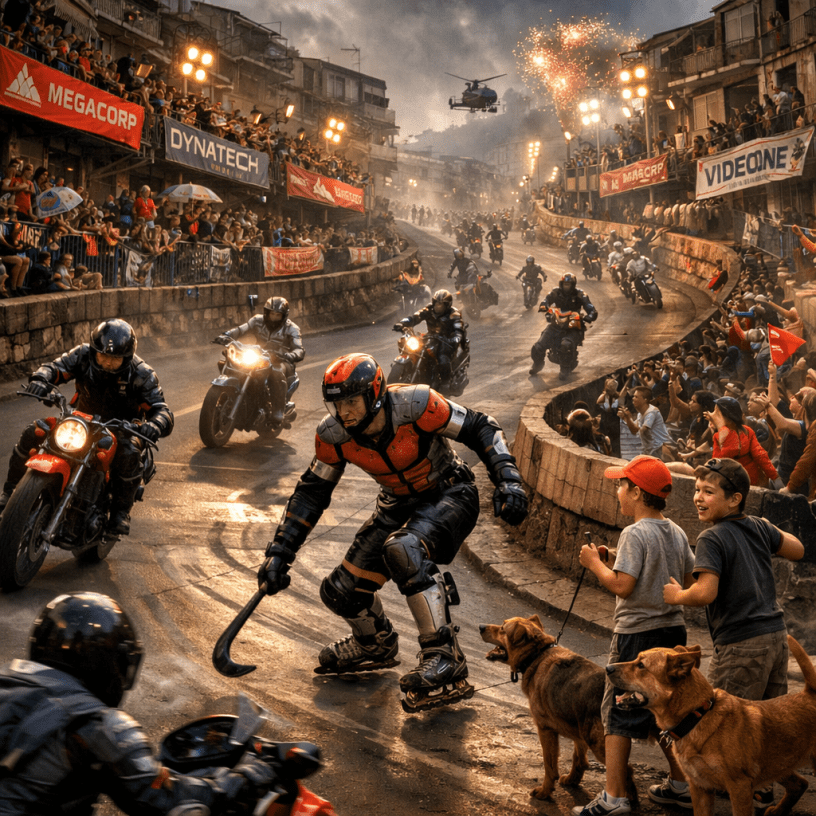
In 1973, William Harrison wrote a short story titled “Roller Ball Murder,” later adapted into the 1975 film Rollerball. In that world, corporations replaced governments. Violence became entertainment. Individual glory was discouraged. The system demanded obedience disguised as sport.
In Brangue Guadalupe, there are no roller skates.
There is a frying pan.
But the structure feels familiar.
OPENING CEREMONY: THE FRIDGE AS ARENA
The refrigerator door swings wide.
The silence is theatrical.
The shelves are not empty because of apocalypse. They are empty because of arithmetic.
Because protein trends upward.
Because supply chains “correct.”
Because the invisible hand does not do dishes.
The announcer’s voice booms in corporate calm:
“Tonight’s objective remains unchanged: convert scarcity into normalcy without triggering a Domestic Incident Review.”
The scoreboard flickers to life above the sink:
CIVILIZATION — CONDITIONAL
CORPORATE ENTITIES — RECORD PROFITS
The eggs are removed from cold storage like strategic assets entering contested airspace.
The rice is assessed. Half a cup. Dry. Breakable.
The tomato is inspected, weighed, sliced with the seriousness of a geopolitical concession.
FIRST PERIOD: DEPLOYMENT
Rice enters the pan first.
Dry heat. Redistribution. Aggressive stirring.
The commentator leans forward.
“That’s a veteran move. He’s stabilizing the base layer before deploying protein.”
The oil shimmers.
Four eggs crack in full commitment. No hedge. No holding back for future breakfast derivatives.
In Rollerball, the corporations staged violence to prove that the individual was replaceable.
In Chum Hockey™, the violence is quieter.
It is structural.
It is the kind that arrives in grocery aisles under fluorescent lighting.
It is the kind that whispers, “Market conditions.”
The eggs scramble.
The rice folds in.
Protein binds to starch.
Soy sauce is negotiated from the boards with a decisive hip check.
A controlled drizzle.
Not excess.
Not flood.
Authority.
The aroma rises.
The orbiting dependents tighten formation.
SPONSOR BREAK
“This segment of Chum Hockey™ is sponsored by Dynamic Price Adjustments, because tomorrow’s cost should always surprise you.”
The broadcast returns.
SECOND PERIOD: UNEXPECTED ASSETS
Movement in the auxiliary pantry sector.
Flour.
Milk.
An egg diverted from primary protein deployment.
The commentators erupt.
“He’s opening a second front!”
Three pancakes emerge like a late-game substitution that shifts momentum.
Syrup cascades in slow motion.
Jelly is applied with ceremonial restraint.
The scoreboard glitches.
CIVILIZATION — RESILIENT
CORPORATE ENTITIES — UNAWARE
The children’s faces shift from calculation to cautious optimism.
This is not abundance.
This is choreography.
THE CORPORATE PARALLEL
In Harrison’s original vision and in the 1975 film adaptation, corporations maintained control by eliminating the illusion of personal agency. Jonathan E. was dangerous not because he was violent, but because he persisted.
In the 2002 remake of Rollerball, the spectacle increased, the subtlety decreased, and the message blurred under CGI and speed. It had its moments — flashes of critique — but the sharp edge dulled.
Chum Hockey™ sits somewhere between the two.
There is no grand rebellion here.
There is maintenance.
And maintenance is not glamorous.
Corporations optimize.
Households stabilize.
Optimization extracts.
Stabilization absorbs.
The corporate boardroom does not feel the micro-tension of a child asking, “Is that all?”
The boardroom does not see the silent redistribution of the largest pancake to the smallest hands.
It sees volume.
It sees trend lines.
It sees “consumer behavior.”
It does not see governance in cast iron.
THIRD PERIOD: THE QUIET TENSION
Plates are distributed with geometric fairness.
Egg and tomato rice in a bowl, glistening with soy authority.
Three pancakes, sliced strategically to maximize perceived abundance.
Coffee brews like post-conflict diplomacy.
No one claps.
No one declares triumph.
Eating silence descends — not anxious silence.
The good kind.
The silence of stabilization.
The fridge, however, remains empty.
That is the unresolved chord.
In Rollerball, the corporations feared the individual who would not yield.
In Chum Hockey™, the system does not fear at all.
It is indifferent.
Indifference is more dangerous than brutality.
Brutality leaves scars.
Indifference leaves receipts.
POST-GAME INTERVIEW
The microphone finds the champion of Brangue Guadalupe.
“Clifford. Clifford. Clifford. Clifford. Clifford. Clifford.”
“How do you keep winning?”
He adjusts the spatula like a helmet.
“We’re not winning. We’re maintaining.”
Maintenance is the most subversive act left in a system that expects fracture.
The corporations expect stress to metastasize into cruelty.
They expect scarcity to breed resentment.
They expect households to cannibalize morale.
Instead, there is egg and tomato rice.
There are pancakes.
There is soy sauce deployed with discipline.
There is coffee poured evenly.
No diplomatic incidents.
No visible despair metrics.
The scoreboard flickers one last time:
CIVILIZATION — HOLDING
CORPORATE ENTITIES — CONTINUING
THE BOUNDARY
The boundary between civilization and uncaring corporate entities is not marked by barricades.
It is marked by portion sizes.
It is marked by who eats last.
It is marked by whether humor survives depletion.
Civilization is not skyscrapers.
It is the decision to divide fairly.
It is the refusal to let scarcity become cruelty.
It is maintenance under pressure.
And maintenance, unlike spectacle, does not trend.
Tomorrow, the refrigerator will open again.
Tomorrow, prices will still rise.
Tomorrow, the Arena of Brangue Guadalupe will host another match.
Tonight, no victory is declared.
Only this:
The line held.
References
Harrison, W. (1973). Roller Ball Murder.
Jewison, N. (Director). (1975). Rollerball [Film].
McTiernan, J. (Director). (2002). Rollerball [Film].
Summary
In a kitchen called the Arena of Brangue Guadalupe, four eggs, half a cup of rice, and three surprise pancakes become a corporate-era Rollerball — where the real game is converting scarcity into stability without surrendering dignity.
When the refrigerator opens to near emptiness, the broadcast begins: Chum Hockey™ pits a household against the indifferent logic of quarterly earnings in a satire inspired by Rollerball.
Soy sauce, scrambled eggs, and pancakes take center stage in this domestic dystopia, where portion control replaces roller skates and maintenance becomes quiet rebellion.
In the shadow of corporate profit reports, one kitchen becomes an arena proving that civilization survives not through spectacle, but through fair division and stubborn care.
Chum Hockey™ reframes Rollerball for the age of inflation — a sharp satire about households stabilizing what corporations merely optimize.
Four eggs and half a cup of rice become strategic assets in a fictional league where the only victory is keeping the table calm under systemic pressure.
In this Occupy 2.5 allegory, the real scoreboard reads Civilization—Holding, as families quietly absorb shocks that markets never feel.

