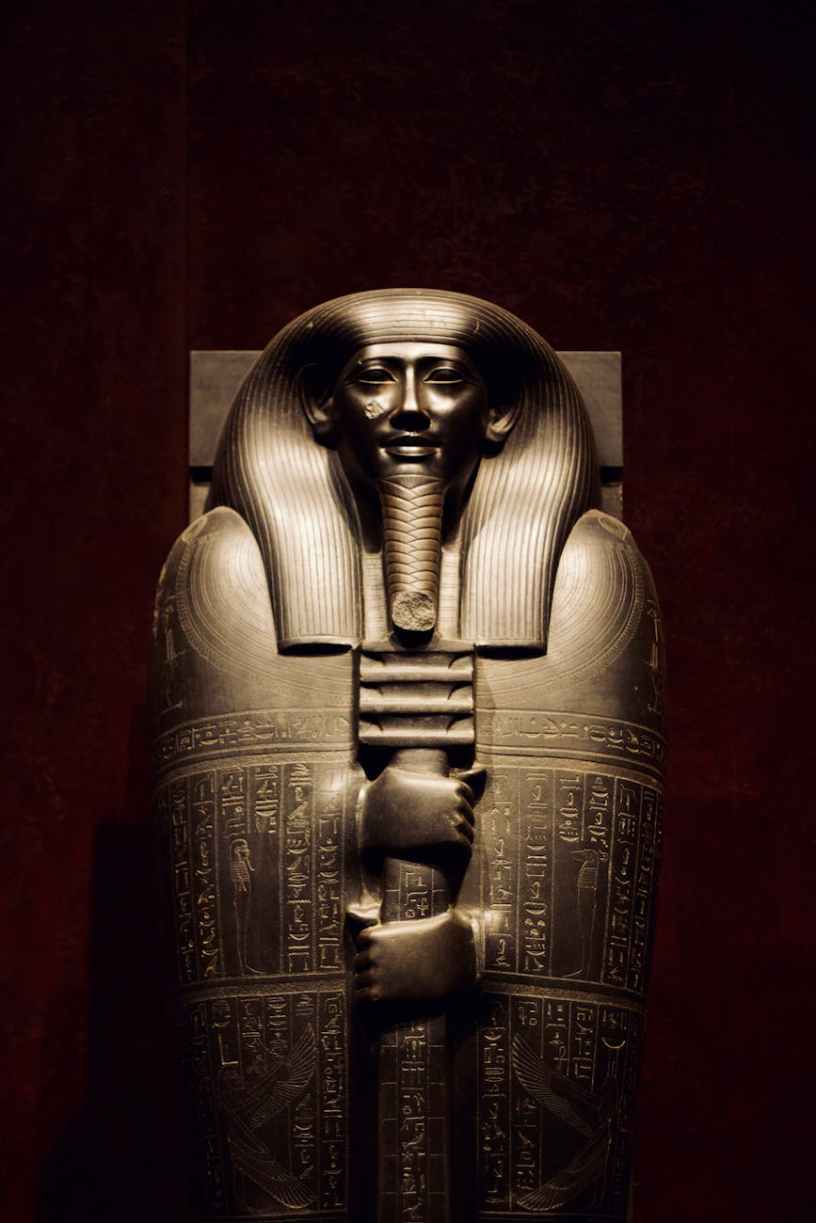
He was listed on the manifest as mummified human remains, intact, enclosed within a painted wooden sarcophagus, origin Egypt—Valley of the Kings, consigned to the American Museum of Natural History, cleared through customs without incident, certified non-hazardous by the CDC, and insured for exhibition purposes at four and a half million dollars.
Designation: Unidentified Male, Late New Kingdom.
Condition: stable.
—
The crate arrived on schedule.
It was signed for, logged, and transferred according to procedure. Temperature-controlled, documented at each step. No discrepancies noted. No irregularities reported.
It was, by every measure that mattered, handled correctly.
The sarcophagus was opened under supervision.
There were witnesses.
There were notes.
There was, as required for the transfer of high-value antiquities, a uniformed officer present.
He stood just inside the room, hands resting lightly on his belt, watching with the detached patience of someone assigned to stand watch over something that was not expected to move.
The lid was lifted.
The linen-wrapped figure lay as it had for centuries—still, intact, undisturbed.
Someone leaned in.
Someone made a note.
And then—
He sat up.
Not violently. Not suddenly.
Deliberately.
The room did not react all at once. There was a moment—brief, uncertain—where no one understood what they were seeing.
The officer did.
“Hey—”
The word came out sharp, instinctive.
“Don’t move.”
The figure turned its head.
Slowly.
As if acknowledging the instruction.
It did not attempt to leave the table.
It did not resist.
It simply… existed in a way it had not been expected to.
The officer stepped forward, one hand raised—not quite drawing his weapon, not quite relaxed.
“Stay right there.”
A pause.
“Can you understand me?”
The figure inclined its head slightly.
That was enough.
Protocol shifted.
This was no longer a museum matter.
—
The report, later, would describe it as:
“Unidentified individual concealed within transported artifact.”
There were procedures for that.
The officer made the call.
—
By the time anyone thought to question the description, the situation had already been handed off.
He was compliant.
He had no identification.
He had arrived inside a container not intended for human transport.
That was sufficient.
He was transferred.
—
By the time anyone thought to reconsider the paperwork, he was already in processing.
He stood without assistance.
He followed instructions.
He did not resist.
Fingerprinting was attempted and abandoned.
Photographing was completed, though the images were flagged for review without explanation.
“Name?” the intake officer asked.
A pause.
“That is not the name you have given me.”
The officer glanced at the file.
“Unidentified Male,” he read.
“That is not a name.”
A box was checked anyway.
—
“Country of origin?”
He considered the question.
“It has been called many things.”
“Egypt?” the officer prompted.
“That is one of them.”
Another box was checked.
—
Hearing Room B was small, fluorescent, and overly cold.
A judge sat at the front, file open. Government counsel to one side. A public defender—assigned, unprepared—on the other.
The respondent sat in a standard chair, hands resting lightly on his knees, linen-wrapped, still.
There was a faint smell. Not decay. Not exactly.
Time, perhaps.
The clerk read the case number.
No one wrote it down.
—
“State your name for the record,” the judge said.
“I do not have one that would be recognized.”
The judge made a note.
“Do you understand the nature of these proceedings?”
“I understand that I am being asked to justify my presence.”
“That is correct.”
“I am present,” he said. “That is the justification.”
—
Government counsel cleared his throat.
“Your Honor, the respondent entered the United States as cargo, not as a person. He is not listed on the manifest as a living individual and possesses no documentation establishing lawful status.”
The judge looked down at the file.
“That appears to be accurate.”
“I was not awake,” the respondent said.
—
“Do you have any documentation?” counsel asked.
He lifted one hand, slowly, the linen shifting with the motion.
“This is what remains.”
“That is not documentation.”
“It has endured.”
Counsel did not respond.
—
“Country of origin?” the judge asked again.
“The land where I was prepared does not object to my absence,” he said.
“That is not responsive.”
“It is the only answer I have.”
—
“Is there a country that will accept your return?”
“No.”
“Is there a government that claims you?”
“No.”
“Is there any record of your existence prior to your arrival here?”
“There are records,” he said. “They are not… accessible.”
—
There were forms for admission.
There were forms for detention.
There were forms for removal.
The clerk sorted them, once, twice, then set them aside.
None of them seemed to apply.
—
“Your Honor,” government counsel said carefully, “the respondent cannot establish lawful entry. He has no documentation, no verifiable country of origin, and no legal status under existing statutes.”
The judge nodded.
“Yes.”
He looked at the respondent.
“Is there any place to which you can be returned?”
The respondent considered this.
“I have outlasted those places.”
—
The room was quiet.
The fluorescent lights hummed.
Someone shifted in their seat.
—
“The court will need time to consider,” the judge said.
The respondent inclined his head slightly.
“I have time.”
—
The decision, when it came, was careful.
There was no clear basis for removal.
There was no mechanism for detention that made sense.
There was, ultimately, no category into which he could be placed.
He was released.
—
At the conclusion of the hearing, the file was closed.
The respondent remained seated for a moment, as if waiting for a cue that did not come.
The judge watched him.
“What will you do now?” he asked, before he could stop himself.
The respondent looked down at his hands, at the linen that had survived centuries.
“I will require appropriate clothing,” he said.
A pause.
From somewhere off to the side, the clerk spoke without looking up.
“You might try Brooks Brothers.”
Another pause.
“They’re used to dealing with the dead.”

