By Just Another First Occupier
Baybay City, Leyte, Philippines — November 6, 2026, 11:00 p.m. EST
Well, congratulations, America.
We’ve elected another Democratic Congress.
Break out the balloons. Uncork the champagne. Somebody find a television camera so a newly empowered congressman can explain how this changes absolutely everything.
Excuse me if I don’t stand up and applaud.
I’ve seen this movie before. Several times, actually. The cast changes, the campaign slogans improve, and the ending somehow keeps looking suspiciously familiar.
Let’s start with Bill Clinton.
We Elected a Democrat. We Got Republican-Lite.
After twelve years of Reagan and Bush, Americans elected a Democrat in 1992.
Some of us thought that meant reversing the economic direction of the country.
Silly us.
Ronald Reagan had helped sell America the proposition that enriching the wealthy, weakening labor’s bargaining position, and letting markets work their magic would eventually benefit everybody.
By the time George H. W. Bush left office, we’d had quite enough of that experiment.
Then along came Bill Clinton.
The Third Way.
What a lovely name for taking a wrong turn and insisting it’s progress.
Clinton signed welfare reform, embraced free trade, and presided over further financial deregulation. His defenders point to economic growth, job creation, and budget surpluses.
Fine. Those things happened.
But so did the consolidation of an economic philosophy that treated Wall Street’s confidence as a national necessity and working-class insecurity as an unfortunate side effect.
We elected a Democrat.
We didn’t elect a Republican with better saxophone skills.
Hope Became Nope
Then came Barack Obama.
Hope.
Change.
Yes We Can.
Wonderful slogans. Almost poetic.
Unfortunately, when the financial system collapsed, Washington discovered that the most important people in America were apparently the people who had helped wreck it.
Now, let’s get the history straight.
The financial rescue began under George W. Bush. Obama inherited the crisis and continued major stabilization efforts.
The defenders of those policies argue that allowing major financial institutions to collapse would have caused even greater unemployment, destroyed savings, and deepened the recession.
That was a genuine risk.
But there were choices about who received assistance, under what conditions, and who bore the losses.
And here’s where this old Occupier gets particularly irritated.
Where was the comparable urgency for the homeowners?
Where was the extraordinary mobilization to protect families from foreclosure?
Where was the political determination to ensure that the people who profited from reckless financial practices faced consequences proportionate to the damage?
There were mortgage-relief programs. There were settlements. There were regulatory reforms.
There were also millions of foreclosures and enormous human suffering.
We can argue about whether the financial system had to be rescued.
What I refuse to accept is the idea that rescuing the financial system automatically meant delivering justice to the people it had failed.
The banks got bailed out. We got sold out.
Corporate socialism.
Individual capitalism.
When powerful institutions stumble, the public is told that everybody must help catch them.
When ordinary Americans stumble, they’re lectured about personal responsibility.
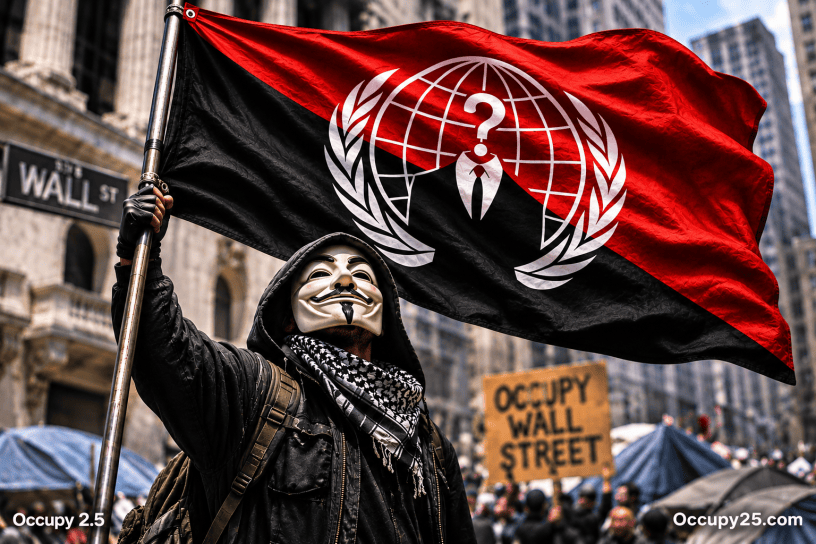
That’s the economic double standard Occupy challenged in 2011.
And fifteen years later, I haven’t forgotten it.
And Then Came Biden
Joe Biden arrived promising to restore normalcy.
His defenders can point to infrastructure investment, industrial policy, climate legislation, and other initiatives.
I know the list.
I’ve heard the speeches.
But my question is simpler.
Did Washington fundamentally change the relationship between concentrated wealth and political power?
Did the economic insecurity that helped fuel Occupy disappear?
Did accountability become the normal consequence of institutional failure?
From where I’m sitting, the answer is no.
That doesn’t mean nothing happened during Biden’s presidency.
It means that doing something and solving the underlying problem are two very different accomplishments.
Washington has become extraordinarily skilled at confusing the first with the second.
And Now We’re Supposed to Celebrate Again?
Here we are in November 2026.
Democrats have won Congress.
The hearings are coming. The investigations are being discussed. The subpoenas are practically warming up backstage.
And I can already hear the speeches.
This time will be different.
This time there will be accountability.
This time the American people will finally get answers.
Maybe.
But I’ve spent enough years watching politicians promise consequences for powerful people to develop a modest degree of skepticism.
You want my enthusiasm?
Earn it.
Don’t tell me how angry you are.
Don’t tell me how deeply concerned you are.
Don’t give me another television hearing where everybody gets five minutes to deliver a campaign commercial disguised as a question.
Show me the evidence.
Enforce the subpoenas.
Write laws that protect ordinary people.
Challenge corporate privilege.
And stop treating accountability as a campaign slogan that expires the morning after Election Day.
A Message From One First Occupier
Occupy wasn’t created because we wanted a different collection of politicians sitting in expensive chairs.
We wanted a political and economic system that stopped protecting powerful institutions while leaving ordinary people to absorb the damage.
We wanted accountability.
We wanted economic justice.
We wanted government that remembered who was supposed to own it.
And now, after another election, we’re being invited to believe that Washington has finally learned its lesson.
Perhaps it has.
I’ll be delighted to examine the evidence.
But until somebody produces it, this First Occupier isn’t buying another ticket to the same performance.
What am I expecting from the new Democratic Congress?
Not a fuck of a lot.
I’d welcome being proven wrong.
Thank you.
This has been your First Occupier.
Have yourself a good day.
References
Clinton, W. J. (1996, August 22). Statement on signing the Personal Responsibility and Work Opportunity Reconciliation Act of 1996. The American Presidency Project. https://www.presidency.ucsb.edu/
Congressional Oversight Panel. (2011). March oversight report: The final report of the Congressional Oversight Panel. U.S. Government Publishing Office. https://www.govinfo.gov/
Financial Crisis Inquiry Commission. (2011). The financial crisis inquiry report. https://www.govinfo.gov/content/pkg/GPO-FCIC/pdf/GPO-FCIC.pdf
U.S. Department of the Treasury. (n.d.). Troubled Asset Relief Program (TARP). https://home.treasury.gov/data/troubled-assets-relief-program
U.S. Department of the Treasury. (n.d.). Making Home Affordable. https://home.treasury.gov/
White House. (2024). The Biden-Harris administration record. Archived presidential materials. https://bidenwhitehouse.archives.gov/

