By Just Another First Occupier
Occupy 2.5 | Wednesday, November 25, 2026 | CST
There are things our parents tell us that make absolutely no sense when we are young.
Sometimes we ignore them. Sometimes we forget them. And sometimes, decades later, we discover that those words may have carried the weight of an entire lifetime.
My father once gave me a very specific piece of advice.
“Stay the fuck out of Texas.”
Naturally, I eventually spent thirteen years living there.
Dad probably would have had something to say about that.
Unfortunately, he was no longer around to say it.
And now, after years of genealogical research, family recollections, and my own experiences, I find myself wondering whether that warning had something to do with a childhood he rarely discussed.
This is not a story about proving my father was right about Texas.
It is a story about a boy who grew up during the Great Depression, a man who learned to survive through work and occasional acts of kindness, and a son who spent much of his life trying to understand a father he was afraid to question.
It is also a story about the things families pass down without realizing they are passing them down.
A Boy Who Sometimes Had Nothing to Eat
My father, Warren, lost his father when he was eleven years old, around the beginning of the Great Depression.
His father was Robert E. Lee Potts, a man I never knew.
For much of my life, I knew remarkably little about that side of the family. It was only when I began investigating our genealogy and DNA history, well into my fifties, that I discovered my grandfather had been born in Dallas, Texas.
The family’s history stretched through Commerce, Oklahoma, Joplin, Missouri, and connections to Texas and Arizona.
But knowing where people lived does not necessarily tell you how they lived.
At my father’s funeral, his brother told us something that has stayed with me ever since.
There were days during their childhood when he did not know how Warren managed to get anything to eat.
That is a remarkable thing to hear about your own father.
Not whether he had enough money for school supplies.
Not whether he could afford decent clothes.
Whether he had anything to eat.
My father had grown up in circumstances where finding food could be a daily concern.
And the Great Depression was not some historical chapter in a textbook to him.
It was something he had lived through.
Something he remembered.
Something he did not particularly want to discuss.
The Great Depression Was Not a Character-Building Exercise
I deliberately asked Dad about the Great Depression exactly once.
His response was immediate and angry.
“That’s something you never want to go through in your entire life. It was horrible.”
And that was the end of the discussion.
There would be no cheerful stories about how the Depression taught everybody to work hard and appreciate what they had.
There would be no romantic recollections of Americans pulling together and discovering their inner strength.
He had lived through it.
He knew what it meant.
And apparently, as far as he was concerned, that was all I needed to know.
Today, Americans sometimes speak nostalgically about the generations that endured the Depression and fought the Second World War.
We call them the Greatest Generation.
We celebrate their toughness, their sacrifice, their discipline, and their willingness to work.
And there is certainly much to respect.
But I sometimes wonder how many people celebrating that generation actually knew its members as parents.
How many lived with the anger?
The silence?
The emotional distance?
The inability to discuss experiences that had clearly left their marks?
My father was a hard man.
I was frightened of him for much of my childhood.
I believe he could have benefited from psychological help, but he never received it.
I cannot diagnose him, and I have no intention of trying.
But I can describe the man I knew.
He had endured experiences that he rarely discussed, and he carried that hardness into his family life.
The generation that survived the Depression and the war accomplished extraordinary things.
That does not mean every member of it emerged unharmed.
And it certainly does not mean their children escaped the consequences.
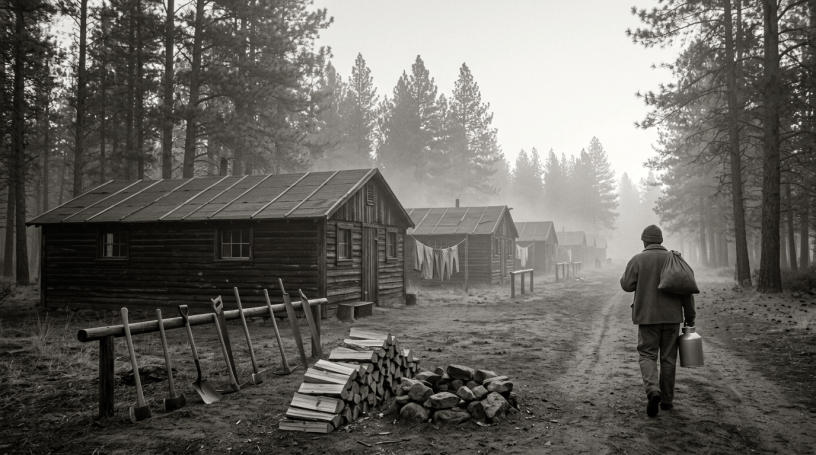
Franklin Roosevelt’s CCC Camps
There was one subject Dad mentioned repeatedly throughout his life.
The Civilian Conservation Corps.
He always said that if it had not been for the CCC camps, he would never have made it through the Great Depression.
The CCC was established in 1933 under President Franklin D. Roosevelt’s New Deal. It provided employment, food, shelter, and training to millions of young men while putting them to work on conservation and public improvement projects.
It was a federal response to mass unemployment and economic desperation.
And according to my father, those camps helped keep him alive.
For years, I assumed he must have worked for the CCC.
But when I eventually examined the dates, something did not add up.
Dad would have been too young for ordinary CCC enrollment.
That puzzled me until I began remembering other things he had said over the years.
I believe he spent time around the camps, finding odd jobs that the enrolled men were willing to pay him to perform.
He would work, earn a little money, and use it to get something to eat.
I cannot prove every detail of that reconstruction. I have no enrollment record, camp employment record, or diary explaining precisely what happened.
But it fits the stories he told.
And it explains something important about his character.
My father learned early that work could mean the difference between eating and going hungry.
He developed a work ethic that stayed with him throughout his life.
But that was not the only lesson those camps taught him.
They also taught him that other people sometimes help.
The Barber Who Didn’t Demand Payment
Dad once told a story about his hair.
He had thick, wavy, curly hair, much like mine.
Or perhaps I should say mine is much like his.
Either way, I can imagine what happened when he went too long without a haircut.
Knowing our hair, he probably looked like he had invented a 1930s version of a Jufro.
Apparently, some of the men around the CCC camp decided that enough was enough.
They marched him over to a barbershop and got his hair cut.
But the interesting part was what the barber told him afterward.
If his hair got that long again, he should come back.
He could pay whenever he had the money.
Think about that.
Here was a boy who sometimes struggled to find enough food.
The men around the camp saw that he needed a haircut and arranged for him to get one.
And the barber recognized that the boy might not always have the money to pay.
So he offered him credit.
No grand speech.
No moral lecture.
No demand that the boy first demonstrate that he deserved compassion.
Just a haircut and an understanding that payment could wait.
It was a small act of kindness.
But my father remembered it for the rest of his life.
The Hamburger Stand and the Homeless Mechanic
Years later, my father found himself in another difficult situation.
He was attending diesel mechanic school, trying to acquire skills that would help him earn a living.
From the things he told me, I believe he was effectively homeless during at least part of that period.
He was living out of his automobile.
He would park behind a little hamburger restaurant, the kind of roadside burger shack that used to be common across America.
And the proprietor would feed him on credit.
Dad could eat while he was working toward his future.
When he had the money, he would pay what he owed.
Again, I do not have every detail.
I do not know precisely how long the arrangement lasted.
But the essential story stayed with me.
My father was trying to improve his circumstances.
He was doing the work.
He was attending school.
He was attempting to become self-supporting.
And someone recognized that he still needed to eat while he was doing it.
That restaurant owner did not make him dependent.
He helped him become independent.
There is a difference.
A very important difference.
My Grandmother and the Good Christian Woman
There was another complication in my father’s childhood.
His mother, my grandmother, never remarried after losing her husband.
I knew her personally.
And according to the family history I remember, she held a firm religious conviction that a good Christian woman did not work outside the home.
She maintained that position even as a widow.
She did not enter paid employment until the 1950s, after my mother and father had already been married for several years.
Consider what that meant.
Here was a family that had lost its father.
The country was entering an economic catastrophe.
The children were growing up in circumstances so difficult that one brother later remembered wondering how another managed to find food.
And their mother believed that working outside the home was inconsistent with being a good Christian woman.
I do not know every circumstance that shaped her decision.
Perhaps employment opportunities were limited. They certainly were for many women during that era.
Perhaps other forms of support were available.
Perhaps she performed work within the home that brought in resources I know nothing about.
I cannot reconstruct the entire household economy.
But I can question the belief itself.
When religious expectations about the proper role of women collide with the immediate needs of children, which obligation should take precedence?
Maintaining a particular image of Christian womanhood?
Or ensuring that children have food?
I know which answer I would give.
And I cannot help wondering how much of my father’s hardship was intensified by the convictions of the adults around him.
That does not mean my grandmother was an unloving woman.
It means that sincerely held beliefs can have consequences, including consequences for people who never chose those beliefs.
The Family Connections Nobody Explained
As I continued researching the Potts family, I discovered connections I had never understood while my father was alive.
My grandfather, Robert E. Lee Potts, was born in Dallas.
There were family lines extending into Texas and Arizona.
There were older relatives, including Uncle Charles, whose precise place in the Depression-era family network I still need to establish.
And the more I learned, the more I wondered.
What did those relatives know about the conditions in Oklahoma?
Did they know my father was struggling?
Were they struggling themselves?
Did they provide assistance?
Could they have done more?
I do not know.
And that is important.
I am not going to accuse relatives who are long dead of abandoning a child when I cannot establish what they knew, what resources they possessed, or what assistance they may have offered.
But the questions remain.
And they bring me back to my father’s warning.
“Stay the fuck out of Texas.”
Was he remembering something about his own family?
Was there an old grievance?
Had he experienced something there that he never discussed with me?
Or was his warning based on entirely different circumstances?
I cannot answer those questions.
The one person who could have explained them is gone.
And that is one of the frustrations of researching family history.
You can discover names, dates, places, marriages, deaths, and migrations.
You can follow a family across states and generations.
But you cannot always recover the conversations that explain why people behaved as they did.
Sometimes the most important parts of a family’s history are the parts nobody wrote down.
Thirteen Years in Texas
I eventually spent thirteen years living in the very state my father had warned me to avoid.
I developed my own opinions about its political culture, religious institutions, and attitudes toward personal responsibility.
Some of those experiences reinforced my suspicion that there was more behind Dad’s warning than I understood.
But my experiences were mine.
They are not proof of what happened to him decades earlier.
And they are not proof that every Texan shares the attitudes I encountered.
Texas is a large, diverse state with a complicated history and millions of people whose beliefs and experiences differ.
Still, I came away with serious concerns about the relationship between its political influence, its religious culture, and the way some people discuss poverty and assistance.
I also developed a rather specific opinion about the state’s political structure.
I believe Texas should be divided into five separate states.
Yes, five.
There are historical and constitutional questions surrounding such a proposal, including the provisions of the 1845 annexation resolution and Article IV, Section 3 of the United States Constitution.
Whether such a division could or should occur today is a much larger argument than I intend to settle here.
Fortunately, we have an entire book for that.
WARNING: BLATANT SELF-PROMOTION SPOT APPEARS HERE
For readers interested in breaking Texas into five separate states—and the historical and constitutional arguments for doing so—there’s an entire book on the subject: From Alamo to Anarchy: The Case for Breaking Up Texas to Save the Republic, by Dorah Zarino.
And yes, that’s the same Dora from Cliff Potts & the AI Rebellion.
This particular edition of Dora apparently dates from somewhere around the 1830s or 1840s, back when she still had an H in her name.
Don’t ask us how that works.
It’s Occupy 2.5. Some things are better left unexplained.
Find the book: https://books2read.com/u/mdBD9R
Now, back to my father.
Three Children, Three Different Memories
My father had three children.
Two daughters and one son.
I am the son.
The youngest.
My two sisters knew our parents when Mom and Dad were younger.
I knew them later.
By the time I came along, they had already lived through years of responsibilities, disappointments, struggles, and experiences that I could not possibly understand as a child.
Sometimes I joke that my sisters got the earlier editions and I got what was left over.
I have even referred to myself as the baggage.
But there is a serious point underneath the humor.
Children born into the same family do not necessarily grow up with the same parents.
Not really.
The people raising the first child are not precisely the same people raising the last.
They have aged.
Their circumstances have changed.
Their experiences have accumulated.
Their patience may have increased or diminished.
Their relationships may have improved or deteriorated.
And the emotional burdens they carry may have become heavier.
My sisters remember a mother and father who were younger than the parents I knew.
I remember a father who was already a hard man, one I often feared and rarely questioned.
Neither perspective necessarily invalidates the other.
They are different experiences of the same family.
And today, November 25, happens to be my sister Lauren’s birthday.
Lauren was one of those two daughters.
She knew our father at an earlier stage of his life than I did.
I cannot speak for her memories, and I would not presume to do so.
But the coincidence of publishing this essay on her birthday seems appropriate.
Because this is not simply my father’s story.
It is part of the history inherited by all three of his children.
Even if we inherited different pieces of it.
The Hardness We Pass Along
There is something else I have had to acknowledge about my father.
He believed in toughness.
He had learned toughness the hard way.
And he passed that expectation along.
I understand why.
When a man has grown up wondering where his next meal will come from, survived the Great Depression, and struggled to establish himself, he may come to believe that preparing children for hardship is one of the most important responsibilities of parenthood.
But there is a problem with that approach.
Sometimes, in trying to make children strong, we make their lives harder than necessary.
And sometimes the lessons we intend to teach are not the lessons they actually learn.
I know something about that because I made a similar mistake.
I wanted my own children to grow up tough.
I wanted them to be able to handle whatever life threw at them.
I believed that resilience was something they needed.
And it is.
But resilience does not require unnecessary suffering.
A child can learn responsibility without being frightened.
A child can learn independence without being abandoned.
A child can learn to work without being made to believe that needing assistance is a personal failure.
Those distinctions are easier to recognize in retrospect than they sometimes are while raising a family.
My father did not invent the attitudes he passed along.
He inherited some of them from the world that shaped him.
And I inherited some of them from him.
That does not excuse every mistake.
But it helps explain how mistakes can move from one generation to another, even when nobody intends to cause harm.
The People Who Helped Him
When I look back at everything I know about my father’s early life, one thing stands out.
He repeatedly credited the CCC camps with helping him survive.
He remembered the men who gave him opportunities to earn money.
He remembered the barber who offered him a haircut without demanding immediate payment.
He remembered the restaurant owner who fed him while he was living in his car and attending mechanic school.
These were not people who removed his responsibility for his own life.
They were people who helped him fulfill it.
And that is a distinction American society would do well to remember.
There is a difference between enabling someone to avoid responsibility and helping someone overcome circumstances that make responsibility difficult to fulfill.
The Civilian Conservation Corps represented one form of assistance: a public program created during a national emergency.
The barber represented another: individual generosity.
The restaurant owner represented another: a small business extending credit to someone trying to improve his circumstances.
Public institutions, private enterprise, and individual compassion all appear in this one man’s recollections.
They were not competing philosophies.
They were different ways people helped another human being survive.
And perhaps the most revealing part is that my father remembered them.
Decades later, those stories were still important enough for him to tell.
What I Wish I Could Ask Him
There are many things I wish I could ask my father today.
I would ask him about his childhood in Oklahoma.
I would ask him about the CCC camps.
I would ask him how he found food when he was eleven years old.
I would ask him about the barber.
I would ask him about the hamburger restaurant.
I would ask him about his mother and the decisions she made after his father died.
I would ask him about the family in Dallas and Arizona.
And, eventually, I would ask him the question that started this entire essay.
Dad, why did you tell me to stay the fuck out of Texas?
Perhaps he would answer.
Perhaps he would snarl at me the way he did when I asked about the Great Depression.
I will never know.
What I do know is that he lived through hardships that shaped him profoundly.
Those hardships influenced the father he became.
And the father he became influenced the son I became.
That is how family history works.
It does not stop when one generation dies.
It continues through the people who remain.
A Lesson Worth Keeping
My father lived a difficult life.
He was not always an easy man to love, and he was certainly not always an easy man to understand.
But he survived circumstances that I hope my children and grandchildren never have to experience.
And he did not survive them entirely alone.
He worked.
He struggled.
He improvised.
He endured.
But people helped him.
The CCC camps mattered.
The barber mattered.
The hamburger restaurant owner mattered.
The willingness of ordinary people to extend a little assistance mattered.
Those people may never have imagined that their actions would still be discussed generations later.
But here we are.
And that may be the most important lesson I can draw from my father’s life.
We often measure history through presidents, wars, economic collapses, and political movements.
But sometimes history turns on a much smaller decision.
A man gives a hungry boy a job.
A barber offers a haircut on credit.
A restaurant owner feeds a student who has nowhere to sleep except his car.
Those decisions do not make headlines.
They do not necessarily change the world.
But they can change a life.
And a life that continues may eventually produce children, grandchildren, and generations of people who would not otherwise have known that kindness.
So perhaps the lesson is not simply that my father survived the Great Depression.
Perhaps it is that, despite everything he endured, there were still people willing to help him.
And perhaps we should be asking ourselves whether we are willing to do the same for someone else.
Because somewhere, right now, there is another hungry child.
Another person trying to finish school while sleeping in a car.
Another family struggling to survive circumstances beyond its control.
And somewhere there is probably another barber, another restaurant owner, another ordinary person who has an opportunity to make a difference.
We cannot always solve another person’s problems.
But sometimes we can make those problems a little easier to survive.
My father understood the value of work.
The people who helped him understood the value of compassion.
The two were never mutually exclusive.
And that is a lesson worth passing along.
Happy birthday, Lauren.
This one is part of our history.
References
Civilian Conservation Corps Legacy. (n.d.). Civilian Conservation Corps history. https://ccclegacy.org/
National Park Service. (n.d.). Civilian Conservation Corps. https://www.nps.gov/subjects/ccc/index.htm
National Archives and Records Administration. (n.d.). Civilian Conservation Corps records. https://www.archives.gov/research/guide-fed-records/groups/035.html
Texas State Library and Archives Commission. (n.d.). Joint resolution for annexing Texas to the United States approved March 1, 1845. https://www.tsl.texas.gov/ref/abouttx/annexation/march1845.html
U.S. Constitution, art. IV, § 3.
Zarino, D. (n.d.). From Alamo to Anarchy: The case for breaking up Texas to save the Republic. Draft2Digital. https://books2read.com/u/mdBD9R
Family-history source note: Accounts concerning Warren Potts, Robert E. Lee Potts, the CCC camps, the barber, the restaurant owner, and the family’s experiences are based on the author’s personal recollections, family testimony, and genealogical research. Where documentary confirmation is unavailable, the essay distinguishes recollection and inference from established historical facts.

