⚖️ Keeping It in Perspective: A Mid-May Preamble
Let’s get something straight before we go any further down this twisted memory lane: Donald J. Trump is not the first American president to royally screw things up. And — brace yourself — he won’t be the last. This country has a rich, almost competitive tradition of presidential boneheadedness, stretching from powdered wigs to spray tans.
Now, Trump absolutely earned his spot on this list — and not just with tweets and tantrums, but with real-world chaos. But it’s important to remember: the White House has been a magnet for questionable decisions long before the Apprentice theme music echoed through the West Wing.
We’ve had presidents who thought forced relocation was “progress,” others who believed letting people starve would teach them responsibility, and even a few who invaded the wrong country just because it was nearby and handy. Some were brilliant minds who had catastrophically bad days. Others? Well, let’s just say they peaked at being elected.
This month — May — we’re revisiting 31 of the most jaw-dropping, shortsighted, spectacularly stupid decisions ever made by a sitting U.S. president. One a day. Like a vitamin. But instead of keeping you healthy, it’ll just make you appreciate the resilience of democracy.
This isn’t about being cynical. It’s about being honest. Because the truth is, even the best presidents have left flaming dumpsters in their rearview mirrors. The difference between good and bad leadership isn’t the absence of mistakes — it’s whether or not you learn from them. Or at least don’t repeat them on national television.
So, as we dig deeper into our #WorstPresidentialFails series, remember: This isn’t just political theater. It’s a civics class taught with a raised eyebrow, a wince, and the occasional facepalm.
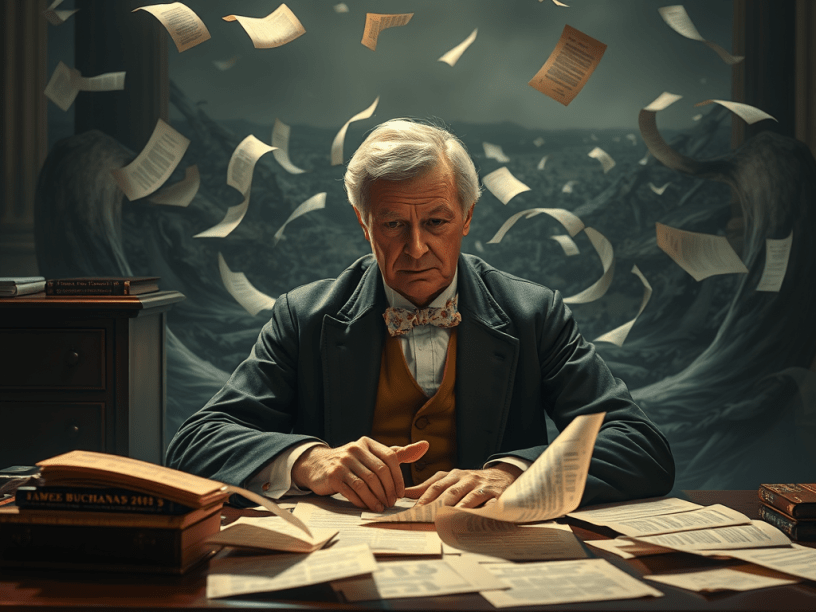
📅 May 5 – James Buchanan Does Nothing While the Nation Collapses (1857–1861)
If you were writing a political thriller, you couldn’t invent a worse lead-up to civil war than the real-life presidency of James Buchanan. He didn’t just fail to stop the Civil War — he acted like it wasn’t even his business. As if the breakup of the United States was an unfortunate scheduling conflict he’d rather not attend.
When South Carolina seceded in December 1860 — just a month after Abraham Lincoln was elected — Buchanan’s response was to basically shrug and say, “Well, I don’t think I can legally stop them.” Which, given the whole “preserve the Union” thing in the job description, is like a firefighter refusing to enter a burning building because it’s technically not their lease (McPherson, 1988).
Buchanan believed that the Constitution didn’t give him the authority to act, and so he politely watched as the country unraveled. States seceded. Militias formed. And Buchanan, still writing long-winded letters, seemed more interested in proving he wasn’t the problem than in solving one.
To make things worse, Buchanan’s administration was riddled with corruption, his cabinet was divided, and his leadership so limp that even his own party stopped inviting him to things. He left office with approval ratings that hovered somewhere between “cold oatmeal” and “locust swarm.”
To be fair, the sectional crisis was decades in the making. But Buchanan didn’t just inherit the problem — he poked it with a stick, declared it unsolvable, and went back to rearranging office furniture.
Lincoln, to his credit, arrived to find the country on fire and at least tried to put it out. Buchanan just handed him the matchbook and muttered something about states’ rights.
In the pantheon of presidential flops, Buchanan doesn’t get much attention — probably because most Americans block out the 1850s like a bad college roommate. But make no mistake: he steered this ship into the iceberg, then blamed the ocean.
 Occupy 2.5