By Just Another Friendly Occupier
Baybay City, Leyte, Philippines — April 17, 2026
Bless You Anyway
While governments trade missiles and commentators argue about escalation, I keep thinking about sneezes.
I once said “bless you” to a man in a Jewel grocery store near Skokie. I didn’t think about it. It was automatic. Midwest reflex. Somebody sneezes, you say “bless you.” That’s the rule.
He looked at me.
He had a yarmulke, the side curls, the whole deal. Orthodox. The look wasn’t angry. It was more like: Why are you saying that?
Now here’s the part that made it even more amusing. At that point in my life, my wife had converted to Judaism. I’d been around Jewish family and community long enough that I had picked up, without trying, some of the cadence. A little rhythm. A little lilt.
So when I realized who I was talking to, I doubled down, half unconsciously slipping into that borrowed tone:
“Ahh, bless you anyway?”
Not confrontational. Not theological. Just reflex layered on reflex.
He turned back to his groceries. Conversation over. Culture brushed against culture for half a second and then went on its way.
No clash of civilizations. Just aisle seven.
Holding the Door
Another time, in New Jersey, I held the door open for a Jewish gentleman. Again, automatic. That’s how I was raised. You see someone coming, you hold the door.
He stopped and said, almost emphatically, “Well, thank you!”
It wasn’t sarcasm. It was surprise. As if the gesture carried more weight than I thought it did.
Small courtesies land differently depending on context. What feels routine to one person can feel intentional to another.
In the Philippines, for example, nobody says “bless you” when someone sneezes. You sneeze. Life continues. No ritual, no reflex. It simply isn’t part of the social wiring.
I once floated a half-serious anthropological theory that maybe the “bless you” custom never fully made the jump through Spanish Catholic transmission the way it did through Northern European folk Christianity. Maybe that’s right. Maybe it’s nonsense. But cultural habits travel unevenly. They spread along strange routes and stop in unexpected places.
The point isn’t who’s correct. The point is that we assume our reflexes are universal — until we discover they aren’t.
One Bench Seat
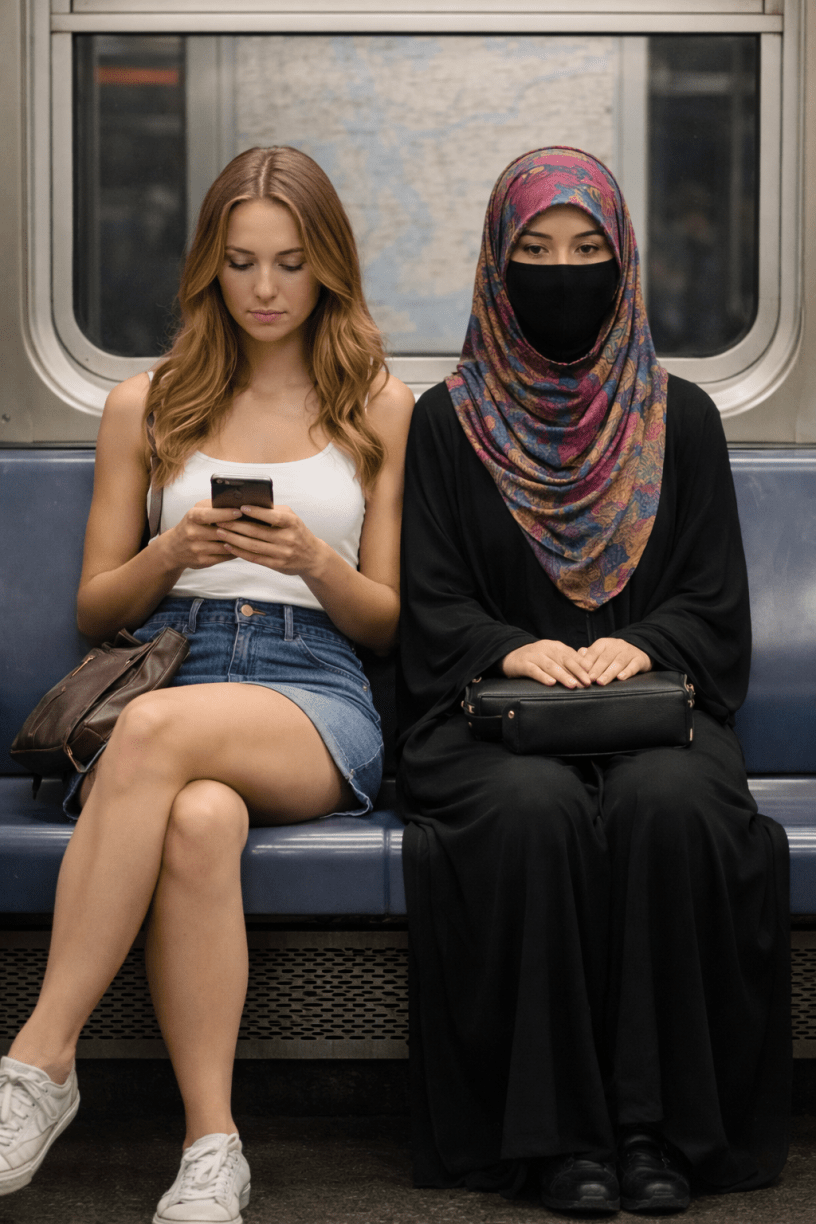
The clearest picture of that came on a train from Newark into Manhattan, the line that runs under the World Trade Center.
Two women were sitting side by side.
You could tell they were about the same age. That detail made it better. Same generation. Same train. Different worlds.
One wore a low-cut tank top and a miniskirt. Summer confidence. Bare arms, bare legs.
The other wore a colorful hijab, everything covered except her eyes.
They weren’t arguing. They weren’t staring at each other. They weren’t performing for anyone. They were just commuters, riding into the city.
Two cultures. One bench seat.
That image has stayed with me for years.
We spend so much time imagining cultural conflict as explosive. Religious versus secular. East versus West. Tradition versus modernity. But most of the time, civilization looks like shared proximity without panic.
People sitting next to each other and minding their own business.
I find people amusing in general. Not in a cruel way. Just in the way human beings are endlessly fascinating. Everybody’s funny if you watch long enough. The way we dress. The way we talk. The way we carry our assumptions into public space.
That train car was a moving portrait of coexistence.
And here’s the part that only hit me later: the park where Occupy Wall Street took place is just a block away from the World Trade Center. At the time, I didn’t even connect the geography. I was just riding a train. But the layers were there — finance, protest, faith, fashion, history — all compressed into a few square blocks and one underground tunnel.
The Real Infrastructure
When I see reckless memes encouraging violence against political leaders — even ones I strongly disagree with — something in me recoils.
Not because of loyalty.
Because of consequence.
Political violence doesn’t land neatly. It spills. It misses. It hits bystanders. It erodes the quiet system that makes the train ride possible.
War removes people.
It rarely removes systems.
And the systems that hold a society together are not just courts, elections, and constitutions. They’re habits. Restraint. The decision to hold the door. The decision not to escalate a difference into a fight.
The guy in Skokie went back to his groceries.
The man in New Jersey walked through the door.
The two women rode into Manhattan together.
That’s the real infrastructure.
Not the headlines.
Not the outrage.
The quiet agreement that we can occupy the same space without trying to erase each other.
That’s harder than it looks.
And it’s worth protecting.
Bless you.
 Occupy 2.5