By just another first occupier
There is a kind of memory that does not fade because it is unfinished. It does not soften with time, because it was never resolved. Occupy Wall Street — and Occupy Chicago — live in that space.
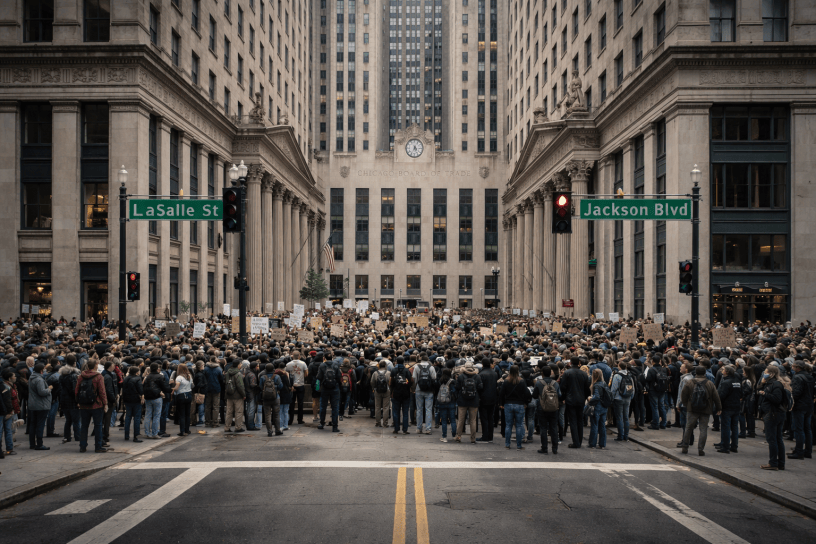
I was there at the beginning. I did not know I was a “first occupier.” I was not trying to be one. I was simply there when it started, in Chicago, when a small group gathered in front of the Sears Tower and then walked — together — toward the Chicago Board of Trade and the Federal Reserve Bank. We were early enough that nothing felt scripted yet. No branding. No hierarchy. Just people who had reached the same conclusion at the same time.
Something was wrong. And no one in power was dealing with it.
Occupy was not violent. It was not an insurrection. It was not radical in the way it was later described. It was people standing in public spaces, saying out loud what had already happened behind closed doors. The financial collapse of 2008 was not a mystery. It was not an accident. It was the result of decisions that had names attached to them. Banks were rescued. Executives walked free. Ordinary people lost homes, jobs, and futures.
Occupy did not invent that reality. It simply refused to accept silence as the price of survival.
The offer was simple and lawful.
We will show up peacefully.
You will acknowledge what happened.
We will talk about accountability.
That was the road not taken.
What still matters, years later, is not just that Occupy was pushed aside, but how — and by whom. This did not happen under a right-wing government openly hostile to protest. It happened under a Democratic administration. A supposedly liberal president. A political party that spoke the language of inequality while protecting the institutions that caused it.
They had options.
They could have opened investigations.
They could have convened hearings.
They could have created a truth and reconciliation process — not for revenge, but for repair.
They did none of that.
Instead, they sent police.
What followed was not a single act of repression, but a slow campaign of attrition. Mass arrests. Kettling. Curfews. Sanitation harassment. Permit games. Sleep disruption. Constant daily pressure designed not to shock, but to exhaust. Occupy was not crushed overnight. It was worn down.
Looking back now, it is clear that the restraint shown then was not moral. It was tactical. What we see today — expanded surveillance, militarized policing, open contempt for dissent — shows that they could have gone further. During Occupy, they did only what they believed they could legally get away with without exposing themselves.
That choice reshaped everything that came after.
When a system refuses peaceful truth-telling, people learn lessons. They learn that honesty is optional. That reform is performative. That accountability does not travel upward. Some people disengage. Some radicalize. Some lose faith entirely. And years later, many wonder how authoritarian politics found fertile ground in the United States.
It did not come from nowhere.
Occupy was the last clean off-ramp. The last moment when the country was offered a lawful, nonviolent way to confront elite wrongdoing and restore trust. Not a revolution. Not vengeance. Just acknowledgment and reform.
They turned it down.
Occupy 2.5 exists because memory matters. Because erasing that moment is a second failure layered on top of the first. Because when people ask how things went so wrong, there needs to be a record that says this plainly: it did not have to go this way.
I was there.
I did not know I was early.
But I was.
And that is why this still matters — not as nostalgia, but as unfinished history.

