By Just Another Friendly Occupier
CHICAGO, ILLINOIS — September 28, 2026
You want to know how stupid people can get?
Let me tell you about Procter & Gamble.
When the Moon Became the Devil
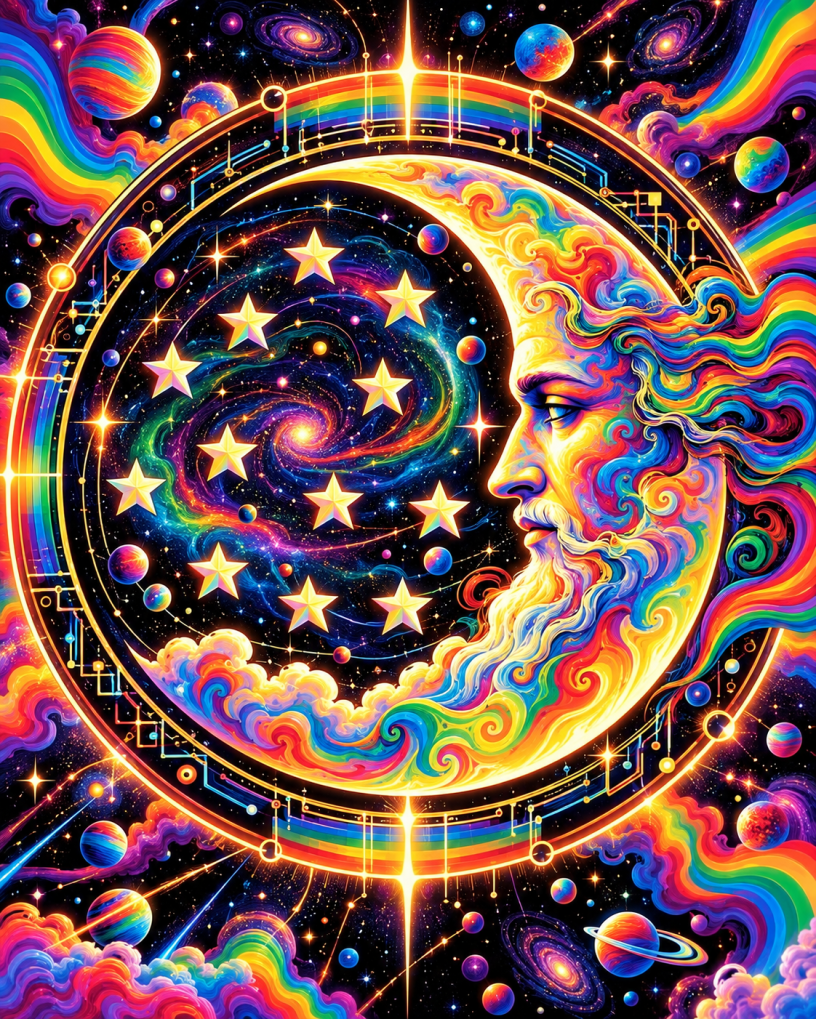
For generations, Procter & Gamble used a distinctive trademark featuring a man in a crescent moon looking toward 13 stars. The design evolved during the 19th century, and the 13 stars represented the original American colonies. The familiar moon-and-stars trademark was formally registered in 1882.
Then people decided it was Satanic.
By the early 1980s, rumors were spreading that the moon, stars, beard and curls concealed occult symbols. Another story claimed that a Procter & Gamble executive had appeared on television and admitted that the company supported Satanism.
It never happened.
The rumors nevertheless spread through churches, word of mouth, photocopied material and eventually distributor networks. Procter & Gamble received tens of thousands of calls and letters and eventually filed lawsuits against people it accused of spreading the false claims (Los Angeles Times, 1985; The Washington Post, 1982).
The controversy became so persistent that in 1985 the company announced it would remove the familiar moon-and-stars trademark from its packaging. A symbol that had existed for more than a century had effectively been chased off supermarket shelves by a conspiracy theory (Los Angeles Times, 1985).
Sound familiar?
What This Comparison Does — and Does Not — Mean
Artificial intelligence is not the Procter & Gamble logo.
That distinction matters.
The old logo was harmless. Artificial intelligence is a powerful technology capable of producing useful results and real harm. Fraud, misinformation, surveillance, privacy violations, biased automated decisions and military applications are legitimate reasons for concern.
So I am not arguing that fears about AI are imaginary in the way the Satanic-logo story was imaginary.
The comparison is about the way fear can work.
During the Procter & Gamble panic, people stopped asking what the symbol actually meant and began assigning evil to the symbol itself.
Something similar happens when discussion of specific AI risks collapses into a declaration that AI itself is bad and that responsible people therefore should refuse to use it.
That leap is where the analogy begins.
And that is also where it ends.
Real Risks Require Real Scrutiny
Artificial intelligence deserves scrutiny precisely because it can matter.
The National Institute of Standards and Technology has developed a risk-management framework for identifying and reducing harms associated with the design, development, deployment and use of AI systems (National Institute of Standards and Technology, 2023).
That approach makes sense because it focuses attention on actual risks rather than symbolism.
What is the system being used for? Who controls it? What safeguards exist? Who is accountable when it causes harm?
Those questions get us somewhere.
Simply saying “don’t use AI” does not.
The Human Being Is Still in the Loop
AI can help someone research a subject, organize information, write software, translate language or create music.
It can also be used to deceive people, conduct surveillance, automate questionable decisions or assist military operations.
The technology matters, but human choices still determine enormously important parts of what happens next.
People design these systems. People decide where to deploy them. People establish—or fail to establish—the rules governing their use.
That is precisely why ethical people should understand them.
The United States Department of Defense adopted ethical principles for artificial intelligence in 2020 covering both combat and noncombat applications. Those principles emphasize responsibility, equity, traceability, reliability and governability (U.S. Department of Defense, 2020).
Whether those principles are adequate or consistently followed is another question entirely.
But governments, militaries and corporations are clearly not going to stop developing artificial intelligence because conscientious citizens decide not to touch it.
So I have a problem with the idea that ethical people should withdraw.
I Want Ethical People at the Table
I want journalists who understand AI well enough to investigate it.
I want researchers capable of testing its claims and exposing its weaknesses.
I want teachers who understand what it can and cannot do.
I want artists and writers experimenting with it while asking hard questions about ownership, attribution and creativity.
And I want ordinary citizens who understand enough about these systems to recognize when powerful institutions misuse them.
That does not mean trusting artificial intelligence.
It means understanding it.
Those are two very different things.
If responsible people refuse to learn the technology while less responsible people continue building and deploying it, we have not made society safer.
We have simply surrendered knowledge and influence.
The Lesson of the Moon and Stars
That is what the Procter & Gamble story still has to teach us.
The mistake wasn’t merely believing something false.
The deeper mistake was allowing a frightening story to replace investigation.
We should not repeat that mistake with AI from either direction.
Do not worship the technology.
Do not demonize it.
Do not assume that every new application is progress.
And do not assume that refusing to use it somehow protects society from what governments, corporations or militaries may do with it.
Learn enough to ask informed questions.
Check the output.
Verify important claims.
Demand transparency.
Challenge harmful uses.
Insist that human beings remain accountable for decisions made with automated systems.
And when somebody tells you that the solution is simply “don’t use AI,” ask yourself who will still be using it after all the conscientious people leave the room.
Artificial intelligence is a tool with consequences.
The important fight is not over whether the tool exists.
It is over what human beings choose to do with it.
APA-Style Sources
Los Angeles Times. (1985, April 28). The devil made them do it. Los Angeles Times.
Los Angeles Times. (1985, May 16). P&G sues over Satan rumors. Los Angeles Times.
National Institute of Standards and Technology. (2023). Artificial Intelligence Risk Management Framework (AI RMF 1.0). U.S. Department of Commerce.
The Washington Post. (1982, January 22). The man in the moon: Procter & Gamble’s logo dilemma. The Washington Post.
U.S. Department of Defense. (2020, February 25). DOD adopts 5 principles of artificial intelligence ethics.

