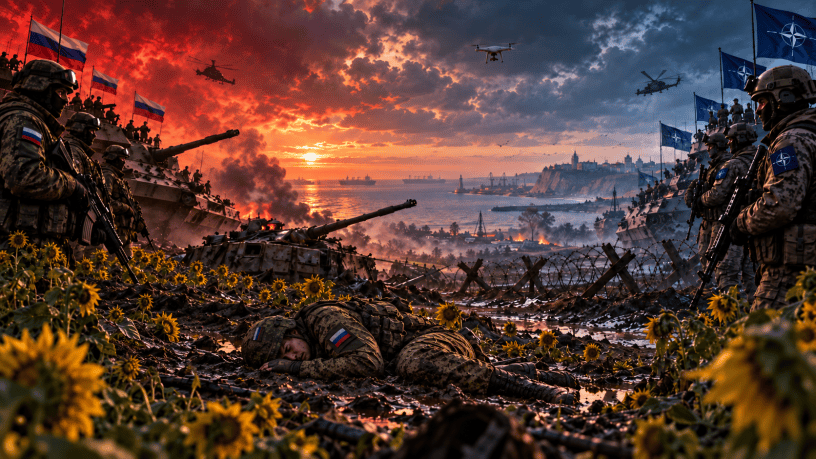
Romania had every right to shoot down attack drones in its airspace. That is not the same thing as proving Russia deliberately attacked Romania—or an empty tanker headed to load cooking oil.
By Just Another First Occupier
BAYBAY CITY, LEYTE, Philippines — October 19, 2026 — 17:15 PHST
TWO DRONES, FOUR MINUTES
Romania had a problem Saturday afternoon.
Its radar detected aerial targets approximately 120 kilometers east of Snake Island moving southwest. Two Romanian Air Force F-16s scrambled from Borcea.
At 17:59, one target crossed into Romanian national airspace. At 18:01, an F-16 shot it down.
A second crossed at 18:01. Four minutes later, another F-16 destroyed that one.
Both were shot down over Romanian territorial waters in the Black Sea.
Romania’s Defense Ministry subsequently identified them as jet-powered Geran-family attack drones. Acting Defense Minister Radu Miruță said they appeared to be Russian-made Geran-4s capable of flying roughly 450 kilometers per hour (Romanian Ministry of National Defence [MApN], 2026a; Reuters, 2026a).
So let’s establish something before anybody accuses JAFO of suggesting Romania should politely wave while explosive drones fly through its airspace.
Romania had every right to shoot them down.
If an unidentified attack drone enters your sovereign airspace, you do not need to send it a questionnaire.
Shoot the damn thing.
The question comes afterward.
Who sent it?
GERAN DOES NOT AUTOMATICALLY MEAN MOSCOW ORDERED THIS PARTICULAR FLIGHT
Russia manufactures and uses Geran-family attack drones extensively in its war of aggression against Ukraine.
That is a fact.
Russia also had enormous numbers of drones operating against Ukraine during this same period.
Also a fact.
Romania says that during the week preceding Saturday’s shootdowns, its radar detected aerial targets near the Ukrainian border on eight separate occasions, with unmanned aircraft briefly entering Romanian airspace during four of them (MApN, 2026a).
That makes Russian responsibility entirely plausible.
It does not complete the evidentiary chain.
Romania’s public statement does not tell us that military unit X launched drone Y from location Z under orders to attack Romania.
It does not publicly give us recovered serial numbers, telemetry, communications intercepts, launch tracks or targeting instructions.
Maybe NATO possesses all of those things.
John Q. Public does not.
And when the potential defendant in the next stage of this argument possesses nuclear weapons, “probably” is a word worth examining carefully.
THE SHIPPING STORY MAKES THIS MESSIER
Two days before the F-16 shootdowns, drones struck two chemical tankers near the entrance to the Sulina Canal.
The San Marino-flagged Wine Trader was hit near Romanian waters. Five of its 12 crew members were rescued and seven remained missing.
The Comoros-flagged Yara J was hit inside Romanian territorial waters. Its crew survived.
Reuters reported that at least five additional commercial ships near Romania and Bulgaria had been attacked during the preceding ten days, leaving 23 sailors dead or missing (Reuters, 2026b).
This is not some empty patch of ocean.
Sulina is a gateway into the Danube system and has become an important commercial corridor during the war.
But Wine Trader presents a particularly peculiar case.
According to the San Marino naval registry, the vessel was heading toward Moldova to load seed oil when it was attacked (San Marino Naval Register, as cited by Tribuna Politica Web, 2026).
In other words, the ship was not hauling a deck full of T-72 tanks.
It was going to pick up cooking oil.
Apparently sunflower seeds and their relatives have entered the strategic calculus of the nuclear age.
Except that joke only works if Russia actually attacked the ship.
And that part still requires examination.
WHAT DO WE ACTUALLY HAVE ON THE WINE TRADER?
Reuters reported that a NATO military source attributed the drones involved in the tanker attacks to Russia.
That is evidence.
It is not nothing.
Romanian President Nicușor Dan, however, did not publicly make the same definitive attribution at the time. The Associated Press likewise reported that Russia was widely suspected while conclusive public proof remained absent (Reuters, 2026b; Associated Press, 2026).
Then something considerably more interesting appeared.
On October 18, Bulgarian maritime publication Maritime.bg examined footage released by the Russian Defense Ministry purporting to show a Russian drone striking a commercial vessel near Odesa.
Maritime.bg argues that the ship in the Russian video strongly resembles the Wine Trader.
Its analysis compares the silhouette of the ship, damage location, Sentinel-2 satellite imagery, cloud conditions and—most intriguingly—a distinctive red rescue vessel visible beside the target after the strike. Romanian rescue ship Apollo, also painted red, was dispatched to Wine Trader and appears beside it in satellite imagery.
If that identification is independently confirmed, it could become exceptionally strong evidence that Russia attacked Wine Trader.
But there is a problem.
That identification presently comes from an independent maritime publication analyzing Russian footage. Romania, NATO and major international wire services have not yet publicly authenticated that identification.
Maritime.bg may be completely right.
That is still different from writing that the case has been proved (Maritime.bg, 2026).
SHOW YOUR WORK
Romania has requested that NATO ambassadors discuss Black Sea security on Tuesday.
Fine.
They should.
Commercial vessels are being hit. People are disappearing or dying. Drones are entering NATO airspace. Romanian fighters are now actually destroying airborne targets (Reuters, 2026a).
Bulgaria is asking for additional aircraft and counter-drone systems (Reuters, 2026c).
This is precisely what an alliance is supposed to discuss.
But tomorrow’s discussion should also answer a very simple question:
How do you know who is doing what?
If NATO radar watched these drones launch from a Russian-controlled site, tell us what can safely be released.
If recovered components identify a particular production batch, say so.
If electronic intelligence links the attack to Russian command systems, explain as much as security permits.
If the Russian Defense Ministry accidentally uploaded video documenting its own attack on Wine Trader, authenticate the damn thing.
Because “the drone was a Geran” and “the Russian military deliberately attacked NATO territory” are not interchangeable sentences.
AND WHILE WE’RE COUNTING MONEY
Romania has released cockpit imagery indicating that missiles were used during Saturday’s interceptions, although it has not publicly identified the missile type.
Suppose, strictly for argument, that the weapon was the AIM-9X Sidewinder commonly carried by NATO F-16s.
That is an extremely capable short-range air-to-air missile—and an expensive way to dispose of a comparatively cheap drone.
Romania also has another option.
On August 20, one of its F-16s engaged a small explosive maritime drone near the Neptun Alpha offshore platform with its onboard cannon. It hit the target, although explosive-ordnance personnel later had to finish destroying it (MApN, 2026b).
So, if the accountants start crying about the missile bill, we have confirmed that the trigger controlling the F-16’s 20-millimeter cannon still works.
That is sarcasm.
An airborne jet-powered Geran traveling hundreds of kilometers per hour is not the same engagement as shooting a slow maritime drone. Closing to cannon range puts the pilot and aircraft closer to an explosive target, and a missile may have been the safer tactical choice.
Still, this war has demonstrated an unpleasant piece of arithmetic: relatively inexpensive drones can force defenders to consume weapons costing several times more.
You do not have to destroy NATO aircraft if you can make NATO keep firing expensive ammunition at cheap targets.
AND NOW WE ARRIVE AT THE PART EVERYBODY SHOULD REMEMBER
Governments have been wrong before.
More importantly, they have sometimes been right about the background facts and wrong about the crucial fact used to justify escalation.
That distinction matters.
Country Joe McDonald wrote that song in 1965 as deliberately cheerful military satire about Vietnam. His own website describes it as tongue-in-cheek military humor (McDonald, n.d.).
The question survives the war.
What are we fighting for?
Before somebody answers “Russia,” there is some history worth remembering.
TONKIN: ONE REAL ATTACK DOES NOT PROVE THE NEXT ONE
On August 2, 1964, North Vietnamese patrol boats really did engage the USS Maddox in the Gulf of Tonkin.
That incident happened.
Two days later, American destroyers reported another attack.
President Lyndon Johnson responded militarily, and the Gulf of Tonkin Resolution helped provide political authority for the enormous expansion of U.S. involvement in Vietnam.
Decades later, a classified NSA historical study concluded that the supposed August 4 attack did not occur. The study found that contradictory intelligence had been mishandled or excluded while information supporting the attack narrative was emphasized (National Security Agency [NSA], 2005).
The lesson is not that nothing happened in the Gulf of Tonkin.
Something absolutely did happen on August 2.
That real event helped make a nonexistent second event on August 4 easier to believe.
That is exactly why context is not proof.
IRAQ: SADDAM REALLY DID HAVE CHEMICAL WEAPONS—UNTIL THAT FACT STOPPED ANSWERING THE QUESTION
Saddam Hussein’s Iraq really possessed chemical weapons.
Iraq really used them during the Iran-Iraq War.
Iraqi forces really used poison gas against Kurdish civilians at Halabja in 1988, killing thousands (U.S. Department of State, 1998).
And yet Iraq did not use chemical or biological weapons against Coalition forces during Operation Desert Storm in 1991, according to subsequent U.S. intelligence assessments (U.S. Department of Defense, 1996).
Then came 2002.
The British government’s Iraq dossier included the famous claim that chemical or biological weapons could be ready for use within 45 minutes.
Later reviews concluded that the claim had not been properly contextualized for the public: it referred to battlefield chemical and biological munitions, and the intelligence surrounding Iraqi capabilities was presented with more confidence than was justified (Intelligence and Security Committee, 2003; Iraq Inquiry, 2016).
Again, the lesson is not that Saddam Hussein had been misunderstood as a harmless fellow.
The lesson is that:
Saddam used chemical weapons in 1988
does not logically become
therefore every chemical-weapons claim made in 2002 is correct.
Just as:
Russia launches Geran drones against Ukraine
does not automatically become
therefore Russia deliberately sent this specific Geran into Romania to attack NATO.
The disputed step still requires evidence.
THIS TIME THE PEOPLE MAKING THE DECISION HAVE NUCLEAR WEAPONS
Here is why JAFO is making such a fuss about a couple of drones and an empty tanker that was going to pick up cooking oil.
If Romania and Russia were the only two countries involved, this would already be serious.
They are not.
Romania belongs to NATO.
The United States, Britain and France possess nuclear weapons. Russia possesses nuclear weapons. NATO’s own current policy says any nuclear use against the alliance would “fundamentally alter the nature of a conflict” (NATO, 2026).
Nobody can promise that a conventional Russia-NATO war would automatically go nuclear.
Nobody can promise that it would not.
And nobody can guarantee that a supposedly limited use of tactical nuclear weapons would remain limited.
Princeton University’s Science and Global Security program modeled one plausible U.S.-Russia escalation beginning with limited nuclear employment and proceeding through strategic strikes and attacks on cities.
Its result: more than 90 million dead and injured within the first few hours.
That is a simulation, not a prophecy.
It exists to demonstrate precisely why escalation control after nuclear weapons begin exploding is not something sane people should casually assume (Princeton Science & Global Security, n.d.).
The people making decisions tomorrow are not arguing over whose dog dug under the neighbor’s fence.
They are managing a confrontation in which a series of bad decisions can eventually reach weapons capable of destroying societies far beyond Romania, Russia or Ukraine.
SO, ROMANIA: SHOOT THE DRONE. NATO: ASK THE QUESTIONS.
This is not an argument for Romanian passivity.
Protect Romanian airspace.
Protect Romanian territorial waters.
Protect merchant ships.
Deploy radar.
Deploy counter-drone systems.
Scramble fighters when necessary.
Shoot down explosive objects that enter sovereign territory.
But do not quietly convert suspicion into attribution, attribution into intent, intent into armed attack, and armed attack into retaliation without showing the evidence supporting each step.
Tuesday’s NATO meeting does not need to spank Russia.
It needs to determine what happened.
If Russia deliberately attacked civilian shipping and intentionally sent attack drones into Romanian territory, then that is what the evidence should establish.
And if the evidence cannot yet establish that, NATO should say that too.
Because history contains enough examples of governments discovering later that the intelligence used during a crisis was less certain than the speeches made from it.
The Wine Trader was an empty commercial tanker headed toward Moldova to load seed oil.
Somebody attacked it.
Russia may very well have done it.
There is increasingly interesting evidence pointing in that direction.
But before that incident becomes one more brick in the road toward direct confrontation between nuclear powers, somebody owes the public more than:
Trust us.
We have seen where that road can lead.
And before anybody sends the boys back to war in Europe, JAFO would like the oldest antiwar question answered first.
What are we fighting for?
APA-Style Sources
Associated Press. (2026, October 16). Drone strikes in the Black Sea raise fears of Russian escalation to test NATO’s response.
https://apnews.com/article/866f21a940311b13abd9425457edf388
Intelligence and Security Committee. (2003). Iraqi weapons of mass destruction—intelligence and assessments. Government of the United Kingdom.
https://www.gov.uk/government/publications/iraqi-weapons-of-mass-destruction-intelligence-and-assessments–2
Iraq Inquiry. (2016). The report of the Iraq Inquiry: Volume IV—Iraq WMD assessments, October 2002 to March 2003. Government of the United Kingdom.
https://assets.publishing.service.gov.uk/media/5a80b723e5274a2e8ab51c0c/The_Report_of_the_Iraq_Inquiry_-_Volume_IV.pdf
Maritime.bg. (2026, October 18). A fatal blunder by Russian propaganda: Is the Kremlin responsible for the attack on a ship off Romania?
https://www.maritime.bg/156386/
McDonald, J. (n.d.). I-Feel-Like-I’m-Fixin’-to-Die Rag (Vietnam Rag).
https://www.countryjoe.com/feelmus.htm
National Security Agency. (2005). Skunks, bogies, silent hounds, and the flying fish: The Gulf of Tonkin mystery, 2–4 August 1964.
https://www.nsa.gov/portals/75/documents/news-features/declassified-documents/gulf-of-tonkin/articles/release-1/rel1_skunks_bogies.pdf
NATO. (2026, September 25). NATO’s nuclear deterrence policy and forces.
https://www.nato.int/en/what-we-do/deterrence-and-defence/natos-nuclear-deterrence-policy-and-forces.
Princeton Science & Global Security. (n.d.). Plan A.
https://sgs.princeton.edu/the-lab/plan-a
Reuters. (2026a, October 18). Romanian F-16 fighter jets shoot down two drones over Romanian territorial waters.
https://www.reuters.com/world/romanian-f-16-fighter-jets-shoot-down-two-drones-over-romanian-territorial-2026-10-18/
Reuters. (2026b, October 15). Seven sailors missing after drones hit two ships near Romania.
https://www.reuters.com/world/two-ships-ablaze-romanian-black-sea-waters-8-sailors-missing-2026-10-15/
Reuters. (2026c, October 16). Bulgaria seeks NATO anti-drone systems, says defence minister.
https://www.reuters.com/business/aerospace-defense/bulgaria-seeks-nato-anti-drone-systems-says-defence-minister-2026-10-16/
Romanian Ministry of National Defence. (2026a, October 17). Press release: Two drones shot down over Romanian territorial waters.
https://english.mapn.ro/cpresa/6888_Press-Release
Romanian Ministry of National Defence. (2026b, August 20). Press information: Romanian F-16 engages maritime drone near Neptun Alpha.
https://english.mapn.ro/cpresa/6845_Press-Information
San Marino Naval Register. (2026, October 15). Drone attack on the San Marino-flagged Wine Trader in the Black Sea [Statement reported by Tribuna Politica Web].
https://news.tribunapoliticaweb.sm/attualita/2026/10/15/attacco-con-droni-alla-nave-battente-bandiera-sammarinese-wine-trader-nel-mar-nero-operazioni-di-ricerca-e-soccorso-in-corso-sette-marinai-dispersi/
U.S. Department of Defense. (1996). Final unclassified report on intelligence related to Gulf War illnesses: No intentional Iraqi use of chemical or biological agents.
https://gulflink.osd.mil/khamisiyah/kham_ref/n01en093/2496_war.htm
U.S. Department of State. (1998, March 16). Anniversary of the Halabja massacre.
https://1997-2001.state.gov/briefings/statements/1998/ps980316a.html

